At the risk of asking a dumb question: how safe was Mogo exactly? Have they constructed some sort of firebreak perimeter that would have been unbreacheable even in the event of a much larger fire?
"Larger" fire is a bit of a difficult thing to quantify.
The Clyde Mountain fire which burned through Mogo (one of over 100 fires burning around NSW) has already burned over 68,000 ha of land.
The "ferocity" of a fire is determined by many factors including humidity (lower humidity is required for fuel to burn more readily), fuel load (lots of dry underbrush / dense forest / highly flammable trees like Eucalyptus / etc), wind speed and direction and so on.
The defensibility of a fire will depend on the circumstances of the time the fire front hits and the location you are trying to defend.
It may well be that if the fire had come from a different direction, there would have been a much greater risk.
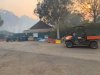
The fact is - from what I have read about the actions of staff - they had extensive sprinkler systems in place to provide water coverage for animals and their enclosures - and the staff were able to directly engage spot fires that were breaking out around the property - usually started by embers being pushed ahead of the blaze.
Some fires are indefensible - a ferocious fire in a Eucalyptus forest pushed by strong winds is not going to be fightable - the oil in the trees simply explodes and if you get a crowning fire, it will simply leap from tree to tree very rapidly - regardless of what you do on the ground. You cannot fight these fires.
Being prepared for a fire involves clearing dense foliage and dry undergrowth - it is much easier to fight a grass fire than a fire spreading through trees.
I haven't seen exactly where the fire impacted at Mogo - but from my memory of the facility, there are lots of open spaces with large open paddocks for the giraffes / zebras / etc. However, I also recall that in another direction (closer to the entrance) there is a lot more bushland. If the fire had spread rapidly from that direction, it may have been a lot more difficult to contain.
So as much as good preparation was key here - I believe that luck also had a large factor in their ability to save the facility without any real damage. It could easily have been much, much worse.
Put it this way - on the same day the fire hit Mogo Zoo, a nearby fire destroyed over 50 houses in the small township of Conjola Park just over an hour north of Mogo. Virtually the entire town has simply disappeared and at least one man died in his car nearby. We drive to through that town in October every year for a family holiday at Lake Conjola where there were also houses lost.
So yes, there was a potentially huge risk and I think Mogo Zoo has been extremely lucky to avoid any significant loss.
Spread of the Clyde Mountain fire.
To put the fires into perspective - earlier this year the Amazon was burning. According to Wikipedia, they've lost over 900,000 hectares of forest.
By comparison, so far we have had over 6,000,000 hectares of land (mostly forest area) burn this summer in Australia - and the fires are still raging.
That's an area larger than any of the following countries:
- Croatia
- Costa Rica
- Slovakia
- Denmark
- Netherlands
- Switzerland
Imagine if the whole of Croatia or the whole of the Netherlands had been burned by bushfire!? That's how much of Australia has burned in the past two months and many of the fires are still burning out of control.