ZooChat Big Year 2020

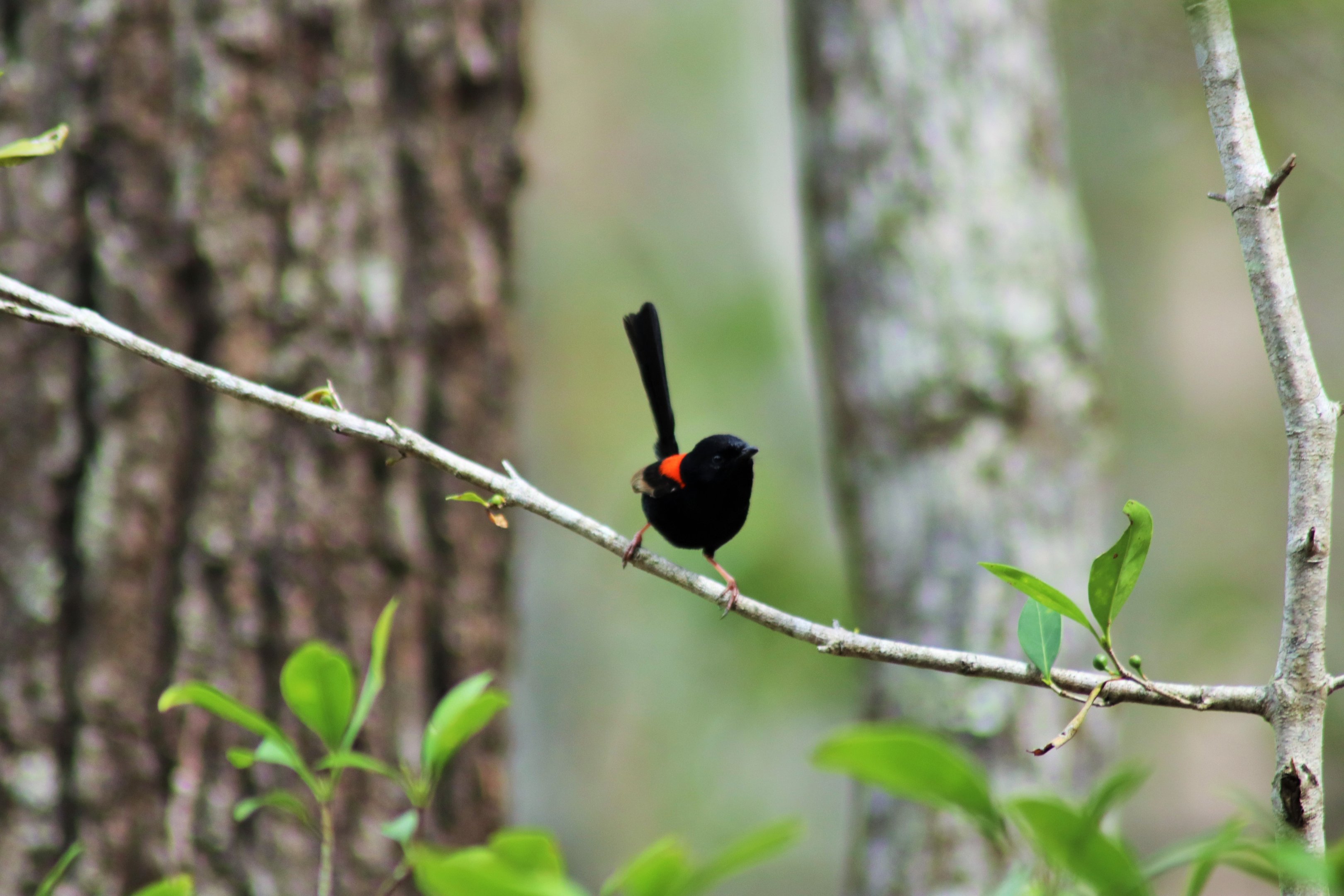
I saw two lifers today that were high on my 2020 wish list.
Birds
72. Sacred Kingfisher Todiramphus sanctus
73. Eastern Whipbird Psophodes olivaceus
74. Red-backed Fairy Wren Malurus melanocephalus


Invertebrates
26. Blue-banded Bee Amegilla cingulata
27. Daddy Long-legs Spider Pholcus phalangioides
28. St Andrew’s Cross Spider Argiope keyserlingi
29. Blue Tiger Butterfly Tirumala hamata
30. Bush Fly Musca vetustissima
31. Common Eggfly Hypolimnas bolina
Birds
75. Golden Whistler Pachycephala pectoralis

76. Channel-billed Cuckoo Scythrops novaehollandiae
77. Eastern Koel Eudynamys orientalis
 
On January 2nd, I went over to a local gravel pit to find waterfowl. Viewing at this location isn't amazing, but it is one of the most reliable places in Kansas for Greater Scaup.

35 Greater White-fronted Goose - Anser albifrons
36 Redhead - Aythya americana
37 Greater Scaup - Aythya marila
38 Bufflehead - Bucephala albeola
39 Hooded Merganser - Lophodytes cucullatus
40 Ruddy Duck - Oxyura jamaicensis
41 Pied-billed Grebe - Podilymbus podiceps
42 Double-crested Cormorant - Phalacrocorax auritus
43 Song Sparrow - Melospiza melodia

The next day, I decided to take my visiting family to Maxwell Wildlife Refuge. About an hour north of Wichita, this is a fenced in area home to semi-wild bison and elk.

44 Red-winged Blackbird - Agelaius phoeniceus
45 Loggerhead Shrike - Lanius ludovicianus
46 White-crowned Sparrow - Zonotrichia leucophrys
47 Harris's Sparrow - Zonotrichia querula
48 Spotted Towhee - Pipilo maculatus
49 Brewer's Blackbird - Euphagus cyanocephalus

There had been a lone great egret hanging on for the winter at Sedgwick County Zoo, and I was able to find him hanging out at the South Lake by the elephants.

50 Great Egret - Ardea alba

The next day, we took our guests down to Oklahoma City, to visit the Oklahoma City Zoo. I picked up a couple new birds.

51 American Coot - Fulica americana
52 Turkey Vulture - Cathartes aura
53 Great-tailed Grackle - Quiscalus mexicanus

The rest of the list so far is just birds I've seen in and around Wichita. Mostly on my lunch hours.

54 White-throated Sparrow - Zonotrichia albicollis
55 Sharp-shinned Hawk - Accipiter striatus
56 House Finch - Haemorhous mexicanus
57 Hairy Woodpecker - Dryobates villosus
58 Tufted Titmouse - Baeolophus bicolor
59 White-breasted Nuthatch - Sitta carolinensis
60 Winter Wren - Troglodytes hiemalis
61 Killdeer - Charadrius vociferus
62 House Sparrow - Passer domesticus
63 Lesser Scaup - Aythya affinis
64 Horned Lark - Eremophila alpestris
65 Herring Gull - Larus argentatus

3 Common Muskrat - Ondatra zibethicus

At the confluence of the Big and Little Arkansas Rivers, near downtown Wichita is a large statue titled, "Keeper of the Plains". This local landmark also happens to be the site where a handful of black-crowned night-herons have decided to tough out the winter. On my lunch hour I dropped by to visit them.

66 Black-crowned Night-Heron - Nycticorax nycticorax

I don't know if this is just a North American thing, or do people throughout the world go birding in cemeteries? Seems around here they are a great place to bird, especially in the winter. I'm guessing its because they often have large coniferous trees. I stopped by Maple Grove Cemetery in Wichita to do a little birding. Only got one new species, but overall it was pretty birdy.

67 Golden-crowned Kinglet - Regulus satrapa
 
Mammals
2. House Mouse, Mus domesticus

Forgot to update during the week.

Birds
Tuesday
25. Barn Owl, Tyto alba
26. Song Thrush, Turdus philomelos

Thursday
27. Blackbird, Turdus merula
 
Half-day off work today for complicated reasons so took the opportunity to head down to Carsington Water in order to fail to see a Jack Snipe for the second time this year. I did indeed fail to see a Jack Snipe, but nature rustled up a consolation addition nevertheless.

Birds:
87. Common Gull - Larus canus

:)
 
Thought someone might ask about that :p

Bit of an interesting story. I saw it while I was swimming in my pool. I did not see it at the ocean but around 7kms inland.

My list really isn’t in order, some of those birds were seen as early as the 6th of January while others others were seen today, so that’s why it’s mixed in with a bunch of random birds, and also I didn’t see it out on the ocean.

I am well and truly within the range of red footed boobies.

I’ll explain the bird I saw, see if anyone agrees or disagrees on the ID (I’m not entirely certain on red footed booby, I just chose this as it was the best fit with the thought that I could always just change into later or remove it). For reference I saw the bird from directly below it and it was quite high up. It had very angular wings, like that of a frigate birds. It had a cream white belly and much darker wings. It had a yellow bill and a short tail that was slightly triangular. It was a decent size, bigger than a black kite. It was definitely a seabird.

@Dannelboyz you seem to have seen your fair share of seabirds, what’s your opinion?
Not a Red-footed Booby. They're pretty infrequently reported off Australian coasts and pretty strictly at sea (with the exception of a sick bird that showed up in a school in Essendon a year or two ago). If you saw it inland, it'd have to be a pretty unwell bird, in which case I'd expect it wouldn't be flying overhead, and unless you're Brisbane or further north, you're not really well within range. Even Brisbane's only had a few records I believe... And if you're 7 km inland you're in totally the wrong spot to see one.

While it's hard to know without seeing the bird, the description sounds very good for Pacific Gull. Pacific Gulls will often fold their wings in a very angular fashion when they're gliding in strong winds and they have yellow bills, dark wings and are bulkier than a Black Kite. Red-footed Boobies do not have yellow bills and they have long, thin tails not short triangular ones. I'd also not be too surprised to see a Pacific Gull 7 km inland, even if they're usually coastal.

MAMMALS
12 - Short-beaked Echidna (Tachyglossus aculeatus)

BIRDS
138 - Emu (Dromaius novaehollandiae)
139 - Pacific Gull (Larus pacificus)
140 - Forest Raven (Corvus tasmanicus)
141 - Red-capped Plover (Charadrius ruficapillus)
-- Horsfield's Bronze-cuckoo (Chrysococcyx basalis) [heard]
142 - Caspian Tern (Hydroprogne caspia)
143 - Common Greenshank (Tringa nebularia)
144 - Striated Fieldwren (Calamanthus fuliginosus)
145 - Little Tern (Sternula albifrons)

BIRDS
146 - Australasian Gannet (Morus serrator)
147 - Short-tailed Shearwater (Puffinus tenuirostris)
-- Australian Golden Whistler (Pachycephala pectoralis) [heard]
148 - White-throated Needletail (Hirundapus caudacutus)

REPTILES
4 - Common Blue-tongued Skink (Tiliqua scincoides)
5 - Southern Water Skink (Eulamprus tympanum)

FISH
2 - Short-finned Eel (Anguilla australis)

INVERTEBRATES
5 - Common Shining Cockroach (Drymaplaneta communis)
6 - Common Brown (Heteronympha merope)
7 - Blue Ant (Diamma bicolor)
 
Last edited:
Not a Red-footed Booby. They're pretty infrequently reported off Australian coasts and pretty strictly at sea (with the exception of a sick bird that showed up in a school in Essendon a year or two ago). If you saw it inland, it'd have to be a pretty unwell bird, in which case I'd expect it wouldn't be flying overhead, and unless you're Brisbane or further north, you're not really well within range. Even Brisbane's only had a few records I believe... And if you're 7 km inland you're in totally the wrong spot to see one.

While it's hard to know without seeing the bird, the description sounds very good for Pacific Gull. Pacific Gulls will often fold their wings in a very angular fashion when they're gliding in strong winds and they have yellow bills, dark wings and are bulkier than a Black Kite. Red-footed Boobies do not have yellow bills and they have long, thin tails not short triangular ones. I'd also not be too surprised to see a Pacific Gull 7 km inland, even if they're usually coastal.


BIRDS
146 - Australasian Gannet (Morus serrator)
147 - Short-tailed Shearwater (Puffinus tenuirostris)
-- Australian Golden Whistler (Pachycephala pectoralis) [heard]
148 - White-throated Needletail (Hirundapus caudacutus)

REPTILES
4 - Common Blue-tongued Skink (Tiliqua scincoides)
5 - Southern Water Skink (Eulamprus tympanum)

FISH
2 - Short-finned Eel (Anguilla australis)

INVERTEBRATES
5 - Common Shining Cockroach (Drymaplaneta communis)
6 - Common Brown (Heteronympha merope)
7 - Blue Ant (Diamma bicolor)
Thank you. Pacific Gull seems to fit quite well but I’m still not 100%.

Just for the record, I am North of Brisbane, but considering it obviously wasn’t a red footed booby it doesn’t really matter anymore.

I’ll remove red footed booby from the list which brings me down to 57.

What do you reckon are the chances of it being an albatross? As that was my first thought when I originally saw it...
 
One quick addition at Yorkshire Wildlife Park today:

Birds:
88. Grey Wagtail - Motacilla cinerea

:)
 
Thank you. Pacific Gull seems to fit quite well but I’m still not 100%.

Just for the record, I am North of Brisbane, but considering it obviously wasn’t a red footed booby it doesn’t really matter anymore.

I’ll remove red footed booby from the list which brings me down to 57.

What do you reckon are the chances of it being an albatross? As that was my first thought when I originally saw it...
I wouldn't like your chances of it being an albatross either. They're even less likely to fly over land than a Red-footed Booby, although more common in the area. If you want to tell whether it's a seabird, get a good look at the wings and the flight pattern, and check the shape of the bill. Most tube-noses almost never flap their wings and just turn and glide fairly low over the water with long streamlined wings constantly straight and outstretched. They also have relatively small heads, thin bodies, short tails and long bills. Also check the underwing pattern - it varies by species, but the Thalassarche species which are more likely to show up near shore have black feathers lining the leading and trailing edges of the wings continuously.
 
Birds
75. Golden Whistler Pachycephala pectoralis

76. Channel-billed Cuckoo Scythrops novaehollandiae
77. Eastern Koel Eudynamys orientalis
A local flowering tree had an abundance of butterflies; orchard swallowtails, clearwing swallowtails, blue triangles and a new species I was finally able to identify up close.
Birds
78. European Starling Sturnus vulgaris

Invertebrates
32. Rhinoceros Beetle Xylotrupes gideon
33. Dainty Swallowtail Papilio anactus
 
Are the crows in Norfolk Ravens, Fish crows, or American?
Not Ravens. In the east they only occur in the mountains. Close to the coast Fish Crow are most likely but American are also quite possible. The easiest way to ID is the call. The "caw" of a Fish Crow is short and sort of hollow or nasal-sounding. The American Crow has a longer "caw" that is deeper and seems to resonate more.
 
Most of the below are from the Waikanae Estuary (with a few at the beginning and end being seen on the way there and back). I usually only go up there once a year because I have to take two buses and a train to get there, which takes me three hours - partly due to distance and partly due to waiting times between connections - and the birds there are mostly common species which I merely "need" to see so that the year list isn't too pathetic.


32) Black Swan Cygnus atrata
33) White-faced Heron Ardea novaehollandiae
34) Caspian Tern Sterna caspia
35) White-headed (Pied) Stilt Himantopus leucocephalus
36) Pukeko (Purple Gallinule) Porphyrio porphyrio
37) Song Thrush Turdus philomelos
38) White-fronted Tern Sterna striata
39) Variable Oystercatcher Haematopus unicolor
40) Banded Dotterel Charadrius bicinctus
41) Royal Spoonbill Platalea regia
42) European Greenfinch Carduelis chloris
43) New Zealand Dotterel Charadrius obscurus
44) New Zealand Dabchick Poliocephalus rufopectus
45) Australasian Coot Fulica atra
46) Yellowhammer Emberiza citrinella
47) Australasian Shoveller Anas rhynchotis
48) Bar-tailed Godwit Limosa lapponica
49) Sacred Kingfisher Todiramphus sanctus
50) Canada Goose Branta canadensis
51) Australasian Harrier Circus approximans
52) Spotted Shag Stictocarbo punctatus

53) Eastern Rosella Platycercus eximius

A little flock just flew past my window, coincidentally as I was writing the Australian posts for my latest trip thread.
 
Heavy smoke on the weekends in Sydney has kept me indoors so I haven't had a chance to go birding until recently. Hopefully, with the rains forecast for tonight and tomorrow, with any luck I'll be able to get out some more soon.

Birds
1. Pacific Black Duck
2. Feral pigeon
3. Crested Pigeon
4. Eastern Koel
5. Dusky Moorhen
6. Eurasian Coot
7. Australasian Swamphen
8. Black-fronted Dotterel
9. Little Pied Cormorant
10. Little Black Cormorant
11. White-faced Heron
12. Australian White Ibis
13. Straw-necked Ibis
14. Sulphur-crested Cockatoo
15. Red-rumped Parrot
16. Rainbow Lorikeet
17. Satin Bowerbird
18. Superb Fairywren
19. Bell Miner
20. Noisy Miner
21. Black-faced Cuckoo-shrike
22. Dusky Woodswallow
23. Grey Butcherbird
24. Australian Magpie
25. Willie Wagtail
26. Magpie-Lark
27. Australian Raven
28. Fairy Martin
29. Tree Martin
30. Common Starling
31. Common Myna

Mammals
1. European Rabbit

:p

Hix

Birds
32. Australian Wood Duck
33. Hardhead
34. Australasian Grebe
35. White-headed Stilt
36. Masked Lapwing
37. Spotted Dove
38. Kookaburra
39. White-winged Triller
40. Eastern Rosella
41. Australian Reed Warbler
42. Welcome Swallow
43. Red-browed Firetail Finch
44. Black Swan

Mammals
2. Wallaroo

Reptiles
1. Eastern Water Dragon

:p

Hix
 
Last edited:
Mammals
3. Bonnet Macaque Macaca radiata
Birds
49. White-browed Wagtail Motacilla maderaspatensis
50. Tickell’s Blue Flycatcher Cyornis tickelliae
 
Well, that was an interesting day. First lifer of the year! I was overdue a Whipsnade visit anyway, to catch up in general and see the new aquarium in particular, but the seemingly-reliable presence of a certain bird convinced me to make it sooner rather than later. The day was boosted even further by a stop just off the motorway at Brogborough as a shrike had been reported (and as so often with this species, it was exactly where it had been reported) and by filling in a few more common species as well. Green Woodpecker and Red Kite have a habit of turning up together on a zoo day - either Whipsnade or Hamerton are both good.

Birds:
89. Great Grey Shrike - Lanius excubitor
90. Black-throated Thrush - Turdus atrogularis
91. Mistle Thrush - Turdus viscivorus
92. Red Kite - Milvus milvus
93. European Green Woodpecker - Picus viridis

:)
 
Back
Top