Walrus currently in captivity

Searching in this thread I found Garik listed under "St. Petersburg dolfinarium" in 2018, but could not find any record of Frosya.

These two (full names Svyatogor and Yefrosinya) were captured around 2012 and came to Belgium from the Utrish Marine Station, where they were transferred after Saint Petersburg closed in November of 2020 (Saint Petersburg, as far as I know, has a 6-year-old 1.2 group remaining in Utrish which will presumably return to their facility when it reopens at another location in 2022)
 
These two (full names Svyatogor and Yefrosinya) were captured around 2012 and came to Belgium from the Utrish Marine Station, where they were transferred after Saint Petersburg closed in November of 2020 (Saint Petersburg, as far as I know, has a 6-year-old 1.2 group remaining in Utrish which will presumably return to their facility when it reopens at another location in 2022)
I noticed from the photos that one of them- the male?- still has tusks. I wonder if he can keep them longterm.
 
I noticed from the photos that one of them- the male?- still has tusks. I wonder if he can keep them longterm.

To my knowledge and from what I have seen the vast majority of male walrus in captivity do not, and given that the exhibits at Pairi Daiza are all hard/concrete surfaces, I doubt it.
 
To my knowledge and from what I have seen the vast majority of male walrus in captivity do not, and given that the exhibits at Pairi Daiza are all hard/concrete surfaces, I doubt it.

A little less than half of the captive walrus population had visible tusks in early 2020 (I came to 43% at that time, although my knowledge of the full captive population wasn't as complete then as it is now - I actually now believe this number to be higher)

His tusks may need to be capped, but it's very rare for a walrus to have their tusks removed beyond two or so years of age (although of course it has been done before!). I can't think of any walruses with full tusks that don't live in hard concrete enclosures, so chances are, if he hasn't developed the habit of scraping his tusks after all these years, he'll likely be able to keep them, with caps to protect them if needed. Not accounting of course for any preexisting damage that may be present within the tusks, or any future breaks that may occur.
 
Last edited by a moderator:
18-year-old Silva was transferred from The Land of Legends Theme Park to Istanbul Dolphinarium in recent months -- she had been housed solitarily for the last 16 years or so before joining Istanbul's pair.
 
Interesting timing with last month's conversation in this thread, 9 year old Mitik has had his left tusk removed! He had begun suffering from an infection stemming from the tusk throughout mid-2020 while at the Point Defiance Zoo. I'm not sure when it was removed, but he pulled through the procedure in good health.

Other updates:
  • 20-year-old Himawari delivered her calf at Ise Sea Paradise on June 29th, which unfortunately drowned as she entered the pool of her exhibit while giving birth.
  • The Otaru Aquarium's recent pup, born May 4th, has been named Tsumugi.
  • The Moscow Zoo's Pinnipeds exhibit complex is nearing completion, and remains on track to open with five 3-year-old walruses on display by October of this year.
 
Last edited by a moderator:
  • 20-year-old Himawari delivered her calf at Ise Sea Paradise on June 29th, which unfortunately drowned as she entered the pool of her exhibit while giving birth.

I guess they should never be allowed to give birth in their onshow area with water- if at all possible. I noticed Paira Daiza's calf was born in a holding area.
 
That still seems really hot of an area for walrus.

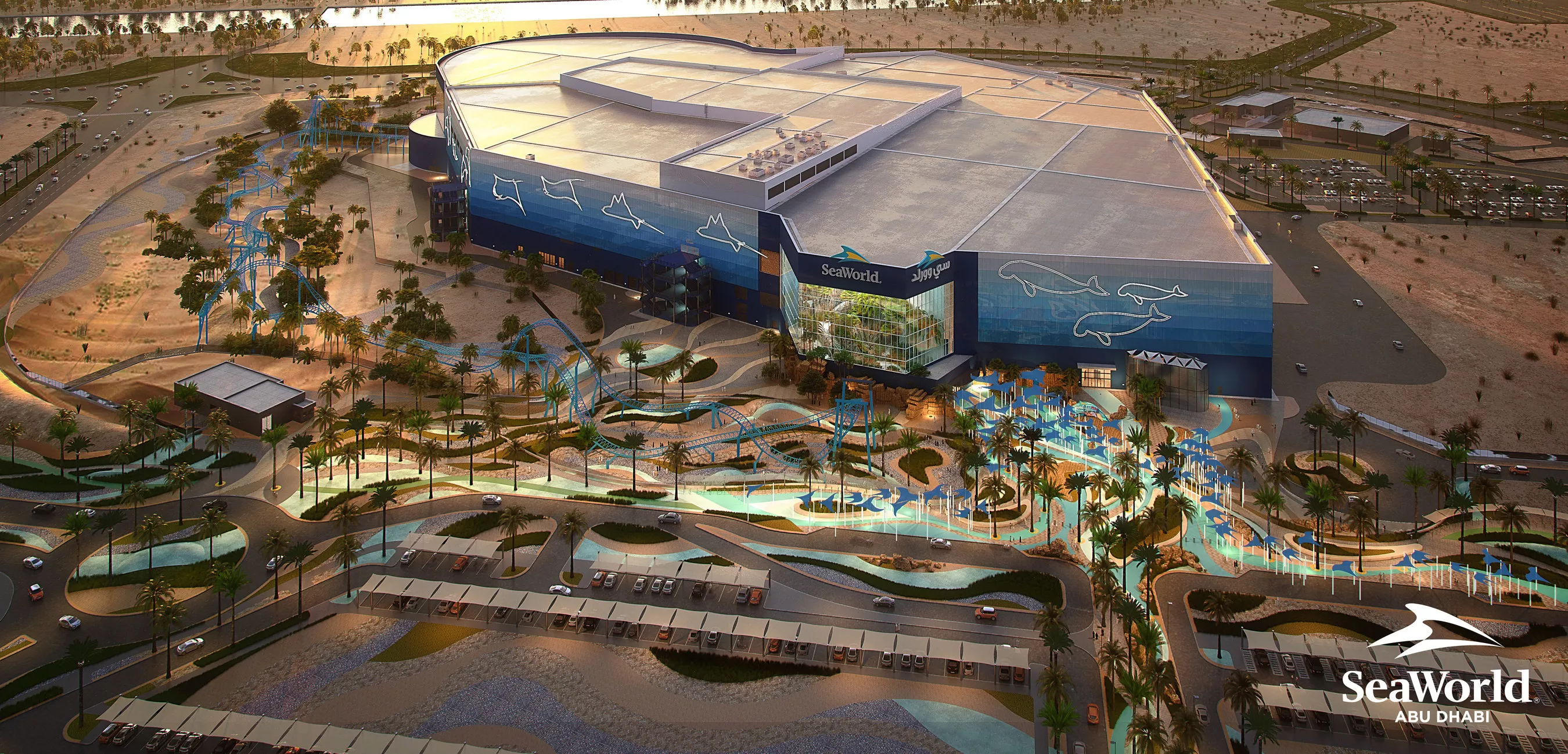
Seaworld Abu Dhabi is all indoors under a massive structure (I think 30 acres). Keeping walrus outside there would be horrible though, but glad that is not the plan.

1_1_.jpg
 
I've finally located 16-year-old cow Sonya after nearly two years of searching -- she was transferred out of Saint Petersburg Dolphinarium on October 13th, 2019, and is now in holding for Children's World (also known as Fairyland) Ocean Park on Sea Flower Island. The facility should be opening on a trial basis relatively soon.

Edit: Forgot to add, Saint Petersburg has recently stressed uncertainty about whether or not their remaining 1.2 herd of walruses will be returning when the facility reopens at a new location. I won't speculate but this seems noteworthy.
 
Last edited by a moderator:
Quick mid-year update and overview on the current walrus population

Current living population = 150 (48.91.11) across 56 facilities in 13 countries
*Of those walruses, four (0.4) haven't been sighted since the first quarter of 2020. An additional walrus (0.1) has also not been sighted since 2020, although it has to be factored in that media from this facility is relatively rare or infrequent at best to begin with.

  • Of the current walruses, 126 (37.77.12) are wild-caught, while 24 (11.13) are captive-born, up to the third generation.
  • The largest herd of walruses is held by Chimelong Ocean Kingdom, with 14 (3.4.7) individuals, followed by Pairi Daiza with 7 (3.4) individuals.
  • Kamogawa SeaWorld is the most successful breeding facility with a total of 12 calves born, 10 of which were liveborn and 7 of which are currently living. All of these were sired by their bull Takku, who passed away in 2019.
  • SeaWorld Orlando holds longevity records for both bulls and cows -- Slowpoke is the oldest cow ever to live (43 years), while Bruiser (39 years, died 2017) was the oldest bull to ever live. The oldest living bull is Garfield (39 years), who is set to exceed Bruiser's lifespan and become the new record-holder in five months.
Belgium
Currently housing 7 walruses (3.4.0) in 1 facility.
Pairi Daiza - 7 total = 3.4.0

Canada
Currently housing 5 walruses (2.3.0) across 2 facilities.
Aquarium du Quebec - 3 total = 2.1.0
MarineLand Canada - 2 total = 1.1.0

China
Currently housing 57 walruses (20.27.10) across 22 facilities.
Children's World Ocean Park - 1 total = 0.1.0
Chimelong Ocean Kingdom - 14 total = 3.4.7
Dalian Laohutan Ocean Park - 4 total = 2.2.0
Dalian Sun Asia Ocean World - 3 total = 1.2.0
Fuzhou Yongtai Europark Ocean World - 2 total = 1.1.0
Grandview Aquarium - 2 total = 0.1.1
Hangzhou Changqiao Polar Ocean Park - 1 total = 0.1.0
Harbin Polarland - 2 total = 1.1.0
Jingzhou Xiaomeisha Aquarium - 1 total = 1.0.0
Ningbo Ocean World - 1 total = 0.1.0
Ocean Aquarium of Quancheng - 3 total = 1.2.0
Ocean Aquarium of Penglai - 1 total = 1.0.0
Ocean Park Hong Kong - 2 total = 1.1.0
Qingdao Haichang Polar Ocean Park - 3 total = 1.2.0
Royal Ocean Park - 3 total = 1.2.0
Sanya Haichang Fantasy Town - 1 total = 0.1.0
Shanghai Haichang Ocean Park - 1 total = 0.1.0
Shendiao Mountain Wildlife Park - 2 total = 1.1.0
Tianjin Haichang Polar Ocean Park - 4 total = 2.0.2
Wuhan Haichang Polar Ocean World - 3 total = 1.2.0
Xian Huaxia Wenlv Ocean Park - 2 total = 2.0.0
Yantai Haichang Whale Shark Ocean Park - 1 total = 1.0.0

Egypt
Currently housing 1 walrus (0.1.0) in 1 facility.
Dolphin World Egypt - 1 total = 0.1.0

Germany
Currently housing 4 walruses (2.2.0) in 1 facility.
Tierpark Hagenbeck - 4 total = 2.2.0

Iran
Currently housing 1 walrus (0.1.0) in 1 facility.
Kish Dolphin Park - 1 total = 0.1.0

Japan
Currently housing 27 walruses (6.21.0) across 9 facilities.
Ise Sea Paradise - 2 total = 0.2.0
Izu-Mito Sea Paradise - 1 total = 0.1.0
Kamogawa Sea World - 5 total = 1.4.0
Kinosaki Marine World - 2 total = 0.2.0
Minamichita Beach Land - 2 total = 1.1.0
Oita Marine Palace Aquarium - 3 total = 0.3.0
Otaru Aquarium - 3 total = 1.2.0
Toba Aquarium - 4 total = 2.2.0
Yokohama Hakkeijima Sea Paradise - 5 total = 1.4.0

Netherlands
Currently housing 4 walruses (1.3.0) in 1 facility.
Dolfinarium Harderwijk - 4 total = 1.3.0

Russia
Currently housing 22 walruses (7.14.1) across 10 facilities.
Aquatoria Yalta - 6 total = 1.4.1
Delfiniya - 1 total = 0.1.0
Dolphinarium Starfish - 1 total = 1.0.0
Dolphin Planet - 2 total = 1.1.0
Gelendzhik Dolphinarium - 1 total = 0.1.0
Izhevsk Zoo - 3 total = 1.2.0
Moskvarium - 1 total = 0.1.0
NEMO Anapa Dolphinarium - 1 total = 0.1.0
Primorsky Oceanarium - 1 total = 1.0.0
Utrish Marine Station - 5 total = 2.3.0

South Korea
Currently housing 2 walruses (0.2.0) across 2 facilities.
Aqua Planet Ilsan - 1 total = 0.1.0
Aqua Planet Jeju - 1 total = 0.1.0

Thailand
Currently housing 4 walruses (1.3.0) in 1 facility.
Safari World - 4 total = 1.3.0

Turkey
Currently housing 3 walruses (1.2.0) in 1 facility.
Istanbul Dolphinarium - 3 total = 1.2.0

United States
Currently housing 13 walruses (5.9.0) across 4 facilities.
Indianapolis Zoo - 2 total = 1.1.0
SeaWorld Orlando - 5 total = 1.4.0
SeaWorld San Diego - 5 total = 2.3.0
Six Flags Discovery Kingdom - 1 total = 0.1.0
*Lengthy content under the spoiler tag, click with caution!
 
why does it seem to be so hard to keep walruses in zoos and aquariums?
I think the biggest issue is reproduction rather than simply keeping them, walruses simply don't breed sustainably in captivity at this time

Only about 35-40% or less of cows who survive to maturity will ever reproduce; 31.5% of known pregnancies are lost or otherwise unsuccessful (*this number is very likely higher considering unconfirmed and unannounced pregnancies), and then about 58% of liveborn calves die in their first year

Beyond this point, life expectancy for captive-born animals is 33.5 years, with a maximum lifespan of 43+ years, which matches estimates made for wild populations of walrus. An ongoing struggle with captive walruses is infections stemming from their tusks which has been the cause of death for a large number of individuals, hence why slightly less than half of the population is tuskless; tusk caps are often used in an effort to prevent and control damage, and in some cases habitat modifications have been attempted with pretty limited success due to walruses being very, very destructive haha.

There's currently only one single country with births outnumbering deaths, and that's Japan -- 12 of the at least 23 calves conceived over the last six years were in Japan. So across the rest of the world the population is declining, often very steeply so.

Edit: As far as why reproduction doesn't work out, I don't have an answer for that. It's been mentioned in this thread before the case of a bull and his two cows being out of sync reproductively, but that was one single case and not necessarily so with the remainder of the population.

The vast majority of the captive population seems to be extremely poorly managed (many facilities only have single animals, same-sex herds, and/or will only have one of multiple cows at the parks housed with bulls during breeding season), and of the facilities actively attempting reproduction, very few practice seasonal separation of bulls and cows + house multiple bulls to stimulate their natural competitive nature, both of which could bring an increase in mating responses.

Walruses are lekking animals, but this natural system is very rarely allowed to be expressed in captivity; the best example is the highly successful Marineland of the Pacific, which had two separate habitats both housing breeding pairs, allowing bulls stimulating auditory and olfactory access to each other.

Chimelong Ocean Kingdom, Pairi Daiza, Tierpark Hagenbeck, and to some extent Toba Aquarium seem to be the most adherent to these more natural arrangements currently. There are plenty of bulls and parks that have been successful without them (after all, at the end of the day all you have to do is put two and two together ;)), but I figure why not allow the benefit of an increase in mating responses each season; worst case scenario, the effect is minimal but the animals are still allowed a more natural life history in captivity and allowed to express more natural behaviors.
 
Last edited:
And they simply need too much space. There are only few adult animals in Europe now, so chance events play a big role.
 
There's been some interest in the topic of tusks on captive walruses in this thread and others on ZooChat, so I wanted to take an exhaustive look at the current status of tusks in the living population (using the data presented in this post).
Why do so many captive walruses not have tusks? The tusks of captive walruses are susceptible to cracks, breakage, and other forms of damage such as grinding, and as such many individuals will have their tusks surgically extracted to prevent highly fatal pulpal infections. Tusk extractions have been done both preventatively in healthy animals, as well as following the onset and attempted treatment of existing infection.

In addition to this, some walruses with no visible tusks have not actually had them surgically extracted, but rather the tusks have broken off and/or been ground down far enough by the animal to no longer be externally visible the vast majority of the time.

There have also been cases were, if the entire tusk and pulp are not thoroughly and completely removed during the extraction process, the tusks are able to regenerate to some extent. In one noteworthy case, a tusk actually grew upwards and penetrated through the top of the walrus's head.

On to the numbers:
  • Of the current living population (*excluding 5 young pups not sighted since approximately 2019), 53% of walruses have tusks to some extent, while 47% have either had their tusks extracted or damaged beyond external visibility.
  • Of animals with intact tusks, 23% are presently equipped with caps on one or both teeth, while 77% are not.
  • Approximately 5 captive animals only have a single tusk; all but one of these are missing their left tusk.
  • 73% of bulls have intact tusks to varying extents, compared to only 39% of cows.
In conclusion, tusks are not uncommon in captive walruses, being present in over half of the population -- but, in captive specimens the tusks have some tendency towards bending, twisting, and overlapping (sometimes dramatically so), in addition to often being shortened by the animal -- in comparison to the generally long, straight, symmetrical tusks present in wild herds.

To wrap this post up I thought I'd showcase just a couple of captive individuals with exemplary tusks, mimicking those of wild walruses as closely as possible; of an appropriate length and circumference for a fully mature adult animal, free from major damage and breakage, free from overlapping and significant twisting, and relatively symmetrical. There are more that could be shared but I believe this post is getting long enough as-is :)

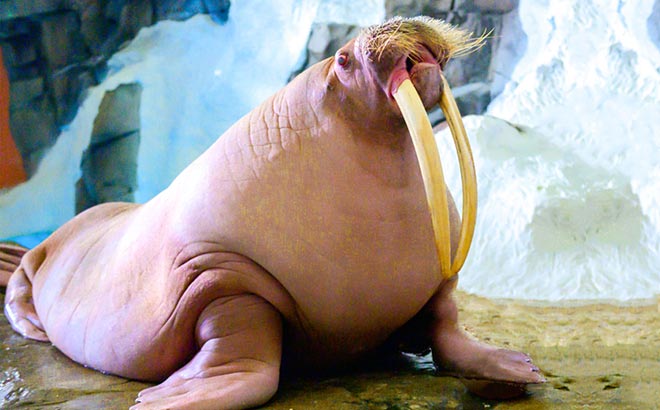
Garfield, 39-year-old bull, SeaWorld Orlando
660x410-SWO-Blog-Garfield.jpg

Source: https://seaworld.com/orlando/blog/ (2020 Walrus Awareness Week post, seems to now be deleted for some reason)
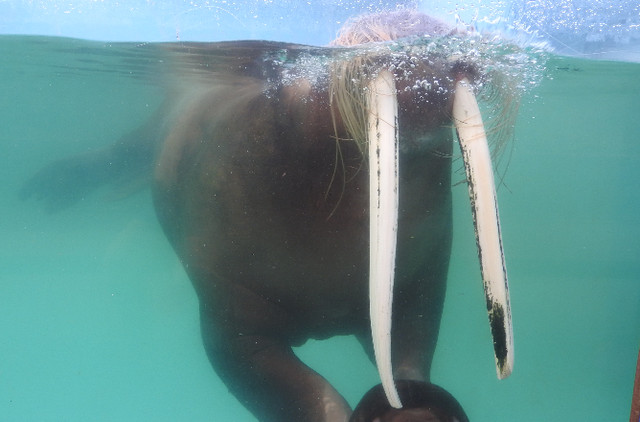
Uchio, 31-year-old bull, Otaru Aquarium
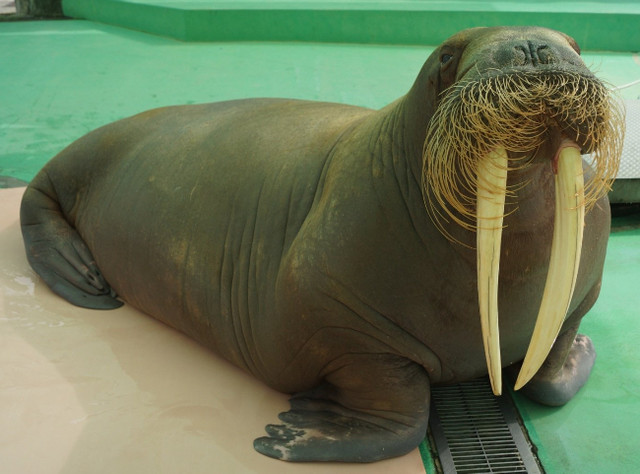
Himawari, 20-year-old cow, Ise Sea Paradise
 
Last edited:
Tusk cases also vary which I find slightly interesting. One of the males at SeaWorld San Diego has a rubber cap on one tusk and a metal cap on the other. One of the males at Indianapolis has both metal. It also sounds like the metal can vary from titanium to silver, so that’s pretty interesting.
 
Tusk cases also vary which I find slightly interesting. One of the males at SeaWorld San Diego has a rubber cap on one tusk and a metal cap on the other. One of the males at Indianapolis has both metal. It also sounds like the metal can vary from titanium to silver, so that’s pretty interesting.
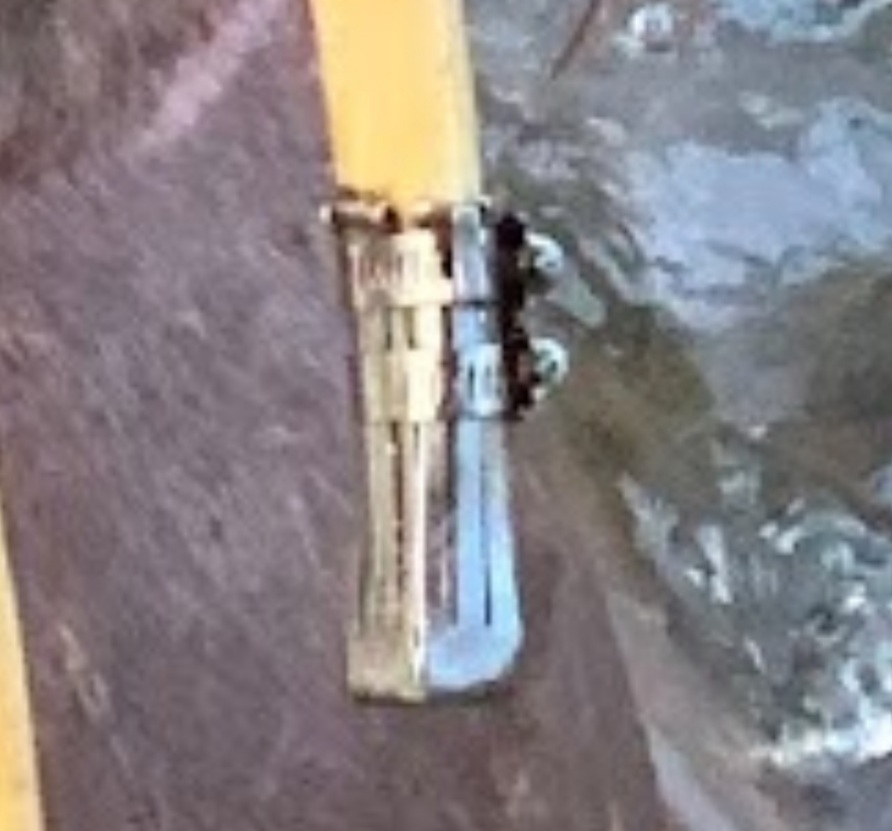
Neither of the San Diego boys currently have caps, but you're definitely right about there being some interesting variations -- hose clamps cinched over some other form of metal material can be seen in use in a couple of Chinese facilities, which is definitely different!
Screenshot-20210812-110712-Photos.jpg

Source: Sina Visitor System
 
Neither of the San Diego boys currently have caps, but you're definitely right about there being some interesting variations -- hose clamps cinched over some other form of metal material can be seen in use in a couple of Chinese facilities, which is definitely different!
Screenshot-20210812-110712-Photos.jpg

Source: Sina Visitor System
I guess not currently but in 2018 I explicitly remember Mitik having two different tusk covers.
 
Back
Top