Europe's 100 must see exhibits

But in the process, not get to see Tierpark until it is unrecognisable :p

I would bet they will run out of money until then. As we Germans say "Not everything is eaten as hot as it's cooked"

On topic, excellent choices so far! Always great to see the familiar structures of my home zoos getting praise. The Kamelwiesen better be included soon!
 
This just makes me want to revisit Berlin even more but I'll wait until most of the major construction at Tierpark is complete. :p

My tactic as well, Once the rhino house in the zoo and the elephant house + savannah in Tierpark are finished, I want to make the journey again

According to the signage this is a cheetah enclosure so hopefully somewhat less alarming.

You are right, I uploaded the wrong picture, this is really the leopard enclosure, with only a slightly higher fence:
full


On topic, excellent choices so far! Always great to see the familiar structures of my home zoos getting praise. The Kamelwiesen better be included soon!

Thank you. Tierpark Berlin will naturally also feature at some point :p
 
22. Reptile house and Aquarium
Kölner Zoo, Germany
Opened: 1971
Size: 2600 square metres
Inhabitants: >400 species of reptile, amphibian, fish and invertebrates


The inclusion of this building is largely thanks to one person: Prof. Thomas Ziegler, the current ectotherm curator in Cologne. At first sight the rectangular concrete building is not very pleasing to the eye and nor are there any large showy attractions inside. Instead the focus increasingly is on showing a large set of endangered smaller species, with specific focuses on freshwater fish and Southeast Asian herpetofauna. The latter is hardly surprising as Prof. Ziegler has been doing loads of field work in especially Vietnam, leading to the description of many species new to science. There are even two species currently kept in Cologne named after him (a newt and a monitor lizard). The collection is therefore extremely interesting to us zoo nerds, with many rarely seen species. Whereas the terrarium section has seen some renovations in exhibitry and looks relatively modern, the aquarium section looks mostly unchanged at first view. But a very good job is done on using the available smaller tanks for endangered fish and highlighting their plight. Of the three large tanks available, one is naturally a coral reef tank, but the other two are more unique. One houses an array of (endangered) Malagasy fish, while the other shows that if you give Australian lungfish space, it makes for a very attractive display. A great house does not have to be shiny and as long as it maximises its options even an older building is fit for the plight of a modern zoo.

Some @snowleopard statistics: the building features 68 aquaria, 60 reptile/amphibian enclosures and 42 invertebrate enclosures, for a grand total of 170 separate enclosures within the building (more than double the total of Burgers' Zoo :p)

full

@lintworm

full

@lintworm

full

@lintworm

full

@Maguari


Similar exhibits; Both Zoo Basel, Switzerland, (Vivarium) and Wilhelma, Stuttgart, Germany (Aquarium) have concrete constructions from a similar age, which are full of life, but have less of a conservation focus. The aquarium in Wilhelma is likely the second most species rich zoo building in Europe.

Wilhelma;
full

@gulogulogulo

Basel:
full

@lintworm

full

@lintworm
 
ROTRA is certainly a stand out exhibit and worthy of a place on this list. It's got me wondering how many, or even if any other UK exhibits will make the list.

Imo, the Sitatunga exhibit at Exmoor zoo is out of this world. It's not only beautiful, but near perfect for its inhabitants... Possibly one of my favourite zoo exhibits.

I guess we (I) shall have to wait and see.
Totally agree, great exhibit at a great zoo, and one of my faves too
 
22. Reptile house and Aquarium
Kölner Zoo, Germany

Reptile house at Wroclaw Zoo is also remarkable. For its architecture (it is a converted huge zoo restaurant from the late 19/ early 20. century), size (2 floors with a great hall inside), number of species (the zoo has 231 reptiles, 59 amphibians and unknown invertebrates, most of which are kept in the reptile house rather than Afrykarium), and number of threatened species bred. It is better than Cologne in terms of species and architecture, in my opinion. Although Cologne it is better known for German-speaking zoogoers, and houses also fish.
 
Reptile house at Wroclaw Zoo is also remarkable. For its architecture (it is a converted huge zoo restaurant from the late 19/ early 20. century), size (2 floors with a great hall inside), number of species (the zoo has 231 reptiles, 59 amphibians and unknown invertebrates, most of which are kept in the reptile house rather than Afrykarium), and number of threatened species bred. It is better than Cologne in terms of species and architecture, in my opinion. Although Cologne it is better known for German-speaking zoogoers, and houses also fish.

The reptile house in Wroclaw is indeed remarkable, but as not an exhibit that is must see on the bona fide of the exhibit, but rather on the insane amount of species kept there and therefore will not feature in the list. Yes the building is nice, but it looked tired to me and in need of renovation, and the quality of the exhibits is definitely hit and miss, with some really outdated ones and generally a crammed fell. Terraria are generally not as nicely landscaped as in Cologne either.

The main reason for including Cologne's house was that it as a building has adapted greatly to the needs of a modern zoo in terms of breeding of endangered species, being a frontrunner when it comes to freshwater fish, reptiles and amphibians (species groups that can really profit from ex situ breeding efforts, but for which many zoos haven't stepped up to the task). The collection choices very clearly reflect this (common and/or larger species being phased-out) and this is also clearly communicated via all educational displays. Wroclaw really seemed just an immense collection, where displaying diversity comes first and conservation maybe second.

The building closest to Cologne in the sense of ex situ breeding would in my opinion clearly be the amphibian and reptile house of Durrell, Jersey:
full
 
I have now visited Cologne twice and for me, the aquarium does very little to spark my feelings.

It’s a big concrete box, with tons of smaller boxes inside and for me a bit of an overdose on smaller species. After seeing the Berlin aquarium, for me personally, I have a hard time seeing what this building adds to the list so it didn’t make mine.

Then again, if this building really is used for propagating and advertising the plight of threatened freshwater fish then it cannot be applauded enough.

I liked the ramshackle “building with a load of reptiles” in Wroclaw. It offers something unique, even if unique means that the exhibitry is just “par”.

So with all your criteria, the building in Cologne with it’s rich history and thoughtfullness definately belongs on this list. For me personally, based on how I feel when I’m there, I rather see Wroclaw’s mess-in-an-old-building, just because there’s nothing like it (and perhaps that’s not even a bad thing) o_O
 
23. Tapir enclosure
Zoo Magdeburg, Germany
Opened: 2009
Size: 2700 square metres
Inhabitants: S-American tapir, white-nosed coati and several smaller species


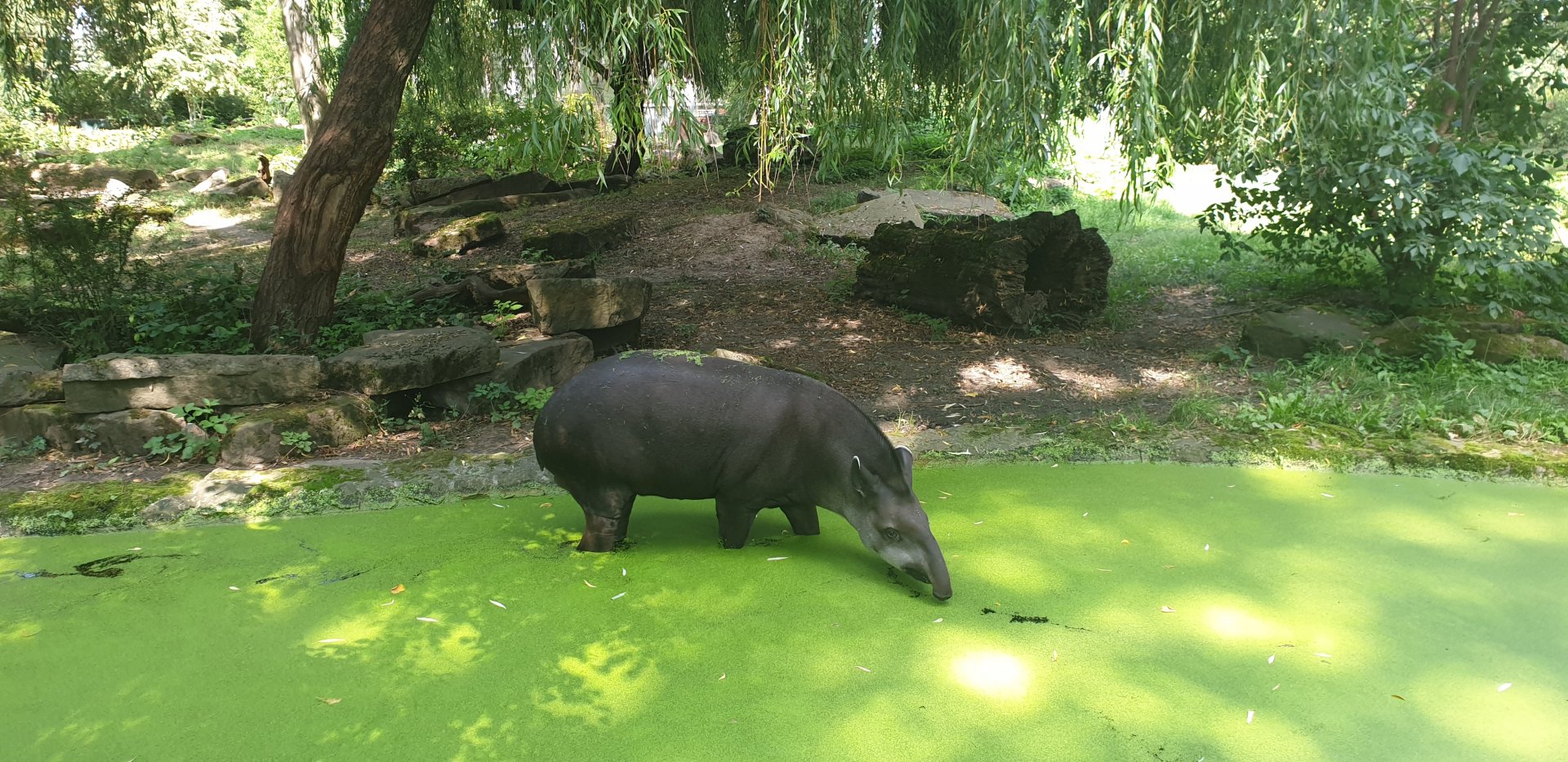
For any cash-strapped zoo it is always a challenge how to create attractive enclosures with a limited budget. One way is instead of building expensive buildings with lots of concrete, to go for a cheaper greenhouse construction. Another is to use the existing landscape to your advantage and use vegetation rather than mock rock. The latter is not always possible, as sometimes the existing landscape is quite unfavourable, but enough examples exist where basically fencing an area is good enough. The tapir house and enclosure in Magdeburg are a great example of this style. The indoor of the tapir house is a rather simple affair, but offers more space than the traditional boxes and several free-roaming species liven up the house. The outdoor enclosure is dominated by a giant weeping willow, which is heavily used by the coati. The whole outside area is well-planted and pleasant to look at. Let such exhibits be a reminder that money is not everything when designing a zoo enclosure…

Apparently this exhibit is almost unrepresented on zoochat, with no overview pictures of the outdoor enclosure

full

@MagpieGoose

full

@MagpieGoose


Similar exhibits: There are several other low-budget tapir exhibits that work very well. Examples include the one for Baird’s tapir in Tierpark Cottbus, Germany, and the Malayan tapir enclosure in Port Lympne Wild Animal Park, UK.


Tierpark Cottbus

full

@lintworm

full

@lintworm

full

@lintworm

Port Lympne:

full

@MagpieGoose

full

@Orycteropus
 
23. Tapir enclosure
Zoo Magdeburg, Germany
Opened: 2009
Size: 2700 square metres
Inhabitants: S-American tapir, white-nosed coati and several smaller species


For any cash-strapped zoo it is always a challenge how to create attractive enclosures with a limited budget. One way is instead of building expensive buildings with lots of concrete, to go for a cheaper greenhouse construction. Another is to use the existing landscape to your advantage and use vegetation rather than mock rock. The latter is not always possible, as sometimes the existing landscape is quite unfavourable, but enough examples exist where basically fencing an area is good enough. The tapir house and enclosure in Magdeburg are a great example of this style. The indoor of the tapir house is a rather simple affair, but offers more space than the traditional boxes and several free-roaming species liven up the house. The outdoor enclosure is dominated by a giant weeping willow, which is heavily used by the coati. The whole outside area is well-planted and pleasant to look at. Let such exhibits be a reminder that money is not everything when designing a zoo enclosure…

Apparently this exhibit is almost unrepresented on zoochat, with no overview pictures of the outdoor enclosure

full

@MagpieGoose

full

@MagpieGoose


Similar exhibits: There are several other low-budget tapir exhibits that work very well. Examples include the one for Baird’s tapir in Tierpark Cottbus, Germany, and the Malayan tapir enclosure in Port Lympne Wild Animal Park, UK.


Tierpark Cottbus

full

@lintworm

full

@lintworm

full

@lintworm

Port Lympne:

full

@MagpieGoose

full

@Orycteropus


Oh, I love this exhibit and I'am pretty sure I have pictures from my two visits. Only this one is uplodaded to ZooChat, tho.

 
Apparently this exhibit is almost unrepresented on zoochat, with no overview pictures of the outdoor enclosure

There are shots of both the indoor and outdoor enclosures within my 2014 review of the collection - I've been meaning to upload the photos from that thread to the gallery for a while, as they're currently only attachments, bit for now I'll quote them into this thread:


I allways loved this very functional design philosphy of medium and smal zoos. Which trys to create the best living conditions in the most effective and simplest way. It createst this feeling of closeness to this animals, that is hard to reach in other kind of exhibit. The modern amusemt park like "fake nature" style, with mock rocks, fake trees and temples looks more like a film set, with no real conection to the animals. The old concrete prision cells, which function is to present the animal, with their cold and depressing nature, without much care for animal wellfare just makes me feel depresed. And the grand exhibits of the late 19th early 20th centery in a similar sense to the amusement park like exhibits, make the animals only showpieces. While like the concrete exhibits, do not forfill basic wellfate conditions. Well atleast do they look pleasing to the eye. ¯\_(ツ)_/¯
 
24. Borealia,
Korkeasaari Zoo, Helsinki, Finland
Opened: 1997
Size: 400 square metres
Inhabitants: Ruff, medicinal leech, grass snake, Eurasian pygmy owl, common toad, harvest mouse, tufted duck, Eurasian teal


Though one might think based on recent posts, that I am a lover of concrete in zoos. However, one of my real preferences is the display of native species in zoos. Borealia is thus a greenhouse after my own heart and a little gem in an already good zoo. The aim of the house is to show native Finnish wetland species, with the ruff, a palearctic wader, in the centre of attention. While looking rather plain most of the year, the breeding season brings a major change. The males develop a stunning breeding plumage and in leks they show off to prospective females with some bizarre dance moves. An attractive walkthrough ensures great views of this spectacle. At first sight it seems rather bizarre to keep native species in a greenhouse, but given that ruff spend their winters in Africa, it makes sense. This is one of those subtle exhibits that one could pass quickly due to the lack of an obvious star species. But Borealia invites you to linger a little longer and only then it shows how lovely a house it is, especially in spring.


full

@Shirokuma

full

@lintworm

full

@Shirokuma

full

@twilighter
 
24. Borealia,
Korkeasaari Zoo, Helsinki, Finland
Opened: 1997
Size: 400 square metres
Inhabitants: Ruff, medicinal leech, grass snake, Eurasian pygmy owl, common toad, harvest mouse, tufted duck, Eurasian teal


Though one might think based on recent posts, that I am a lover of concrete in zoos. However, one of my real preferences is the display of native species in zoos. Borealia is thus a greenhouse after my own heart and a little gem in an already good zoo. The aim of the house is to show native Finnish wetland species, with the ruff, a palearctic wader, in the centre of attention. While looking rather plain most of the year, the breeding season brings a major change. The males develop a stunning breeding plumage and in leks they show off to prospective females with some bizarre dance moves. An attractive walkthrough ensures great views of this spectacle. At first sight it seems rather bizarre to keep native species in a greenhouse, but given that ruff spend their winters in Africa, it makes sense. This is one of those subtle exhibits that one could pass quickly due to the lack of an obvious star species. But Borealia invites you to linger a little longer and only then it shows how lovely a house it is, especially in spring.


full

@Shirokuma

full

@lintworm

full

@Shirokuma

full

@twilighter
I was thinking it could be included. It really is one of my favorite parts of the zoo
 
The Magdeburg enclosure is a perfect example of quite a few very good exhibits all over Europe.

I always found Zodiac Zoos really good at such exhibits. Zodiac Zoos was the former, now bankrupt, company that owned Wissel Zoo in Epe (now closed), Overloon Zoo and AquaZoo Friesland and in both AquaZoo (lemur and kangaroo islands as an example) and Overloon (the former “Maidan” area) you can still see their hand in creating very low cost but rather invisible or unobtrusive barriers.

I hadn’t heard about the Borealis house, but any exhibit that manages to really showcase otherwise usually overlooked species is always special. We had a perfect example before with Nürnberg’s Desert House already and the good examples are so few and far between, they’re all worth a seperate mention in this thread.
 
24. Borealia,
Korkeasaari Zoo, Helsinki, Finland
Opened: 1997
Size: 400 square metres
Inhabitants: Ruff, medicinal leech, grass snake, Eurasian pygmy owl, common toad, harvest mouse, tufted duck, Eurasian teal


Though one might think based on recent posts, that I am a lover of concrete in zoos. However, one of my real preferences is the display of native species in zoos. Borealia is thus a greenhouse after my own heart and a little gem in an already good zoo. The aim of the house is to show native Finnish wetland species, with the ruff, a palearctic wader, in the centre of attention. While looking rather plain most of the year, the breeding season brings a major change. The males develop a stunning breeding plumage and in leks they show off to prospective females with some bizarre dance moves. An attractive walkthrough ensures great views of this spectacle. At first sight it seems rather bizarre to keep native species in a greenhouse, but given that ruff spend their winters in Africa, it makes sense. This is one of those subtle exhibits that one could pass quickly due to the lack of an obvious star species. But Borealia invites you to linger a little longer and only then it shows how lovely a house it is, especially in spring.


full

@Shirokuma

full

@lintworm

full

@Shirokuma

full

@twilighter
Leeches aren’t that common in zoos (at least around where I live), so that’s quite an interesting thing to hear about. I do hope they aren’t in the main aviary though.
 
25. Bear enclosure
ZSL Whipsnade Zoo, Dunstable, UK
Opened: 1931
Size: 5000 square metres
Inhabitants: European brown bear


Enclosures are often said to have a shelf life of 30 years. Unsurprisingly it is rare to see an enclosure older than that with which there is still not much wrong, as zoo husbandry is constantly evolving. To find an enclosure that is close a century old, without changing much at all, but still being well suited to its inhabitants, is an extremely rare sight. The brown bear enclosure in Whipsnade does just that. By just fencing in a piece of woodland, it was far ahead of its time in an age where concrete pits and cages were the standard. If not for the antique looking fence, one wouldn’t have given it so many years. By keeping it simple, it was far ahead of its time, this is a lesson that some zoo architects now (and then) could well use.

full

@devilfish


full

@MagpieGoose

full

@ro6ca66

full

@Maguari


full

@ro6ca66
 
In one of his books the late Gerald Durrell writes about his work at Whipsnade and tells a good deal about this enclosure ( and the bears ) as it was in the last centuary.
 
Bear enclosure
ZSL Whipsnade Zoo, Dunstable, UK
Opened: 1931


By just fencing in a piece of woodland, it was far ahead of its time in an age where concrete pits and cages were the standard.

I noticed a trend that often one zoo has an innovative exhibit for decades, and other zoos don't copy it. Then - bam! - similar enclosures pop up all over. The most clear example was the Dutch Apenheul with its walkthru forests for squirrel monkeys, lemurs, marmosets and Barbary macaques, which existed for decades before other zoos started making such exhibits. 20 years ago, squirrel monkey forest at Apenheul would surely be one of exceptional exhibits in European zoos, but not anymore. In America, something similar happened with giraffe feeding platforms.
 
Back
Top