A Tale of Two Cities: Overlap Species in Nearby Zoos

Well, that's all I had planned to cover. I wanted mainly to highlight the difference in approach between these two sets of zoos in repeating species. With me being done, I am opening the floor for others to share examples of other nearby collections and their repeat species. SDZ and SDZSP? The WCS collections? Dallas, Fort Worth and DWA? Phoenix and Wildlife World? Reid Park and SDZSP? What else?

However, I don't want to see just straight, boring lists of species. In addition to lists of species, your posts should include numbers, stats, graphs, and commentary why zoos may or may not have similar collections. Use my posts as an outline and feel free to expand upon my format!
 
Chicago: Brookfield and Shedd Aquarium

Shedd Aquarium species count: 1011
Lincoln Park Zoo Species count: 156


Brookfield-Shedd overlap: 63 species
Alligator Snapping Turtle
Amazon Milk Frog
Anthony’s Poison Dart Frog
Atlantic Cownose Ray
Atlantic Spadefish
Banded Leporinus
Banggai Cardinalfish
Basketmouth Cichlid
Black Crappie
Blackstripe Topminnow
Blind Cave Fish
Blue Tang
Boeseman’s Rainbowfish
Brazilian Teal
Bristlenose Plecostomus
Bubble-tip Anemone
California Moray
California Sea Lion
Channel Catfish
Chinese Crocodile Lizard
Common Plecostomus
Coral (I know Shedd and Brookfield have at least one species in common)
Coral Beauty
Dwarf Seahorse
Garibaldi
Giant Cockroach
Giant Monkey Frog
Glass Bloodfin Tetra
Grass Carp
Green Swordtail
Greenside Darter
Harlequin Tuskfish
Humpback Cleaner Shrimp
Lemon Goby
Leopard Shark
Longnose Butterflyfish
Lookdown
Moon Jelly
Neon Tetra
Ocellaris Clownfish
Orange Anthias
Orangespotted Sunfish
Powder Blue Tang
Pacific Halfmoon
Pacific Spiny Lobster
Pumpkinseed
Purple Tang
Rainbow Darter
Rock Bass
Round Goby
Sexy Shrimp
Spiny-headed Tree Lizard
Striped Surfperch
South American Lungfish
Tailspot Blenny
Tentacled Snake
Tomato Clownfish
White-blotched River Stingray
White Cloud Mountain Minnow
Yellow-banded Poison Dart Frog
Yellow-spotted Climbing Toad
Yellow Perch
Yellow Tang
Total overlap species: 63

I was absolutely shocked to find that Brookfield and Shedd have nearly as much overlap as Brookfield does with Lincoln Park, as I hadn't really noticed this on my visit to Shedd. But that's simply because Shedd is so packed with species it's harder to notice the species you saw yesterday. Most of the overlap species here are at Brookfield found in The Living Coasts building (for obvious reasons), but a number of them can also be found in The Swamp. At Shedd, the overlap species can be found scattered across the facility. Overlap species between these two collections make up 17% of Brookfield's collection and whopping 6% of Shedd's! That's really, really high! I thought this was a fluke of the coral/cichlid rule, but I found re-implementing it only changed it to 5% of Shedd's collection, which is still shockingly high.

Hate to be that guy again but the species list, that's Lincoln Park Zoo again
 
-Dallas also has the Dallas Children's Aquarium (one of the oldest aquariums in the country) and a Sea Life

-Boston: Stone, Franklin Park, NE Aquarium, and Museum of Science, all AZA facilities

-Philadelphia: Philadelphia zoo, Elmwood Park zoo, and Adventure Aquarium, plus Upper Schuykill Valley Park, the insectarium, and the audubon museum

-VA Beach/Norfolk: VA Aquarium, VA Zoo, VA Living Museum (only maybe a few herps overlap, as the zoo is asia/africa and the LM is natives)

-Knoxville/Gatlinburg area: Knoxville Zoo, Ripley's Aquarium of the Smokies, Rainforest Adventures, Smokey Mountain Deer Farm, Ober Gatlinburg, Parrot Mountain, Dollywood has bald eagles, three bears general store has asiatic black bears. Little Ponderosa Zoo, Briarwood Ranch, and Bright's Zoo are all within an hour, as well.

-Springfield MO: Dickerson Park, Wonders of Wildlife, Wild Animal Safari MO

-St Louis: St Louis Zoo, St Louis Aquarium, Grant's Farm, World Bird Sanctuary, Endangered Wolf Center

-Seattle: Woodland Park, Point Defiance, Seattle Aquarium

Hundreds of combos for Florida. Many for the California cities, as well.
 
If others want to do them its fine, but I'm really not interested in seeing overlaps in random tiny collections, I would try to stick with major facilities.
 
Twin Cities: Como Park and Minnesota

I have to get this out right away - I currently do not have a species list for Sea Life Minnesota, which means I cannot accurately asses its collections' similarities to Minnesota and Como Park, which means I'll be stuck just comparing those two for now.

Also, for ease of counting (since few zoos sign them) I'll be counting all corals and African Rift Valley cichlids as one species each. This won't affect our comparison of Minnesota's and Como Park's collections very much.

Como Park Zoo Full Species List: Como Park Zoo and Conservatory Full Species List [Como Park Zoo and Conservatory]
Minnesota Zoo Full Species List: Minnesota Zoo Full Species List [Minnesota Zoo]

Como Park Zoo Full Species Count: 87
Minnesota Zoo Full Species Count: 314

List of overlap species:
African Penguin
American Bison
Amur Tiger
Common Shelduck
Cougar
Gray Wolf
Reindeer/Caribou
Sunbittern
White-faced Whistling Duck
Total number of overlap species: 9

Como Park and Minnesota have, just as it seems, very little overlap in collection. This can largely be attributed to the fact that these collections have different focuses. Como Park Zoo has a large focus on African megafauna, while Minnesota focuses mainly on cold-climate species and doesn't have any African species bigger than a Red River Hog. In fact, even a couple of the overlap species between the collection are slightly different. Como Park keeps Domestic Reindeer while Minnesota keeps Woodland Caribou. Como Park keeps normal hybridized bison while Minnesota has a generically pure herd.

Como Park and Minnesota do seem to be actively avoiding overlap whenever possible, due to the fairly high number of very similar species between the two collections. For example:
-Como Park keeps Chilean Flamingoes while Minnesota keeps Lesser Flamingoes.
-Minnesota keep Golden Lion Tamarins while Como Park keeps Golden-headed Lion Tamarins.
-Minnesota keeps Ring-tailed Lemurs while Como Park keeps Blue-eyed Black Lemurs.
-Minnesota keeps Linnie's Two-toed Sloth while Como Parks keeps Hoffmann's Two-toed Sloth.
-Como Park keeps Dall Sheep while Minnesota keeps Transcaspian Urial.
-Como Park keeps Gray and Harbor Seals while Minnesota keeps Hawaiian Monk Seals.

Good summary of the two Twin Cities zoos. They have indeed focused on differentiating themselves from one another. This dates to the 1970s, when the Minnesota Zoo was being built. Other places that built new major zoos (Milwaukee, Toronto, Miami, etc.) tended to close the old city zoo. In contrast, the state of Minnesota decided to provide additional money to renovate Como at the same time they were paying to build the state-owned Minnesota Zoo. The master plan that Como followed was careful to renovate in a way that didn't overlap with the new Minnesota Zoo.

Beyond the collection differences it is also notable that overall design of the zoos is very different, with Como featuring animal houses with surrounding paddocks, while Minnesota has expansive pavillions and outdoor trails. This should keep the two zoos as distinct experiences even if Minnesota is eventually able to add more ABC species to its collection.

Unfortunately though, although it feels nice for zoo enthusiasts to visit these two collections and see completely different animals, the local zoo visiting public doesn't seem to see it this way. Como Park sees many more visitors than Minnesota, which can be largely owed to its more ABC collection. Minnesota Zoo has almost closed multiple times in the last decade, and really does provide proof that ABC animals are required for a major zoo to stay afloat, even when you have a really unique collection (in contrast to Como Park which may be the most generic zoo in the country).

I agree that the ABC focus is one reason that Como gets more visitation, but other important factors are being right in the center of population and being free. Minnesota also still does quite well attendance-wise, with >1 million visitors per year pre-pandemic. The closure stories that came out during COVID had much more to do with regulations and restrictions associated with the zoo being a state agency than they did with lack of public support.

Regarding the Sealife Aquarium in the Twin Cities, it has pretty significant overlap in different ways with both zoos. Ignoring the various smaller tanks with the standard selection of jellies, octopus, piranha, seahorse, etc., the vast majority of species in the aquarium are kept in a series of four tunnel tanks in the 100,000-500,000 gallon range. These four tanks include one tank for native North American gamefish, one tank for Amazon species, one tank for sharks, rays, sea turtles, and other mostly predatory species, and one tank for Coral Reef fishes.

There is a similar but smaller native gamefish tank at Minnesota, a similar but smaller Amazon tank at Como, a similar large shark/predator tank at Minnesota, and a similar large coral reef tank at Minnesota. Many of the headliners at Sealife can be seen at one of the zoos instead, including Lake Sturgeon, Pacu, Freshwater Stingray, Sandtiger Shark, Southern Stingray, and Sea Turtle. Sealife does have some notable species to itself, including Alligator Gar, Paddlefish, Arapaima, Green Sawfish, Bowmouth Guitarfish, and various sharks not held at Minnesota.
 
Zoo New England: Franklin Park Zoo and Stone Zoo

As @TinoPup mentioned, Boston has 4 AZA accredited facilities- the Franklin Park Zoo, the Stone Zoo, the New England Aquarium, and the Museum of Science. Unfortunately, I do not have accurate species lists for the New England Aquarium or Museum of Science, so I will have to make do with comparing the species of the Franklin Park Zoo and Stone Zoo on their own.

Franklin Park Zoo Full Species List: Franklin Park Zoo Species List 4/22 + Gorilla Grove Review [Franklin Park Zoo]
Stone Zoo Full Species List: Stone Zoo Species List (7/19/22) [Stone Zoo]

Franklin Park Zoo Full Species Count: 102
Stone Zoo Full Species Count: 53


List of overlap species:
  • Barrow’s Goldeneye (Bucephala Islandica)
  • Blanding’s Turtle (Emydoidea Blandingi)
  • Cottontop Tamarin (Saguinus Oedipus)
  • African Pygmy Goat (Capra Aegarus Hircus)
  • Linnaeus’s Two-Toed Sloth (Choloepus Didactylus)
  • Scarlet Ibis (Eudocimus Ruber)
Total number of overlap species: 6


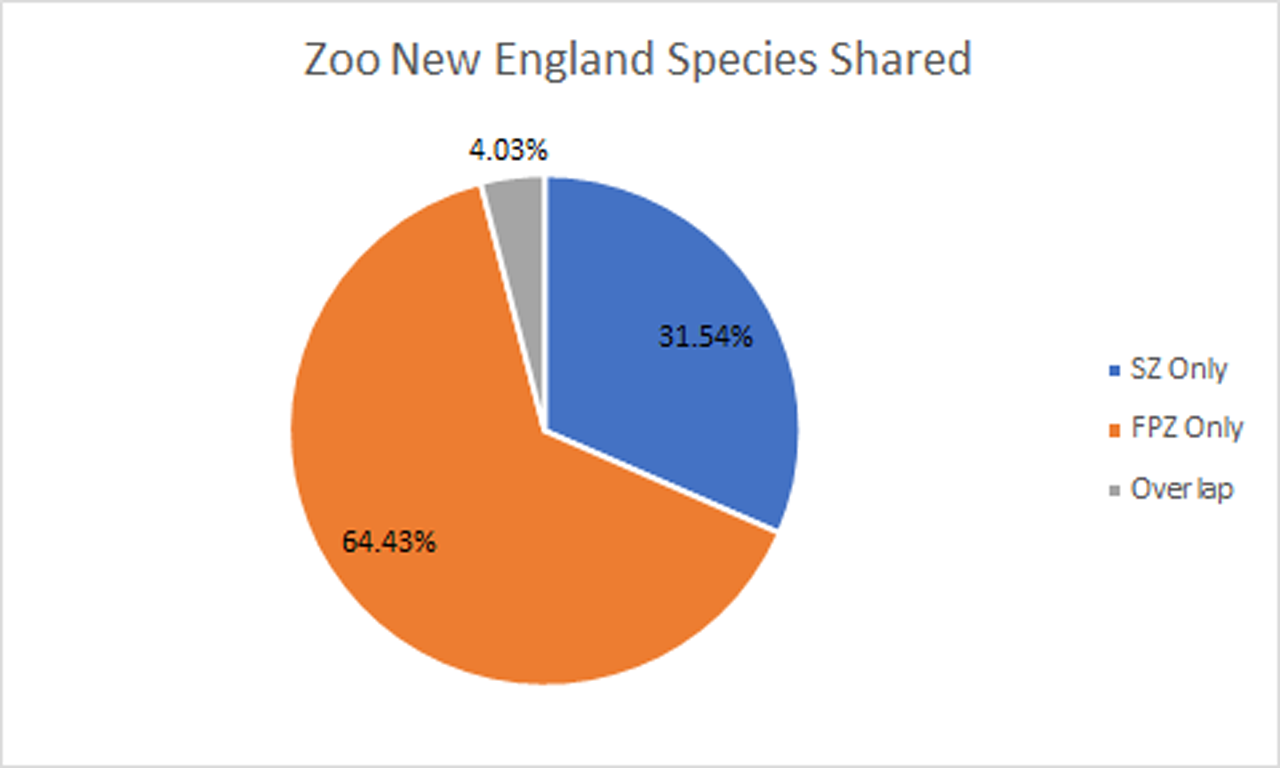
Like the Minnesota Zoo and Como Park Zoo, the Franklin Park Zoo and Stone Zoo have very little overlap in their collections in part due to their different focuses. The Stone Zoo’s collection emphasizes new world species, with a couple exhibits focusing on the Himalayas. The Franklin Park Zoo on the other hand is based mostly around old world species, with an emphasis on African megafauna.

FPZ and SZ are both run by the umbrella organization known as Zoo New England, and so these differences in their collections are intentional. By focusing on different parts of the world, the zoos intend to complement each other, and to each provide guests with unique experiences based on unique species and unique geographically themed complexes.

Here is a graph, showing what percent of species are exclusive to Stone, exclusive to Franklin Park, and which species overlap. Keep in mind that the Stone Zoo takes up 26 acres, while the Franklin Park Zoo takes up 72 acres, which partly accounts for how the species are distributed:

ZNE-species-shared.png
 
Zoo New England: Franklin Park Zoo and Stone Zoo

As @TinoPup mentioned, Boston has 4 AZA accredited facilities- the Franklin Park Zoo, the Stone Zoo, the New England Aquarium, and the Museum of Science. Unfortunately, I do not have accurate species lists for the New England Aquarium or Museum of Science, so I will have to make do with comparing the species of the Franklin Park Zoo and Stone Zoo on their own.

Franklin Park Zoo Full Species List: Franklin Park Zoo Species List 4/22 + Gorilla Grove Review [Franklin Park Zoo]
Stone Zoo Full Species List: Stone Zoo Species List (7/19/22) [Stone Zoo]

Franklin Park Zoo Full Species Count: 102
Stone Zoo Full Species Count: 53


List of overlap species:
  • Barrow’s Goldeneye (Bucephala Islandica)
  • Blanding’s Turtle (Emydoidea Blandingi)
  • Cottontop Tamarin (Saguinus Oedipus)
  • African Pygmy Goat (Capra Aegarus Hircus)
  • Linnaeus’s Two-Toed Sloth (Choloepus Didactylus)
  • Scarlet Ibis (Eudocimus Ruber)
Total number of overlap species: 6


Like the Minnesota Zoo and Como Park Zoo, the Franklin Park Zoo and Stone Zoo have very little overlap in their collections in part due to their different focuses. The Stone Zoo’s collection emphasizes new world species, with a couple exhibits focusing on the Himalayas. The Franklin Park Zoo on the other hand is based mostly around old world species, with an emphasis on African megafauna.

FPZ and SZ are both run by the umbrella organization known as Zoo New England, and so these differences in their collections are intentional. By focusing on different parts of the world, the zoos intend to complement each other, and to each provide guests with unique experiences based on unique species and unique geographically themed complexes.

Here is a graph, showing what percent of species are exclusive to Stone, exclusive to Franklin Park, and which species overlap. Keep in mind that the Stone Zoo takes up 26 acres, while the Franklin Park Zoo takes up 72 acres, which partly accounts for how the species are distributed:

ZNE-species-shared.png

Museum of Science, July 3 2022:
Ambassador area (that I could see/zoom in on signs for):
-Desert tortoise
-Red-footed tortoise
-Timber rattlesnake
-Corn snake
-Eastern garter snake
-Dumeril's ground boa
-Ball python
-Brazilian rainbow boa
-Chuckwalla
-Bearded dragon
-Sheltopusik
-Domestic ferret
-Striped skunk
-Lesser Madagascar hedgehog tenrec
-Four-toed hedgehog

New England Climate Stories:
-Domestic rat
-Blue Jay
-Eastern screech owl
-Garter snake
-Black rat snake
-Eastern box turtle
-American toad
-Gray tree frog
-Spotted salamander
-Redbelly dance
-Eastern oyster
-American eel
-Fiddler crab
-Northern walking stick
-Milkweed bug
-Chinese praying mantis
-Wolf spider

Cotton-top Tamarins:
-Cotton-top Tamarin (surprise!)

Garden Walk & Insect Zoo:
-Poison dart frogs (Unspecified, didn't see any)
-Thorny devil walking stick Eurycantha calcarata
-Giant stick insect Phobaeticus serratipes
-Australian prickly stick Extatosoma tiaratum
-Jungle nymph Heteropteryx dilatata
-Giant cave cockroach Blaberus giganteus
-Giant desert centipede Scolopendra heros
-Florida ivory millipede Chicobolus spinigerus
-Diving beetle Thermonectus sp.
-Sun beetle Pachnoda marginata
-Flamboyant flower beetle Eudicella gralli
-Jade-headed buffalo beetle Eudicella smithii
-Zebra isopods Armadillium maculatum
-Desert hairy scorpion Hadrurus arizonensis
-Asian forest scorpion Heterometrus sp.
-Mexican red knee tarantula Brachypelma hamorii
-Leaf-cutter ants

Yawkey Gallery on the Charles River:
-Eastern milk snake
-Spotted salamander / gray treefrog
-Bluegill sunfish, redbreast sunfish, pumpkinseed sunfish, largemouth bass, brown bullhead, yellow perch
-Unspecified macroinvertebrates

I guess I should make a thread for this lol
 
This is a great thread.

I would be fairly certain Lincoln Park and Brookfield Zoo both shared Black-and-white Colobus Monkeys and Asian Small-Clawed Otters, don't they? I know some former overlap species that have left either collection also include Amur Leopard, Amur Tiger, Ostrich, Warthog, Waterbuck, Andean Bear, Aardvark, Mandrill quite a while ago, African Elephant even longer... possibly Plains Zebra. I would swear there were a few more primates at some point. They have also traded between California sea lion, Harbor and Grey seals along with the Shedd Aquarium going back a long time. Shedd and Brookfield never quite overlapped on American alligator but came very close I think.

Red River Hog are an interesting case as they debuted at Brookfield in Habitat Africa The Forest in the early 2000s but later spread to Lincoln Park Zoo and Milwaukee County Zoo, while all three facilities phased out Warthog in a similar time frame.

In some cases - African Lion, Western Lowland Gorilla - it makes sense both zoos have the same species because there is only one SSP within that grouping, but I can't help but wonder in some cases if there might be room to concentrate on different subspecies, such as if Lincoln Park or Brookfield focused on different gibbons... but ultimatel I look over the list and it's hard to imagine changing away from any of the shared species. I can't imagine Brookfield or Lincoln Park switching away from Black Rhinoceros, for example, or Polar Bear, and we know an Asian Lion SSP is unlikely right now.

A few good examples of divergence are Lincoln Park Zoo holding black bears and red wolves while Brookfield has grizzly bears and Mexican gray wolves, or Brookfield holding orangutan while Lincoln Park has chimpanzees, but both collaborating on gorillas. Brookfield has had gray kangaroos and Lincoln Park has held red kangaroos. Lincoln Park currently has crowned lemur and Brookfield has ringtail lemurs. Also, Brookfield holds bottlenose dolphins while the Shedd has Pacific white-sided, Brookfield has a Kemp's ridley turtle while the Shedd has a green sea turtle, the Shedd is the only holder of cold weather penguins left in the city, and has sea otters while the other two zoos have shared otter species.

I've mentioned this elsewhere but what stands out to me very significantly is both zoos have done significant renovation and expansion to the African continent in the early 2000s and the North American continent in the late 2000s, two very important biogeographic regions, but neither has significant exhibits based on South America or Asia, and only Brookfield has a dedicated Australia habitat, with Lincoln Park Zoo keeping kangaroos sometimes in the Antelope-Zebra Area. It would really make sense for both of them to invest in the Asian bioregion next (Lincoln Park to bring back tigers and Brookfield due to existing infrastructure) although I'd love to see them both develop South America as well.

I think diverse exhibit theming would be a great way to keep both zoos distinct, although ironically both feel set up towards Asia now.
 
My two local zoos are Roger Williams Park Zoo and Capron Park Zoo. From my perception, it's seemed like a relatively small amount of overlapping species has increased in recent years. Here are the species kept on exhibit at both zoos (ambassadors have, as expected, more overlap):
- North American River Otter (New to RWPZ approx. 10 years ago)
- Domestic Goats (though different breeds)
- Alpaca (New to RWPZ approx. 10 years ago)
- Red Panda (New to Capron approx. 6 years ago)
- Red-crowned Crane
- Two-toed Sloths (though different species, Linne's at RWPZ and Hoffmann's at Capron)
- Sunbittern (New to Capron approx. 5 years ago)
- Ringed Teal (New to Capron approx. 5 years ago)
- African Spurred Tortoise
Total Species: 9 (with two being extremely similar though different species, 7 being identical).

Out of these nine species, five of them are new to one of these zoos within the past ten years. In this time frame, there have been a few species to leave one of the collections as well, reducing some overlap:
- Emu (left RWPZ approx. 6 years ago)
- Red-rumped Agouti (in recent years left both (?) collections, RWPZ may still have one bts)
- Golden Lion Tamarin (left Capron approx. 2 years ago)
- Reeve's Muntjac (left Capron approx. 6 years ago)

So while I may have perceived some increased overlap in recent years, the number has really only increased by one species. Really this perception can probably be credited due to the fact two popular species are now highlighted at both facilities, Red Pandas and North American River Otters.
 
New York City
California sea lion: Bronx, Central Park, Queens, Prospect Park, New York Aquarium
Harbor seal: Central Park, New York Aquarium
American bison: Bronx, Queens
Red panda: Bronx, Central Park, Prospect Park
Snow leopard: Bronx, Central Park
Tufted deer: Bronx, Prospect Park
Amur leopard: Bronx, Staten Island
Greater roadrunner: Might still be at Queens and Staten Island
Bald eagle: Queens, maybe Bronx
King vulture: Maybe Bronx and Queens
North American river otter: Prospect Park, Staten Island
Black-tailed prairie dog: Bronx, Prospect Park
Dwarf mongoose: Bronx, Prospect Park
Abdim's stork: Bronx, Central Park
Southern pudu: Queens, maybe Bronx
Fennec fox: Bronx, Prospect Park
Eurasian eagle owl: Bronx, Central Park
Brown bear: Bronx, Central Park
I'm almost certainly missing species

Tampa (ZooTampa & Busch Gardens Tampa)
Lowland nyala
Bornean orangutan
Malayan tiger
Ringtail lemur
Marabou stork
White rhino
Impala
Lorikeets
Komodo dragon
Tomistoma
American alligator
Flying fox
African penguin
American flamingo
Bongo
 
Here is a list of animals found in both the Paris Menagerie and Paris Zoo:
Vicuna
Brazilian tanager, Demoiselle crane, Greater rhea, Little egret, Scarlet macaw, Southern screamer
Garden tree boa
Mission golden-eyed tree frog
 
This is a great thread.

I would be fairly certain Lincoln Park and Brookfield Zoo both shared Black-and-white Colobus Monkeys and Asian Small-Clawed Otters, don't they? I know some former overlap species that have left either collection also include Amur Leopard, Amur Tiger, Ostrich, Warthog, Waterbuck, Andean Bear, Aardvark, Mandrill quite a while ago, African Elephant even longer... possibly Plains Zebra. I would swear there were a few more primates at some point. They have also traded between California sea lion, Harbor and Grey seals along with the Shedd Aquarium going back a long time. Shedd and Brookfield never quite overlapped on American alligator but came very close I think.

Red River Hog are an interesting case as they debuted at Brookfield in Habitat Africa The Forest in the early 2000s but later spread to Lincoln Park Zoo and Milwaukee County Zoo, while all three facilities phased out Warthog in a similar time frame.

In some cases - African Lion, Western Lowland Gorilla - it makes sense both zoos have the same species because there is only one SSP within that grouping, but I can't help but wonder in some cases if there might be room to concentrate on different subspecies, such as if Lincoln Park or Brookfield focused on different gibbons... but ultimatel I look over the list and it's hard to imagine changing away from any of the shared species. I can't imagine Brookfield or Lincoln Park switching away from Black Rhinoceros, for example, or Polar Bear, and we know an Asian Lion SSP is unlikely right now.

A few good examples of divergence are Lincoln Park Zoo holding black bears and red wolves while Brookfield has grizzly bears and Mexican gray wolves, or Brookfield holding orangutan while Lincoln Park has chimpanzees, but both collaborating on gorillas. Brookfield has had gray kangaroos and Lincoln Park has held red kangaroos. Lincoln Park currently has crowned lemur and Brookfield has ringtail lemurs. Also, Brookfield holds bottlenose dolphins while the Shedd has Pacific white-sided, Brookfield has a Kemp's ridley turtle while the Shedd has a green sea turtle, the Shedd is the only holder of cold weather penguins left in the city, and has sea otters while the other two zoos have shared otter species.

I've mentioned this elsewhere but what stands out to me very significantly is both zoos have done significant renovation and expansion to the African continent in the early 2000s and the North American continent in the late 2000s, two very important biogeographic regions, but neither has significant exhibits based on South America or Asia, and only Brookfield has a dedicated Australia habitat, with Lincoln Park Zoo keeping kangaroos sometimes in the Antelope-Zebra Area. It would really make sense for both of them to invest in the Asian bioregion next (Lincoln Park to bring back tigers and Brookfield due to existing infrastructure) although I'd love to see them both develop South America as well.

I think diverse exhibit theming would be a great way to keep both zoos distinct, although ironically both feel set up towards Asia now.
Lincoln Park no longer keeps Asian Small-clawed Otter. Brookfield keeps Angolan Colobus, not Black-and-white.
 
New York City
California sea lion: Bronx, Central Park, Queens, Prospect Park, New York Aquarium
Harbor seal: Central Park, New York Aquarium
American bison: Bronx, Queens
Red panda: Bronx, Central Park, Prospect Park
Snow leopard: Bronx, Central Park
Tufted deer: Bronx, Prospect Park
Amur leopard: Bronx, Staten Island
Greater roadrunner: Might still be at Queens and Staten Island
Bald eagle: Queens, maybe Bronx
King vulture: Maybe Bronx and Queens
North American river otter: Prospect Park, Staten Island
Black-tailed prairie dog: Bronx, Prospect Park
Dwarf mongoose: Bronx, Prospect Park
Abdim's stork: Bronx, Central Park
Southern pudu: Queens, maybe Bronx
Fennec fox: Bronx, Prospect Park
Eurasian eagle owl: Bronx, Central Park
Brown bear: Bronx, Central Park
I'm almost certainly missing species

Tampa (ZooTampa & Busch Gardens Tampa)
Lowland nyala
Bornean orangutan
Malayan tiger
Ringtail lemur
Marabou stork
White rhino
Impala
Lorikeets
Komodo dragon
Tomistoma
American alligator
Flying fox
African penguin
American flamingo
Bongo
Here is a list of animals found in both the Paris Menagerie and Paris Zoo:
Vicuna
Brazilian tanager, Demoiselle crane, Greater rhea, Little egret, Scarlet macaw, Southern screamer
Garden tree boa
Mission golden-eyed tree frog
For these lists - why is the overlapping number of species where it is? What makes the zoos similar? What makes them different? What percentage of these collections is made up of overlap species? These are the kinds of things I'm looking for here, not just straight lists of species.
 
Unfortunately, I cannot seem to find accurate species lists for either Phoenix or Wildlife World (and I'm quarantined in Madison, so I can't just go and check for myself), so I can't properly math this even if I wanted to. However, I did notice a lot of similar species when I visited both facilities during my time in AZ this summer. I also realized that Wildlife World & Odysea have a shocking amount of overlap, too, so I'll cover them in another post.
Here is what I managed to scrounge up for the Phoenix Zoo and Wildlife World Zoo:
  • Lion

  • Southern White Rhinoceros

  • American Alligator

  • Emu

  • Ostrich

  • Greater Rhea

  • Cougar

  • Bobcat

  • Pronghorn

  • Javelina

  • Siamang

  • Squirrel Monkey

  • Mara

  • Scarlet Macaw

  • King Vulture

  • Caracal

  • Thompson’s Gazelle

  • Nyala

  • Hamadryas Baboon

  • African Crested Porcupine

  • Geoffroy’s Tamarin

  • Geoffroy’s Spider Monkey

  • Red Ruffed Lemur

  • Black and White Ruffed Lemur

  • Jaguar

  • Great Horned Owl

  • Warthog

  • Dromedary Camel

  • Cheetah

  • Cownose Stingray

  • Ringtail

  • Bennet’s Wallaby

  • Gila Monster

  • Crested Screamer

  • Colorado River Toad

  • Aldabra Giant Tortoise

  • Galapagos Giant Tortoise

  • Two-Toed Sloth

  • Black Howler Monkey

  • Victoria Crowned Pigeon

  • Marabou Stork

  • Black Swan
  • Scarlet Ibis
There's probably more, but these are the ones I remember. As for formerly shared species, Phoenix used to have Watusi, Generic Giraffe, Asian Water Monitor, Ring-Tailed Lemur, Ocelot, Andean Condor, Keel-Billed Toucan, & African Spurred Tortoise. They also used to have Spotted Hyena and Meerkat, but those are coming back next year. Wildlife World used to have Maned Wolf, African Wild Dog, Grevy's Zebra, & Reticulated Python (although I didn't visit the aquarium section this year, so it might be in there). Both zoos also kept Giant Anteater, but Phoenix might still have Beaker behind the scenes, and I'm convinced that Wildlife World never actually had one and just had a sign.
As for why they're so similar, they're definitely not collaborating with each other, so I think it's more a case of Wildlife World having so many animals that they're bound to overlap with Phoenix's collection in some areas. I think they even boasted that they had the only Cheetahs in Arizona shortly after the last one at Phoenix passed away.
Phoenix is a much more organized zoo with a comparatively smaller (but still impressive) collection. Their AZA status also allows them to keep species Wildlife World could only dream of having, such as Orangutans, Komodo Dragons, & Elephants (for now, at least).
By comparison, Wildlife World is a zoological junk drawer, packed to the brim with so many animals that it's too hard to keep track of them all. And it just so happens that a lot of these animals are animals that the Phoenix Zoo has, too.
 
Species that I know are shared between the Philadelphia Zoo and Adventure Aquarium, probably not a complete list:

Common hippopotamus
Cuvier's dwarf caiman
Pancake tortoise
Sudan uromastyx
Common snapping turtle
Matamata
Eastern long-necked turtle
White's tree frog
 
Species that I know are shared between the Philadelphia Zoo and Adventure Aquarium, probably not a complete list:

Common hippopotamus
Cuvier's dwarf caiman
Pancake tortoise
Sudan uromastyx
Common snapping turtle
Matamata
Eastern long-necked turtle
White's tree frog
For these lists - why is the overlapping number of species where it is? What makes the zoos similar? What makes them different? What percentage of these collections is made up of overlap species? These are the kinds of things I'm looking for here, not just straight lists of species.
 
This is a great thread. As you guys might remember from other posts, when I visit a zoo I like to indulge in the illusion of discovery and imagine I’m documenting an actual ecology. To that end I often combine zoos near each other, for example the San Antonio Zoo and the Natural Bridge Wildlife Ranch. Or the Alaska Zoo and the AWCC. I’ll also include wildlife I see at the zoo or enroute to the zoo. And of course I count domestics and imagine them as representative of their wild ancestors.

I have also recently been traveling through Alaska conducting inventories of every public display of live animals or natural history exhibits (mostly taxidermy…but also life sized models) I can find.

Not so publicly, I have also been using a mapping system to develop Zoo Constellations. Basically creating a radius of about an hour’s drive around every zoo and documenting which other zoos fall within that radius. And then combing their collections into one “ecology”. Just for the fun of it.

Along the line of this thread, within an hour’s drive (about 40 minutes actually) of the Alaska Zoo you can find seven facilities open to the public that exhibit live animals.

They would be:
The Muskox Farm
The Reindeer Farm
The Anchorage Museum at Rasmussen Center
Starr (Anchorage’s Downtown Reindeer along the Park Strip)
The Alaska Zoo
Indian Valley Meats
The Alaska Wildlife Conservation Center.

We also have the seasonal Alaska State Fair in Palmer Alaska during the last two weeks of August. The state fair, in addition to livestock (which in Alaska includes Reindeer and Yaks), you’ll find an annual traveling Reptile Zoo, and this year a Raptor Demonstration. I’ll count those this year as well.

Now let’s leave out the Anchorage Museum (Snapping Turtle and some tide pool fish…once several species of turtle and American Alligators), Starr (a lone Reindeer famous for taking walks around downtown Anchorage), and Indian Valley meats (Reindeer and domestic fowl).

I will also not include The Alaska SeaLife Center which is about an hour and a half south of the AWCC, which this being Alaska is only just over the next town (Moose Pass if you were wondering). The ASLC exhibits Harbor Seals along with the Alaska Zoo.

So let’s assign numbers to the “Zoos” within an hours drive of The Alaska Zoo (on a good day you could probably make it from the Muskox Farm to the AWCC inside of 1.5 hours or less):

Muskox Farm - 1 (Palmer Alaska)
Reindeer Farm - 2 (Palmer Alaska)
Alaska Zoo - 3 (Anchorage Alaska)
AWCC - 4 (Portage Alaska…technically about 10 miles past the Anchorage Municipal Line).

Reindeer/Caribou: 2.3,4
Muskox: 1,3,4
Moose: 2,3,4
Bison: 2,4
Wapiti: 2,4
Brown Bear: 3,4
Black Bear: 3,4
Sitka Deer: 3,4
Red Fox: 3,4
Coyote: 3,4
Canada Lynx: 3,4
Porcupine: 3,4
Great Horned Owl: 3,4
Bald Eagle: 3,4
Alpaca: 2,3
Domestic Yak: 2,3
Domestic Turkey: 2,3
Domestic Chicken: 2,3
Domestic Rabbit: 2,3

The Wolves (3,4) of the Alaska Zoo have died off and the Horses (2,3) found in the adjacent stables (visible from the wolf and tiger enclosures) at the Alaska Zoo have been moved as the Alaska Zoo has acquired the land housing the stables.

So quite a bit of overlap with Moose, Caribou/Reindeer, and Muskox being shared among 3/4ths of the facilities.

The facilities also frequently transfer animals among each other (this includes the AZA member Alaska SeaLife Center).

Anyway Great Thread @TinoPup
 
Last edited:
This is a great thread. As you guys might remember from other posts, when I visit a zoo I like to indulge in the illusion of discovery and imagine I’m documenting an actual ecology. To that end I often combine zoos near each other, for example the San Antonio Zoo and the Natural Bridge Wildlife Ranch. Or the Alaska Zoo and the AWCC. I’ll also include wildlife I see at the zoo or enroute to the zoo. And of course I count domestics and imagine them as representative of their wild ancestors.

I have also recently been traveling through Alaska conducting inventories of every public display of live animals or natural history exhibits (mostly taxidermy…but also life sized models) I can find.

Not so publicly, I have also been using a mapping system to develop Zoo Constellations. Basically creating a radius of about an hour’s drive around every zoo and documenting which other zoos fall within that radius. And then combing their collections into one “ecology”. Just for the fun of it.

Along the line of this thread, within an hour’s drive (about 40 minutes actually) of the Alaska Zoo you can find seven facilities open to the public that exhibit live animals.

They would be:
The Muskox Farm
The Reindeer Farm
The Anchorage Museum at Rasmussen Center
Starr (Anchorage’s Downtown Reindeer along the Park Strip)
The Alaska Zoo
Indian Valley Meats
The Alaska Wildlife Conservation Center.

We also have the seasonal Alaska State Fair in Palmer Alaska during the last two weeks of August. The state fair, in addition to livestock (which in Alaska includes Reindeer and Yaks), you’ll find an annual traveling Reptile Zoo, and this year a Raptor Demonstration. I’ll count those this year as well.

Now let’s leave out the Anchorage Museum (Snapping Turtle and some tide pool fish…once several species of turtle and American Alligators), Starr (a lone Reindeer famous for taking walks around downtown Anchorage), and Indian Valley meats (Reindeer and domestic fowl).

I will also not include The Alaska SeaLife Center which is about an hour and a half south of the AWCC, which this being Alaska is only just over the next town (Moose Pass if you were wondering). The ASLC exhibits Harbor Seals along with the Alaska Zoo.

So let’s assign numbers to the “Zoos” within an hours drive of The Alaska Zoo (on a good day you could probably make it from the Muskox Farm to the AWCC inside of 1.5 hours or less):

Muskox Farm - 1 (Palmer Alaska)
Reindeer Farm - 2 (Palmer Alaska)
Alaska Zoo - 3 (Anchorage Alaska)
AWCC - 4 (Portage Alaska…technically about 10 miles past the Anchorage Municipal Line).

Reindeer/Caribou: 2.3,4
Muskox: 1,3,4
Moose: 2,3,4
Bison: 2,4
Wapiti: 2,4
Brown Bear: 3,4
Black Bear: 3,4
Sitka Deer: 3,4
Red Fox: 3,4
Coyote: 3,4
Canada Lynx: 3,4
Porcupine: 3,4
Great Horned Owl: 3,4
Bald Eagle: 3,4
Alpaca: 2,3
Domestic Yak: 2,3
Domestic Turkey: 2,3
Domestic Chicken: 2,3
Domestic Rabbit: 2,3

The Wolves (3,4) of the Alaska Zoo have died off and the Horses (2,3) found in the adjacent stables (visible from the wolf and tiger enclosures) at the Alaska Zoo have been moved as the Alaska Zoo has acquired the land housing the stables.

So quite a bit of overlap with Moose, Caribou/Reindeer, and Muskox being shared among 3/4ths of the facilities.

The facilities also frequently transfer animals among each other (this includes the AZA member Alaska SeaLife Center).

Anyway Great Thread @TinoPup

Not my thread ;)

Zoo constellations, that's a really interesting way of putting it! I also combine when I can, and have several lists of places that are near each other, plus all of my google maps for regions. I'll have to adopt that term. It's part of why trips can be so hard to plan for me, because if you drive just one more hour you get to another major zoo, and another...
 
Back
Top