
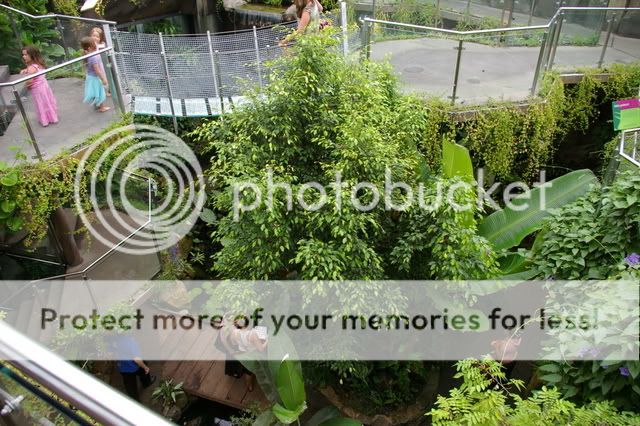
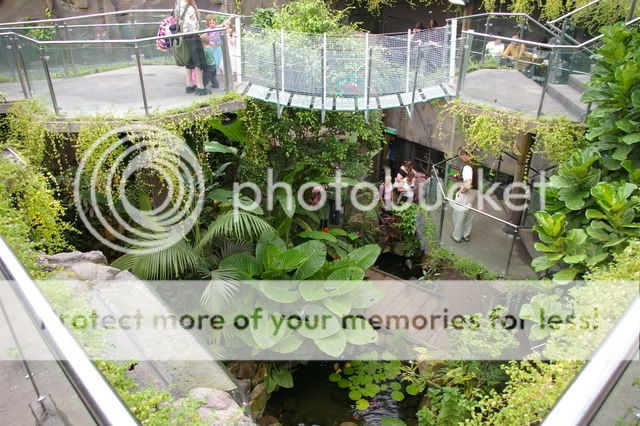
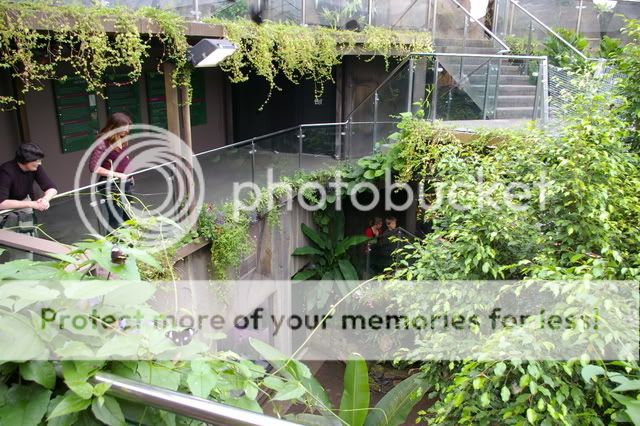
Otago Museum's "Discovery World, Tropical Forest" opened in November 2007, and I went down to see it in December, so I thought I'd just post a bit about it. Compared to some of the overseas ones its not spectacular but it is one of the two largest in NZ. I didn't actually get a lot of time to look around because I was talking for about two hours to Scott Kerr who set it up (he'd been through "my" Aquarium a few times getting advice in preparation); so I basically ran round for ten minutes taking photos before we had to go. My girlfriend had lots of time to herself though! The house is about 12.5 metres high (three stories). I'd variously heard that it's the largest butterfly house in NZ, Australasia, or the Southern Hemisphere (its one of those Chinese whispers things). Scott said he'd compared the size with Butterfly Creek in Auckland and the area is about the same, but the Otago one is much higher. I also asked him about what I'd heard about them not being allowed to breed the butterflies, instead having to import them all as chrysalises. Turns out they are allowed to breed them so long as its not in the public area, but they really can't feasibly do it because of the amount of food-plants they would need. So while they do have a few caterpillars on show, basically all the chrysalises are imported from the Phillipines and Costa Rica (and the butterflies only live for a few days to a few weeks, depending on species, so you can imagine the continual stream of imports that would be needed). The chrysalises are on display in a glass-fronted cabinet so you can watch the butterflies emerging. They have around 1000 butterflies and moths of 60 species.
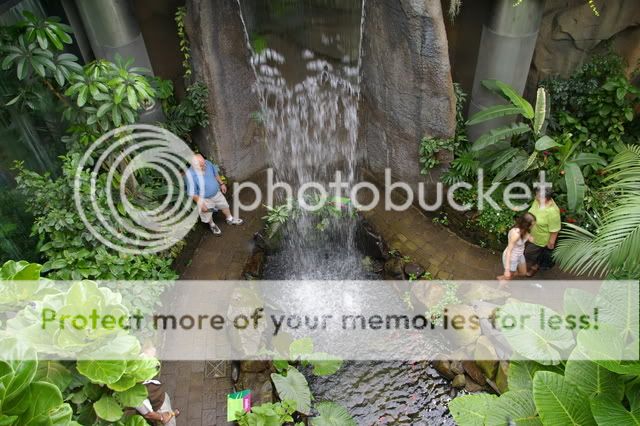
Apart for the butterflies there are also three tarantula tanks, a pool for goldfish and red-eared turtles, and zebra finches and quail. He only has goldfish because the pool loses all its heat into the ground (I suggested he gets a pond heater for it so he can have more interesting fish; he doesn't appear to have actually considered this before). He'd also like to get more exotic birds and some reptiles, including having free-range Madagascar day geckoes which I tried to dissuade him from (they wouldn't last more than a couple of days before leaving in some dishonest person's bag).
The house isn't funded by the council as the Museum itself is, so it has to pay its own way (entry $9.50). After three years they're going to review its performance and if it isn't doing well its going to be terminated. Hopefully that won't happen. Eighty percent of the museum's visitors are locals which is why they are trying to keep the price low to encourage return visits, but I suspect there will be an increase in tourist numbers just to see the butterflies. Totally recommend a visit if you're in Dunedin.
Apart for the butterflies there are also three tarantula tanks, a pool for goldfish and red-eared turtles, and zebra finches and quail. He only has goldfish because the pool loses all its heat into the ground (I suggested he gets a pond heater for it so he can have more interesting fish; he doesn't appear to have actually considered this before). He'd also like to get more exotic birds and some reptiles, including having free-range Madagascar day geckoes which I tried to dissuade him from (they wouldn't last more than a couple of days before leaving in some dishonest person's bag).
The house isn't funded by the council as the Museum itself is, so it has to pay its own way (entry $9.50). After three years they're going to review its performance and if it isn't doing well its going to be terminated. Hopefully that won't happen. Eighty percent of the museum's visitors are locals which is why they are trying to keep the price low to encourage return visits, but I suspect there will be an increase in tourist numbers just to see the butterflies. Totally recommend a visit if you're in Dunedin.


 )
)
 )
)