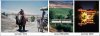
Wild World of Animals - 1972
I just bought the first edition of the San Diego Wild Animal Park's 'Wild World of Animals', the glossy softcover guidebook from the first year of the park's public opening. I had the 1979 edition for years but it disappeared some years ago. I had read it so many times when I was young that this similar edition is a delight to learn about the earlier appearance and differences in those 7 years, although the text is nearly identical.
One major difference was how limited the initial offerings were in Nairobi Village. All three show amphitheaters did not exist, although the one near the administration building was listed as 'future amphitheater'. In fact, there was no Kilimanjaro Trail and thus no access to the areas that would eventually have the bird show and the elephant show. Therefore there was no pedestrian access to the two elephant exhibits, the lion exhibit, or the East Africa exhibit (sound familiar, Disney's Animal Kingdom?) It appears that visitors were confined to the upper hillside and could not descend down to where many features would eventually be built.
So what was there in Nairobi Village initially? The guide map in this book appears to show a complete listing. I'll describe it from the park entrance and go clockwise around Mombasa Lagoon. The Entry Rondavel was nearly the same as it is today, and the entry path immediately entered the Aviary (it was not designated specifically as an African aviary on the map). The map does not show an alternate route to going through the aviary; I seem to remember one on the side for those that did not want to go through it? The current aviary called Wings of the World is a rebuilt one to the side of the same location as this original one, providing the main pedestrian route with a bird-free experience. There were no Safari Outfitters or Nairobi Plant Trader shops. After exiting the aviary, there was a small pond for lesser flamingo, and a larger one for pelican (unidentified species), in the same locations as the present, at the headwaters of the Congo River Fishing Camp. Also a small stage next to the walkway for 'informal shows' now called Animal Ambassador Stage. To the North of these was a toucan exhibit (unidentified species) in a connected series of tall hexagonal wire cages; I seem to remember this exhibit housing spot-nosed guenons in the 1980's. Also here were the restrooms, Administration Building, and Simba Station for boarding the Wgasa Bush Line - all still there but of course the monorail does not exist anymore and the Administration is now called Ranger Base. There was no Carousel or Hunte Pavilion. The connected Thorntree Terrace (restaurant) and Bazaar (main shop) were just as they are today, but the small island exhibit for primates was for spider monkey (it looks like it is for cotton-top tamarin now?) The location of the current meerkat exhibit was occupied by one for Galapagos tortoise. Incredibly, the small exhibit space on the edge of Mombasa Lagoon that has held babirusa and others was originally an exhibit for black rhinoceros! No aviary for bee-eaters or hornbills was there. Where today it appears there are small open exhibits for red river hog and wallaby, there was one larger exhibit for 'hooved animals' although no species were identified; I specifically remember that area divided into two exhibits in the 1980's with slender-horned gazelle and Kirk's dik-dik. The ring-tailed lemur exhibit on the small island in the lagoon was original and lasted for years; the current map does not show anything on the island, has it been abandoned? The Animal Care Center and Kraal were also there, much as they are today (now designated as Nairobi Station, Nairobi Nursery, and Petting Kraal). The current location of the Rodrigues fruit bat exhibit and Jungle Ropes Safari was originally a picnic area, observation point (apparently as close as a pedestrian could get to the field exhibits), and the unloading dock for the Wgasa Bush Line. A planted area next to Mombasa Cooker was the Elephant Wash, where Asian elephants would be walked up the hill from their exhibit and bathed in a pool with a sloping floor, at the time when there was no elephant show for the public to get closer to the elephants. Next to this was a greater flamingo exhibit on the edge of the lagoon, but no island for shoebill as exists today. Mombasa Cooker and the Clock Tower were original features, but not the Mombasa Pavilion next to them (there were play structures there). An exhibit that was gone by the 1980's was near the Clock Tower: one for desert lizards, although none were identified on the map. There was also a tall round structure composed of upright poles that could be entered and it was a green iguana exhibit. I seem to remember this as having been incorporated as the entrance to the Tropical America Aviary by 1980 (it was a large walk-through experience with birds as well as squirrel monkeys and brocket deer and iguanas and turtles), if it is still there it is part of either Lorikeet Landing or Hidden Jungle. They were not there, nor were the small hornbill aviaries, the aviary with the ramp spiraling around it, or the other features down the hill: the elevator, the Benbough Amphitheater for the bird show, the large gibbon exhibit (wich was occupied for many years by Hanuman langur), or the Samburu Terrace restaurant and Jungle Gym. Next to the Green Iguana Exhibit was an elephant ride. The gorilla exhibit was essentially the same as it is today, removed from the rest of the village by being located along a path that went under the track of the monorail. After the gorilla exhibit, the path dead-ended at a Komodo dragon exhibit which must have been removed for continuing the path to the bird show and Kilimanjaro Trail once those were constructed in the early years.
So what exhibits were seen from the 55-minute tour on the Wgasa Bush Line Monorail initially? This book has a separate map that shows them; there were fewer exhibits, but the main 5 as well as 3 smaller ones seen first were in place from opening day. The first seen was the Asian elephant exhibit (now part of the enlarged African elephant exhibit) on the right of the monorail route and African elephant on the left. Then the lion exhibit on the left was seen (there was no tiger exhibit on the right of the monorail opposite the lions, instead there was the first view of the Eastern Africa Exhibit). 4 of the 5 main exhibits were seen on the right of the monorail, while only the smallest one (North Africa) was on the left. The order of encountering them - some multiple times from different sides - was: Eastern Africa, Asian Plains, Eastern Africa, North Africa, Southern Africa, Asian Swamps (later renamed Asian Waterhole), Southern Africa, and Eastern Africa. The gorilla exhibit in Nairobi Village was also seen from the monorail at the end of the tour (again, on the right side!). According to this map, later exhibits built on the left side (rising up the hills from the track) did not exist initially, including exhibits for Grevy's zebra, kiang, onager, Somali wild ass, Arabian oryx, the Mountain Habitat (for multiple goat and sheep species), Przewalski's wild horse, mandrill (later bonobo), gerenuk, and okapi. Unfortunately, the text of the book did not describe what species were held in which enclosures; instead, it had two generalized sections about the wildlife of Africa and Asia, but these sections were illustrated with pictures of animals in the exhibits. Therefore I will list all the animals pictured in these sections, with the assumption that it will give a good picture of what was held there at the time.
Africa is illustrated with pictures of:
African elephant (known to be in their own exhibit)
African lion (known to be in their own exhibit)
Cheetah (they must have been off-exhibit but present somewhere on site)
And the following were exhibited in one of the 3 major exhibits for Africa, either North Africa or Eastern Africa or Southern Africa:
White rhinoceros
Black rhinoceros
Giraffe
Cape buffalo (picture looks like forest buffalo)
Sable Antelope
Southern Eland
Impala
Uganda kob
Greater kudu
Roosevelt's gazelle
Slender-horned gazelle
Springbok
Fringe-eared oryx
Gemsbok
Ellipsen waterbuck
Topi
Cape hartebeest
White-bearded gnu
White-tailed gnu
Sitatunga
Lowland nyala
Red lechwe
Grant's zebra
Grevy's zebra
Hartmann's mountain zebra
Ostrich
Secretary bird
Marabou stork
Demoiselle crane
Asia is illustrated with pictures of:
(these must have been exhibited in either Asian Plains or Asian Swamps):
Water Buffalo
Gaur
Nilgai
Saiga
Blackbuck
Pere David's deer
Axis deer
Sambar deer
Formosan sika deer
Hog deer
Himilayan tahr
Adjutant stork
Sarus crane
Hooded crane