ZooChat Big Year 2013

Status
Not open for further replies.
Update

212) Caspian Tern
213) Blue-headed Vireo
214) Veery
215) Northern Waterthrush
216) Nashville Warbler
217) Black Vulture
218) Forster's Tern
219) Ruby-throated Hummingbird
220) White-eyed Vireo
221) Yellow-throated Vireo
222) American Redstart
223) Yellow-breasted Chat
224) Dickcissel
225) Bobolink
226) Blue Grosbeak
227) Western Kingbird
228) Kentucky Warbler
229) Chestnut-sided Warbler
230) Least Flycatcher
231) Philadelphia Vireo
232) Ovenbird
233) Clay-colored Sparrow
234) Dunlin
235) Gray-cheeked Thrush
236) Magnolia Warbler
237) Common Nighawk
238) Blackpoll Warbler
239) Sora
240) Blackburnian Warbler
241) Yellow-headed Blackbird
242) Ring-necked Pheasant
243) Black Tern
244) Stilt Sandpiper
245) Black-headed Grosbeak
246) Black-billed Magpie
247) Black-bellied Plover
248) Semipalmated Plover
249) Sanderling
250) Short-billed Dowitcher
251) Laughing Gull
252) Bell's Vireo
253) Common Tern
254) Say's Phoebe
255) Ruddy Turnstone
 
84. Eastern spine bill [At home! Melbourne suburb]

85. Blue-billed Duck
86. Freckled Duck
87. Northern Mallard
88. Australasian Shoveler
89. Hardhead
90. Pink-eared Duck
91. Great Egret
92. Intermediate Egret
93. White-plumed Honeyeater

All birds were recorded at Mill Park Lakes, South Morang, Victoria, Australia. This is a wetlands with some man-made lakes too, all surrounded by posh houses. There are LOTS of waterfowl here.

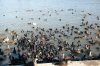
How many species can you identify in the attached pic taken when locals decided to feed them? PS* What's the white bird? Albino northern mallard? Domestic goose?
 

Attachments

  • lots of birds.jpg
    lots of birds.jpg
    597.8 KB · Views: 19
Black Swan
Mallard
Dusky Moorhen
Eurasian Coot
Pacific Black Duck
Hardhead
And at least 1 I dont recognize
 
Black Swan
Mallard
Dusky Moorhen
Eurasian Coot
Pacific Black Duck
Hardhead
And at least 1 I dont recognize

Not bad!

I still don't know what the white one is, and if you look carefully at the top of the pic, there is a brownish duck with a white ring on its neck. It could be a hybrid, but again, I don't know for sure.
 
Not bad!

I still don't know what the white one is, and if you look carefully at the top of the pic, there is a brownish duck with a white ring on its neck. It could be a hybrid, but again, I don't know for sure.

There is one just to the upper right of the thickest concentration of coots...sort of like an all black seabird.
 
Birds
133. Common house martin
134. Garden warbler

Repiles + Amphibians:
11. Common midwife toad
12. Yellow bellied toad
13. Common wall lizard

Further many many new plant species, including the first flowering orchids of the year :)

Birds:
135. Wood owl (finally...)

Mammals:
17. Nathusii's pipistrelle

Reptiles + Amphibians:
14. Alpine newt

@KCZoofan, you're going fast! How many species are your target? I am still planning to beat you :p but that is getting more and more difficult, altough I will cheat by visiting Bulgaria, the Spanish pyrenees and Madagascar this year :P.
 
@KCZoofan, you're going fast! How many species are your target? I am still planning to beat you :p but that is getting more and more difficult, altough I will cheat by visiting Bulgaria, the Spanish pyrenees and Madagascar this year :P.

That's not cheating! I wish I could have made an overseas trip to add to my list too. :)
 
The white bird is a domestic duck of some variety. I thought I saw a grey teal at the back but can't be sure. The brown one certainly looks like a hybrid - mallards and black ducks are known to hybridise (as do black ducks and grey teal). However, it could actually be two birds side-by-side, the one closest to us with it's head under water.

As for the all-black bird, I don't know what that is but I don't think it's a coot because the primaries are way too long.

:p

Hix
 
The white bird is a domestic duck of some variety. I thought I saw a grey teal at the back but can't be sure. The brown one certainly looks like a hybrid - mallards and black ducks are known to hybridise (as do black ducks and grey teal). However, it could actually be two birds side-by-side, the one closest to us with it's head under water.

As for the all-black bird, I don't know what that is but I don't think it's a coot because the primaries are way too long.

:p

Hix

So it seems like this hybridisation isn't as widespread in Australia as in New Zealand, where the pure grey ducks (= Pacific black ducks) have been all but extirpated by the mallards/hybrid population. Any ideas as to why this has been so much worse on one side of the Tasman than the other?
 
@KCZoofan, you're going fast! How many species are your target? I am still planning to beat you :p but that is getting more and more difficult, altough I will cheat by visiting Bulgaria, the Spanish pyrenees and Madagascar this year :P.


My goal is to break 280 in the state of Kansas. 308 overall is a secondary goal. I am sure you will surpass me.
 
So it seems like this hybridisation isn't as widespread in Australia as in New Zealand, where the pure grey ducks (= Pacific black ducks) have been all but extirpated by the mallards/hybrid population. Any ideas as to why this has been so much worse on one side of the Tasman than the other?

Mallards are much more common in NZ, as I remember. It's very rare I see a mallard in Australia, and I haven't seen any this year despite visiting lots of bodies of water housing a variety of waterfowl.

Black Ducks, on the other hand, I see pretty much everywhere I go, and in large numbers.
 
165 Mississippi Kite - Ictinia mississippiensis
166 Great Crested Flycatcher - Myiarchus crinitus
167 Clay-colored Sparrow - Spizella pallida
168 Lark Sparrow - Chondestes grammacus
169 Orchard Oriole - Icterus spurius
170 Tricolored Heron - Egretta tricolor
171 Eastern Wood-Pewee - Contopus virens
172 Upland Sandpiper - Bartramia longicauda
 
136. European reed warbler
137. Sedge warbler
138. Marsh warbler
139. Nightingale
140. European turtle dove
141. Eurasian dotterel (lifer, very nice birds!)
 
HOKITIKA (5 May)
36) NZ pipit Anthus novaeseelandiae

CHRISTCHURCH (5 May)
37) European goldfinch Carduelis carduelis
38) Feral pigeon Columba livia
39) White-faced heron Ardea novaehollandiae
40) Royal spoonbill Platalea regia
41) Caspian tern Sterna caspia
42) Pied shag Phalacrocorax varius
43) Little black shag Phalacrocorax sulcirostris
44) Grey teal Anas gracilis
45) Sacred kingfisher Todiramphus sanctus
46) Canada goose Branta canadensis
47) Australasian brown bittern Botaurus poiciloptilus
48) Pied stilt Himantopus leucocephalus
49) Bar-tailed godwit Limosa lapponica
50) Common coot Fulica atra
51) European greenfinch Carduelis chloris
52) Hedge sparrow (Dunnock) Prunella modularis

AUCKLAND (7-8 May)
53) Common mynah Acridotheres tristis
54) Australasian gannet Morus serrator
55) Buller’s shearwater Puffinus bulleri
56) Fluttering shearwater Puffinus gavia
57) Flesh-footed shearwater Puffinus carneipes
58) Grey-faced petrel Pterodroma macroptera
59) Common diving petrel Pelecanoides urinatrix
60) Whitehead Mohoua albicilla
61) Red-crowned kakariki Cyanoramphus novaezelandiae
62) Stitchbird Notiomystis cincta
63) NZ robin Petroica australis
64) Australian brown quail Coturnix ypsilophora
65) Saddleback Philesturnus carunculatus
66) Little blue penguin Eudyptula minor
67) Eastern rosella Platycercus eximius
68) Morepork Ninox novaeseelandiae
69) NZ pigeon Hemiphaga novaeseelandiae

SAMOA (9-15 May)
70) Jungle mynah Acridotheres fuscus
71) Red-vented bulbul Pycnonotus cafer
72) Polynesian triller Lalage maculosa
73) Wandering tattler Heterosceles incanus
74) Banded rail Gallirallus philippensis
75) Polynesian starling Aplonis tabuensis
76) Samoan starling Aplonis atrifusca
77) Crimson-crowned fruit dove Ptilinopus porphyraceus
78) White-tailed tropicbird Phaethon lepturus

79) Wattled honeyeater Foulehaio carunculata
80) White tern Gygis alba
81) Samoan whistler Pachycephala flavifrons

82) White-throated pigeon Columba vitiensis
83) White-rumped swiftlet Aerodramus spodiopygius
84) Samoan fantail Rhipidura nebulosa
85) Cardinal honeyeater Myzomela cardinalis

86) Pacific robin Petroica multicolor
87) Flat-billed kingfisher Todiramphus recurvirostris
88) Samoan broadbill flycatcher Myiagra albiventris

89) Pacific golden plover Pluvialis fulva
90) Mao Gymnomyza samoensis
91) Pacific imperial pigeon Ducula pacifica

92) Eastern reef heron Egretta sacra
93) Brown noddy Anous stolidus
94) Brown booby Sula leucogaster


AUCKLAND (17 May)
95) Wrybill Anarhynchus frontalis
96) Spotted dove Streptopelia chinensis
97) NZ dotterel Charadrius obscurus
98) NZ dabchick Poliocephalus rufopectus
99) Black-fronted dotterel Elseyornis melanops
100) Little egret Egretta garzetta [new for NZ list]
101) Little tern Sterna albifrons

KAIKOURA (19-20 May)
102) Cape Barren goose Cereopsis novaehollandiae
103) Northern giant petrel Macronectes halli
104) Gibson’s albatross Diomedea gibsoni
105) Southern Buller’s albatross Thalassarche bulleri
106) Cape petrel Daption capense
107) Black-browed albatross Thalassarche melanophrys
108) Westland black petrel Procellaria westlandica
109) Short-tailed shearwater Puffinus tenuirostris
110) NZ white-capped albatross Thalassarche steadi
111) Black-fronted tern Chlidonias albostriata
112) Hutton’s shearwater Puffinus huttoni
113) Southern royal albatross Diomedea epomophora
114) Northern royal albatross Diomedea sanfordi
115) Salvin’s albatross Thalassarche salvini

ARTHURS PASS (21 May)
116) NZ tomtit Petroica macrocephala
117) Kea Nestor notabilis
118) Grey duck (Pacific black duck) Anas superciliosa
119) Blue duck Hymenolaimus malacorhynchus
120) Brown creeper Mohoua novaeseelandiae
121) Rifleman Acanthisitta chloris


MAMMALS:

2) Short-beaked common dolphin Delphinus delphis – Hauraki Gulf, NZ, 7 May
3) Samoan flying fox Pteropus samoensis – Samoa, 10 May
4) NZ fur seal Arctocephalus forsteri – Kaikoura, NZ, 19 May
5) Hector’s dolphin Cephalorhynchus hectori – Kaikoura, NZ, 20 May
6) Chamois Rupicapra rupicapra – Arthurs Pass, NZ, 21 May
 
93) Brown noddy Anous stolidus
94) Brown booby Sula leucogaster

Some very nice species there Chlidonias, I have always wanted to see frigatebirds, boobies and nodies, they seem very interesting, and I am hoping I will get to see some in the near-ish future.

Are there no NZ pigeons in Hokitika? Or are they rare there? I'm surprised you first saw one in Auckland, I assumed they were common everywhere.

Where did you see Cape Barren Geese in Kaikoura specifically? I didn't realise they had established populations in NZ.
 
Status
Not open for further replies.
Back
Top