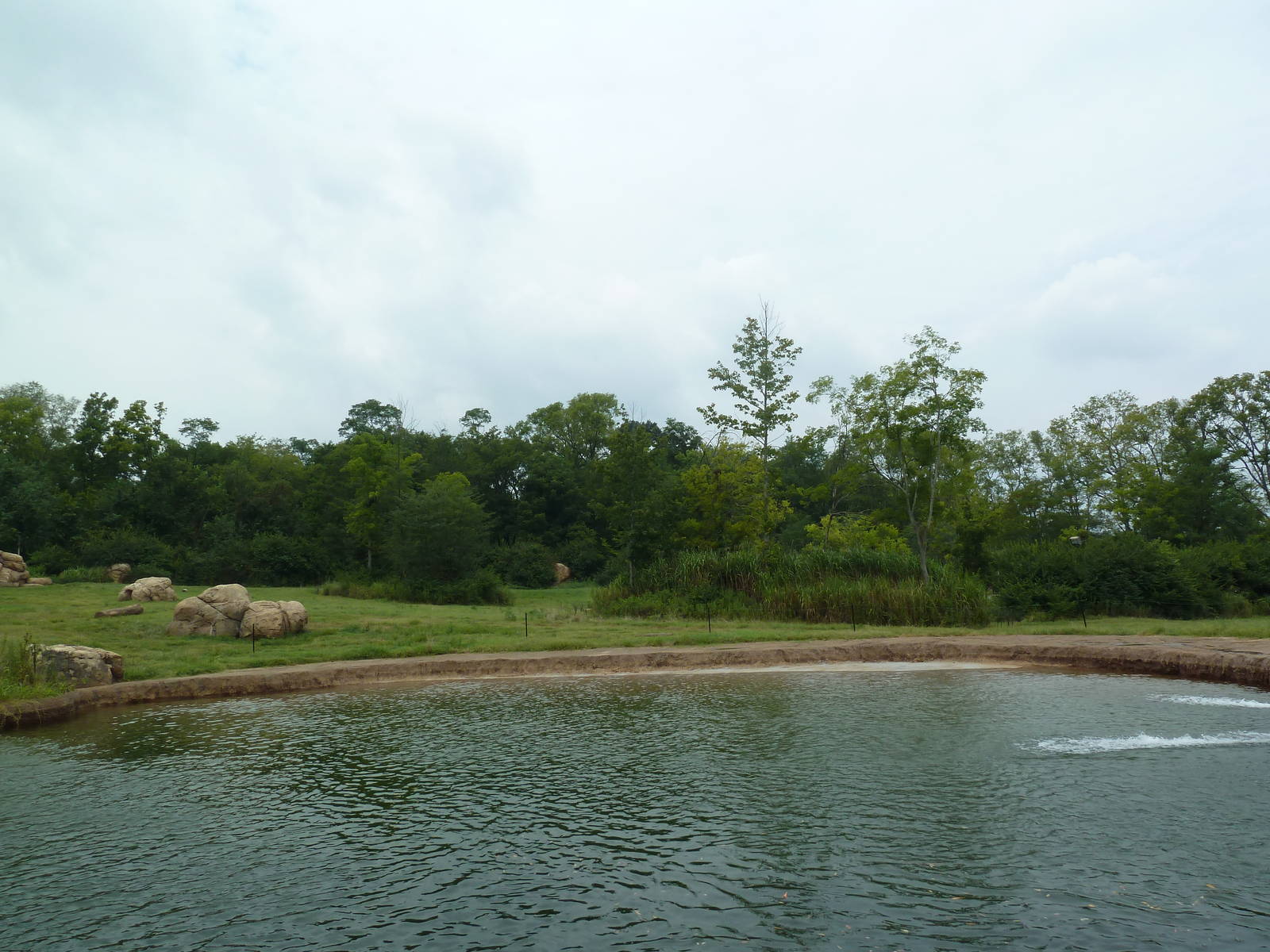
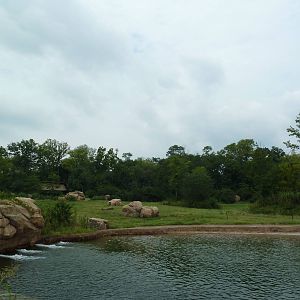
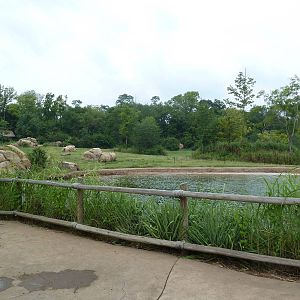
One of the most impressive aspects of this 3-acre habitat (which I believe is currently home to 4 female elephants) is that the sightlines are outstanding. There aren't any conspicuous buildings in the background, there isn't anything unnatural and downright ugly (like San Diego's awful-looking utilitrees) and the dense undergrowth in the distance probably hides a lot of maintenance structures. No wonder this is considered by many to be one of the 3 greatest elephant exhibits in North America, along with North Carolina and Dallas.
One of the most impressive aspects of this 3-acre habitat (which I believe is currently home to 4 female elephants) is that the sightlines are outstanding. There aren't any conspicuous buildings in the background, there isn't anything unnatural and downright ugly (like San Diego's awful-looking utilitrees) and the dense undergrowth in the distance probably hides a lot of maintenance structures. No wonder this is considered by many to be one of the 3 greatest elephant exhibits in North America, along with North Carolina and Dallas.
@snowleopard and whoever else wants to chime in: How would you define "greatness" for elephant exhibits? Are you mainly defining it in aesthetic terms like lack of visible infrastructure? Is it aesthetics that makes Dallas, North Carolina, and Memphis the greatest in your opinion? Why would DAK not be on this list if aesthetics are your definition of elephant exhibit greatness...lack of opportunities for visitor choice in how long to view the elephants?
I would define elephant exhibit quality by welfare of the animals and the quality of how the visitor experience in appreciating and enjoying elephants.
Aesthetics are certainly part of how I would evaluate the visitor experience, but I wonder how important this is overall? It seems to me that opportunities to watch the elephants "be elephants" and how this is interpreted to visitors through graphics, keeper demonstrations and talks, etc. are important also and by this measure I would judge LA, Smithsonian National Zoo, Oakland, and maybe the San Diego Safari Park to have excellent exhibits...I haven't yet seen Dallas, Nashville, or North Carolina's exhibits, but how would you compare them based on elephant interpretation? I would assume that they all of these facilities have consistent (and thus equivalent) excellent qualities of elephant care (although someone please chime in if you have thoughts about this).
Aesthetics are important when it comes to comparison of elephant exhibits, as Nashville's beautiful habitat might have visitors conjure up images of Africa, conservation efforts on the "dark continent", or simply enable people to discuss elephants in the wild. San Diego Zoo's Elephant Odyssey barn is a massive steel structure that is all harsh metal with few soft edges. Aesthetics therefore come into reckoning when debating the worth of an elephant exhibit because feedback from visitors will be much more positive if an exhibit is aesthetically appealing. A study was done 20 years ago at Melbourne Zoo in Australia once the gorillas were moved out of their outdated enclosure and into their new, lush, jungle environment and the response via a visitor survey was astonishing. The exact same animals were now viewed in a positive manner rather than with disparaging, demeaning comments.
However, of course animal welfare and the size and scope of an exhibit is vitally important and I get the impression that Disney's 9.5 acre habitat is simply briliant for the animals. For visitors it is incredibly disappointing as I saw elephants for around 60 seconds on each of my safari rides when I visited the park in late 2008. How on earth can the zoo get people to study elephants when the viewing opportunities are anywhere from 45 seconds to perhaps 3 minutes?
I give kudos to zoos such as Dallas and Birmingham (and Kolmarden Zoo in Sweden has achieved this in spectacular fashion for decades) that have incorporated a variety of birds and hoofstock in with the elephants. It seems as if that is perhaps the next step in the evolution of elephant habitats in zoos. Underwater viewing (such as the pool at Leipzig Zoo in Germany) could also be a future consideration for zoos with the finances to afford such additions.
Aesthetics are important when it comes to comparison of elephant exhibits, as Nashville's beautiful habitat might have visitors conjure up images of Africa, conservation efforts on the "dark continent", or simply enable people to discuss elephants in the wild. San Diego Zoo's Elephant Odyssey barn is a massive steel structure that is all harsh metal with few soft edges. Aesthetics therefore come into reckoning when debating the worth of an elephant exhibit because feedback from visitors will be much more positive if an exhibit is aesthetically appealing. A study was done 20 years ago at Melbourne Zoo in Australia once the gorillas were moved out of their outdated enclosure and into their new, lush, jungle environment and the response via a visitor survey was astonishing. The exact same animals were now viewed in a positive manner rather than with disparaging, demeaning comments.
It would be really interesting to actually measure how elephant exhibit aesthetics affect visitor appreciation of elephants. Do people really appreciate the elephants in Dallas more than they do at San Diego? I wonder how you would measure this or if anyone has tried?
I have tried to find a copy of the Melbourne gorilla study and have not tracked one down. Does anybody out there have a copy that you would be willing to share?
David Hancocks discusses the Melbourne Zoo gorilla habitat in his 2001 book "A Different Nature: The Paradoxical World of Zoos and Their Uncertain Future". On page 144 he writes "survey at Melbourne Zoo in which visitors were asked to select from a list of adjectives to describe gorillas. The first part of the 1988 survey documented responses to seeing gorillas in an exhibit that was essentially a concrete pit and typical of most zoo exhibits until recent times. Predominantly, people chose negative words - 'vicious, ugly, boring and stupid'. Two years later, after the gorillas had been relocated to a large, naturalistic exhibition habitat that replicated the African rain forest, visitors had completely opposite responses, selecting adjectives such as 'fascinating, peaceful, fantastic and powerful'. Unless they are being exposed to extremes of horror or wonder many zoo visitors assess the exhibits and their own relationships to the designed environments only subconsciously. It is for this reason, ironically, that attention to precise detail is essential."
Getting back to elephants, there is a reason why major zoos around the world have been spending tens of millions of dollars on shiny new elephant exhibits. Allocating space to the world's largest land mammal is a major component, but creating modern, naturalistic environments that will appeal to both humans and elephants is a vital necessity as well. When I personally have seen elephants in zoos in Baton Rouge, Audubon or Louisville my first thought is something like this: "those poor bastards are in a small, ugly exhibit". When I've seen elephants in zoos such as Nashville, North Carolina or Dallas my response is quite different and much more positive. On the other hand I believe that there are thousands of people who visit zoos who simply want to see elephants and for the most part don't think too critically about the exhibit that contains the pachyderms, but perhaps on a subconscious level there are question marks that poor zoos never truly answer. Elephants in some type of top-notch habitat in a zoo is a positive thing and can only create a positive aura no matter who the zoo visitor is.
Getting back to elephants, there is a reason why major zoos around the world have been spending tens of millions of dollars on shiny new elephant exhibits. Allocating space to the world's largest land mammal is a major component, but creating modern, naturalistic environments that will appeal to both humans and elephants is a vital necessity as well. When I personally have seen elephants in zoos in Baton Rouge, Audubon or Louisville my first thought is something like this: "those poor bastards are in a small, ugly exhibit". When I've seen elephants in zoos such as Nashville, North Carolina or Dallas my response is quite different and much more positive. On the other hand I believe that there are thousands of people who visit zoos who simply want to see elephants and for the most part don't think too critically about the exhibit that contains the pachyderms, but perhaps on a subconscious level there are question marks that poor zoos never truly answer. Elephants in some type of top-notch habitat in a zoo is a positive thing and can only create a positive aura no matter who the zoo visitor is.
I think that generally we are in complete agreement about things on principle of why better elephant (and zoo exhibits in general) are needed.
When it comes to elephants my question is whether new elephant exhibits like LA or Smithsonian National's are as great as Dallas and Nashville if they are helping people appreciate elephants meaningfully.
"Modern" and "naturalistic" don't seem to be synonymous with elephant exhibits as they are for other species, perhaps because of the massive infrastructure needed to adequately house the species. Most zoos don't have elephant family structures that replicate wild elephant social dynamics the way that many zoos DO have troops of gorillas or chimps in at least a semi-replication of their natural family groups (San Diego Safari Park and DAK being exceptions). So the way that the question of how to meaningfully display elephants in zoos seems different than for how gorilla, tiger, hippo, etc. exhibits can be built that DO capture these species in a naturalistic way.
You bring up a good point and so I checked online and was surprised at what I found. The city of Nashville has extremely hot summers, and in fact 7 months of the year the average temperature is 22 degrees Celsius or hotter (peaking at 32 degrees Celsius in July and August). The two coldest months of the year are December and January but even then the average temperature is between 8-11 degrees Celsius. I'm sure that with only 4 elephants on 3 acres the habitat stays fairly green year-round, and the average snowfall is only 15 cm (5.8 inches) so the elephants there have a much better climate to deal with than elephants in places in Canada like Calgary and Edmonton.
Coincidentally the North Carolina Zoo in Asheboro, North Carolina, has about 6-7 elephants on 7 acres in an equally spectacular exhibit. The temperature in Asheboro is almost identical to the year-round numbers that I provided from Nashville. Along with zoos like Disney's Animal Kingdom, Dallas, Oakland, Oklahoma City and San Diego Zoo Safari Park one could argue that all of the biggest and best elephant exhibits in North American zoos are found in the southern half of the United States where the elephants have year-round access to the great outdoors.