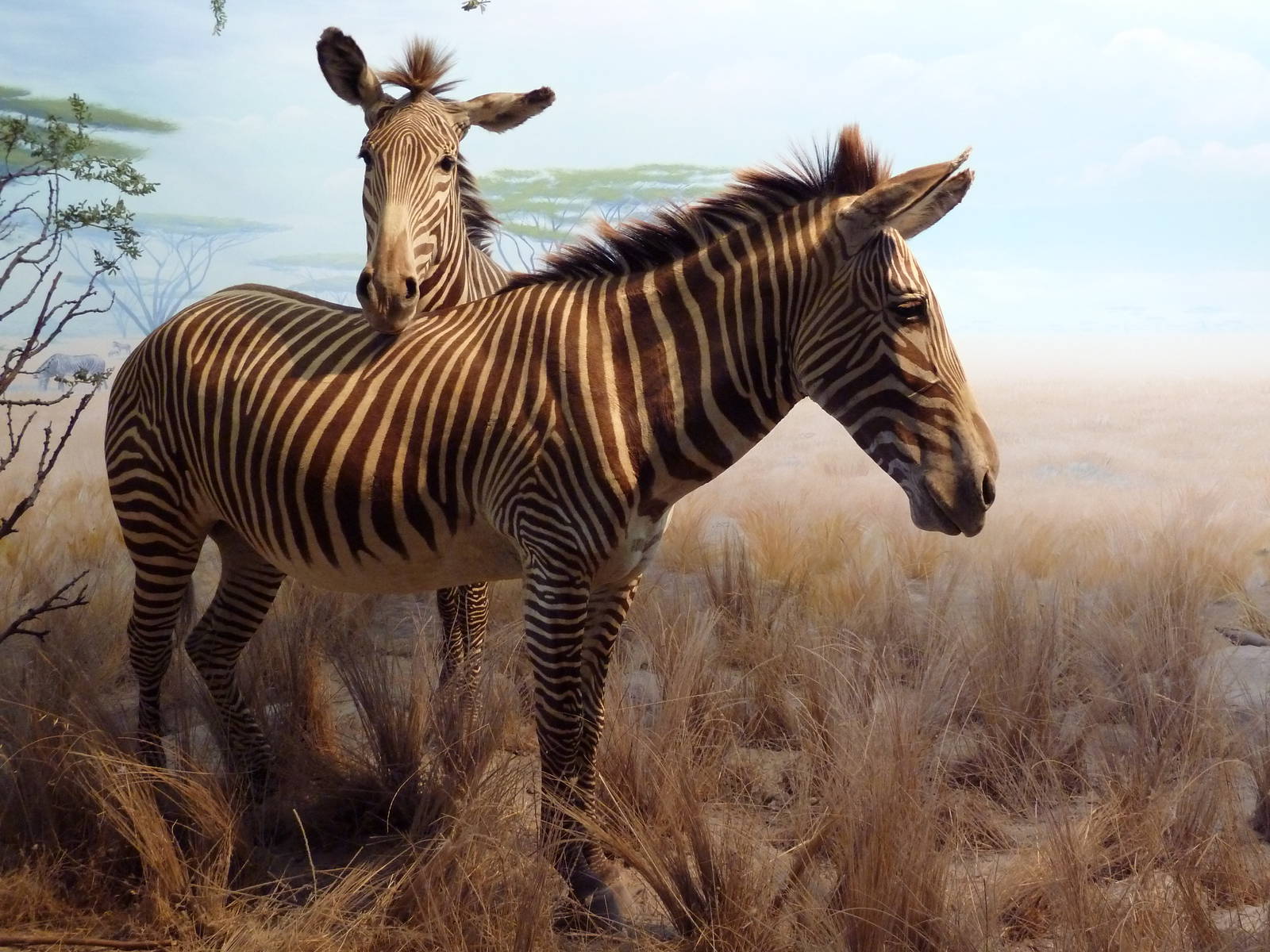
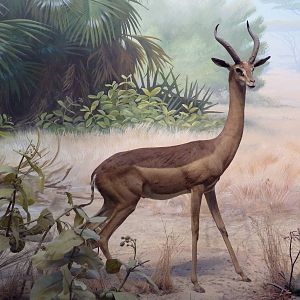
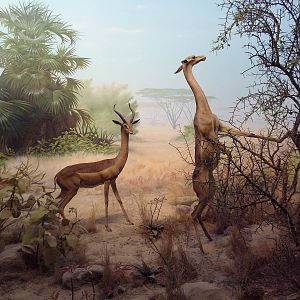
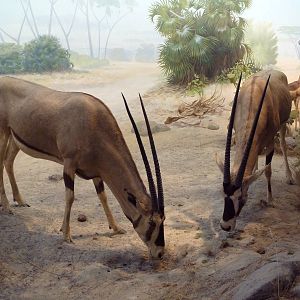
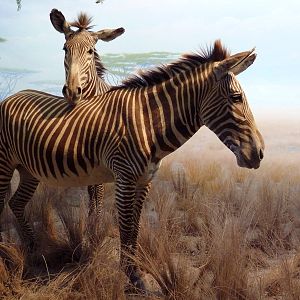
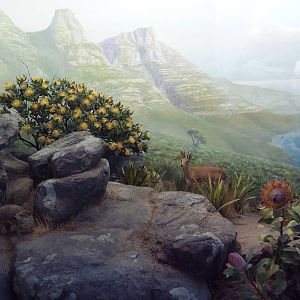
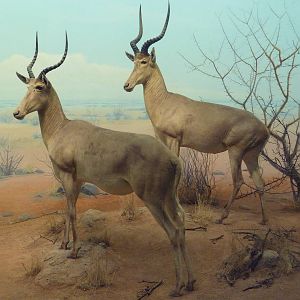
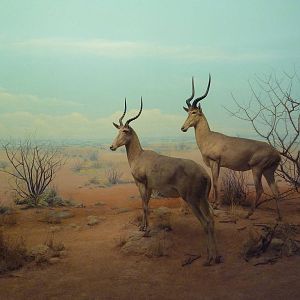
Did you see the video projection of the elephant herd walking along the back of this diorama? I think this is one of the coolest tricks that I have seen in a museum diorama.
Dioramas like these may have been the original natural immersion exhibits; the difference from zoo immersion exhibits being obviously that everything is dead.
The Africa Hall is pretty much a direct reproduction of the prior Academy building which was torn down to build the new one. One major change was that the large exhibit at the end of the Africa Hall was a diorama of an African waterhole with the giraffes that are now out in the main museum hall. This space is now occupied by the black-footed penguins.
Coincidentally last night I uploaded some pictures of the LA County Natural History museum's Africa Hall if you are interested. They are in the "Natural History Museum of Los Angeles County" gallery.
While this diorama style was certainly the antecedent of the "natural habitat" exhibit concept in zoos, it cannot be said that these set pieces--viewed through glass from an architectural hallway--were "immersion" exhibits. A primary characteristic of what has been labeled "immersion" is the extension of the animal exhibit replicated habitat into and surrounding the visitor's space--to put the observer in the scene.
Interestingly, at the old Cal Academy, the waterholes diorama you refer to was modified in the 1980s to be more immersive: the glass was removed and savanna habitat elements were built out into the public gallery, so viewers walked "into" the habitat. They also added an ambient environmental soundtrack, adding to a sense of "being there.". It was quite nice, but seemed to me to be a case of a natural history museum "borrowing" an idea then emerging in zoos.
@reduakari: this is really interesting. What would you say were the origins of immersion exhibits in zoos? What were the original influences and inspirations? I know that Jones and Jones and the Woodland Park Zoo's gorilla and African savanna exhibits are often cited as the origin point for the "immersion school", but what inspirations fed the people who invented those exhibits? Is there a history of this written down somewhere in a book or web article?
Do you think that the African halls in natural history museums that guys like Carl Akeley created had any influence?
While this diorama style was certainly the antecedent of the "natural habitat" exhibit concept in zoos, it cannot be said that these set pieces--viewed through glass from an architectural hallway--were "immersion" exhibits. A primary characteristic of what has been labeled "immersion" is the extension of the animal exhibit replicated habitat into and surrounding the visitor's space--to put the observer in the scene.
Interestingly, at the old Cal Academy, the waterholes diorama you refer to was modified in the 1980s to be more immersive: the glass was removed and savanna habitat elements were built out into the public gallery, so viewers walked "into" the habitat. They also added an ambient environmental soundtrack, adding to a sense of "being there.". It was quite nice, but seemed to me to be a case of a natural history museum "borrowing" an idea then emerging in zoos.
The 1976 Woodland Park Zoo master plan, developed by Jones and Jones and the zoo's director David Hancocks, coined the term "landscape immersion.". It was a very important document in the evolution of zoo design, well worth a read if you can find a copy. More is written about landscape immersion in Hancocks' 2001 book "A Different Nature", also a good read if a bit self-referential.
The impulse behind Akeley's dioramas is reflected in Hagenbeck's revolutionary approach to zoo exhibits, and all of the subsequent refinements of the concept of displaying animals in a natural context, including the landscape immersion "movement" that began in earnest in the 1980s. Akeley certainly set the pace.