Home to a variety of alien species that have been introduced into the Netherlands or Western Europe, either accidentally or deliberately. Some have been declared invasive alien species and a few are on the EU list of banned alien species.
Species list of the alien species aviary:
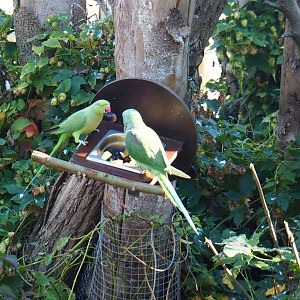
- Ring-necked parakeet or rose-ringed parakeet (Psittacula krameri)
- Alexandrine parakeet (Psittacula eupatria)
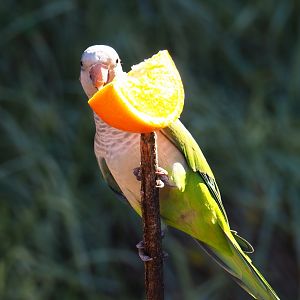
- Monk parakeet or Quaker parrot (Myiopsitta monachus)
- North American wood duck (Aix sponsa)
- Mandarin duck (Aix galericulata)
- Ruddy duck (Oxyura jamaicensis)
- Common pheasant or Ring-necked pheasant (Phasianus colchicus)
- Eurasian collared dove (Streptopelia decaocto decaocto)
- Sacred ibis (Threskiornis aethiopicus)
- Blue-and-yellow macaw (Ara ararauna)
- Red-eared slider (Trachemys scripta elegans)
Most, if not all of these species have been seen living as wild or feral introduced animals in the Netherlands and/or elsewhere in Western Europe. Not all of these species are present in large numbers and probably not all have established populations.
Some though, like the ring-necked parakeet, have become a fairly common sight with a large, self-sustaining, established and spreading population.
The common pheasant isn't commonly regarded as an alien species, as it has been around for a long time already - in fact it was the Romans who first brought these birds to Northwestern Europe, presumably because they bred them for hunting and eating.
The Eurasian collared dove is the only species on the list that didn't arrive in the low countries by human hands, but in fact expanded its range across Europe from the Balkan region on its own fource during the 20th century. It first arrived in the low countries in the 1950s.
The blue-and-yellow macaws were only introduced to the aviary in 2018. There have, according to my research, been sightings of escaped or free-ranging individuals in the Netherlands, but it doesn't seem to me that there is any kind of established population, or that these birds could survive in the Netherlands at all, especially during winter.
Regarding the blue-and-yellow macaws, it is worth noting that from the 1970s to 2009 there was a small population of feral scarlet macaws breeding in Haarlem - between 1980 and 2009 there were at least eight successful breeding attempts by a single pair of the macaws. The population may have survived to the present day, had it not been for a series of nest poaching events that, in 2009, resulted in the death of the breeding female. It seems quite possible that the blue-and-yellow macaw would also be able to live feral in the Netherlands (indeed a pair did roam free with the feral scarlets at first, but were much tamer towards humans and never bred).
@DesertRhino150 I didn't know about that and it didn't turn up in my research, so thank you for sharing! Definitely one I'm going to read as soon as possible.
It seems that when it comes to at least some members of the parrot family, they are hardier than one would think them to be when it comes to surviving temperate and colder climate winters, even when considering the introduced populations usually live in (semi-)urban environments.
I've also heard of at least monk parakeets also surviving in areas with much colder winters than Belgium or the Netherlands (Chicago for example). So feral parrots in temperate climates probably won't be going away anytime soon.
We can safely assume at least the ring-necked parakeets are here to stay in the low countries. And knowing that even these smaller parrots can be a nuissance (although admittedly a beautiful one), I definitely don't like the idea of feral macaws much.