This is the first of a series of factsheets on Texas Wildlife!
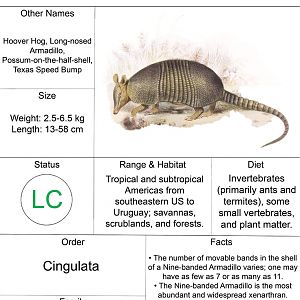
Armadillos (Cingulata) are are a truly Neotropical clade. As one of the three main groups of xenarthrans along with sloths and anteaters, they originated in what is now South America and diverged about 60 million years ago.
Cingulates were formerly a more diverse group: in addition to Dasypodidae (the long-nosed armadillos like the Nine-banded Armadillo) and Chlamyphoridae (the short-nosed armadillos, including the three-banded, hairy, and fairy armadillos as well as the extinct giant glyptodonts), there were once horned armadillos (Peltephilidae), giant “one-banded” armadillos (Pachyarmatheriidae), and a number of large armadillos known as pampatheriids. A few of these sizable forms managed to colonize North America in the Great Biotic Interchange (when South America finally connected up with the North) a few million years ago only to disappear sometime after in the Pleistocene megafaunal extinction event.
It must be stated that, contrary to popular belief, armadillos are not found in the southwestern deserts of Arizona, New Mexico, and Southern California.
It is also important to note the misconception that all armadillos can volvate (roll up); only the two species of three-banded armadillo (neither of which are found in North America) can do this, and only as a means of physical defense (not a mode of rotating locomotion).
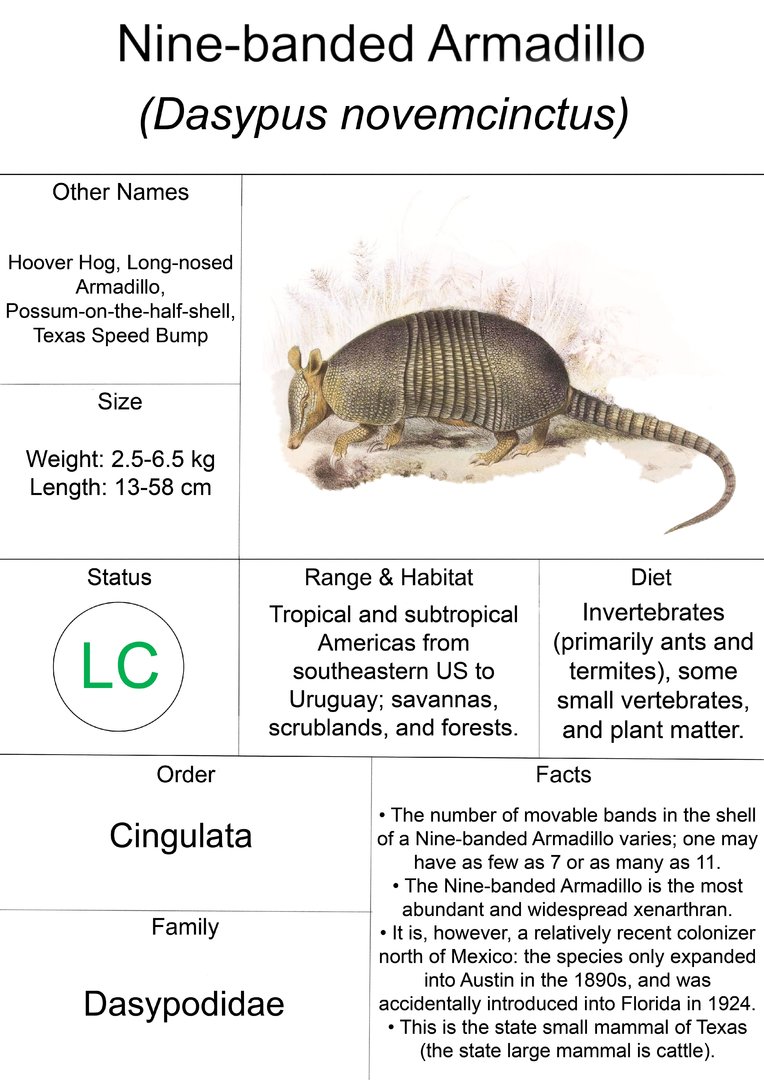
Illustration is from the Mammalia edition of Biologia Centrali-Americana (~1879-1882) and is public domain.