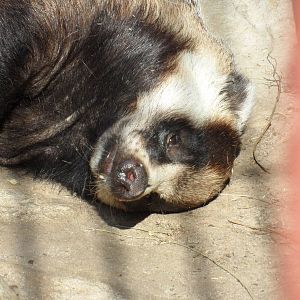
This is an Asian Badger (Meles leucurus), as demonstrated by the paler and muddier appearance of the body, the brownish colouration evident in the central white stripe on the forehead and, most diagnostically of all, the fact the two black facial stripes go up and between the ears, rather than sweeping around and underneath them.
No way it can be Japanese - we didn't import him, this would be too expensive))
Other pics of our badgers are here, please check: http://ekazoo.ru/zoofoto/barsuk/2081.html
I'm not saying it is Japanese - I am saying it is an Asian Badger (Meles leucurus) which is a seperate species from both the European (Meles meles) and the Japanese (Meles anakuma).
In the diagram I posted above, the Asian Badger is the middle animal. Compare that diagram with the following photo from the link you provided, and look at the position of the two black stripes on the head.
In comparison, take a look at the stripe pattern and overall colouration of a European Badger.
The other point to note is that the Asian Badger is your native species as although there is a little bit of overlap in the westernmost parts of Russia, further east than the Volga only M.leucurus is found.
I imagine the problem has arisen because until the work of Alexei V. Abramov in Notes on the taxonomy of the Siberian badgers (2001), and later - along with Andrey Yu. Puzachenko - Geographical variability of skull and taxonomy of Eurasian badgers (2005), all three taxa were classed as Meles meles with the Asian and Japanese taxa held to be subspecies.
As such, if Ekaterinburg Zoo has held these badgers since before 2006 at the latest, it is quite possible the labels have not been updated to reflect the new taxonomy.
I imagine the problem has arisen because until the work of Alexei V. Abramov in Notes on the taxonomy of the Siberian badgers (2001), and later - along with Andrey Yu. Puzachenko - Geographical variability of skull and taxonomy of Eurasian badgers (2005), all three taxa were classed as Meles meles with the Asian and Japanese taxa held to be subspecies.
As such, if Ekaterinburg Zoo has held these badgers since before 2006 at the latest, it is quite possible the labels have not been updated to reflect the new taxonomy.
This information is to be thoroughly checked I think. I live in Izhevsk to the east from Volga. Biologists of our university and specialists of department for controlling of using local fauna made survey on this subject (not genetic research, only coloration recording). M. meles is usual here, and M. leucurus is very rare. But there is the large river Kama on the east border of our region, it could be natural barrier.
This information is to be thoroughly checked I think. I live in Izhevsk to the east from Volga. Biologists of our university and specialists of department for controlling of using local fauna made survey on this subject (not genetic research, only coloration recording). M. meles is usual here, and M. leucurus is very rare. But there is the large river Kama on the east border of our region, it could be natural barrier.
Interesting; the range of overlap must be wider than the original description of the species in the aforementioned papers stated looking at a map, the Kama does look like it would provide a formidable barrier.
However, this individual is certainly M.leucurus - as, looking at the photographs on the link provided, are all the other badgers held.