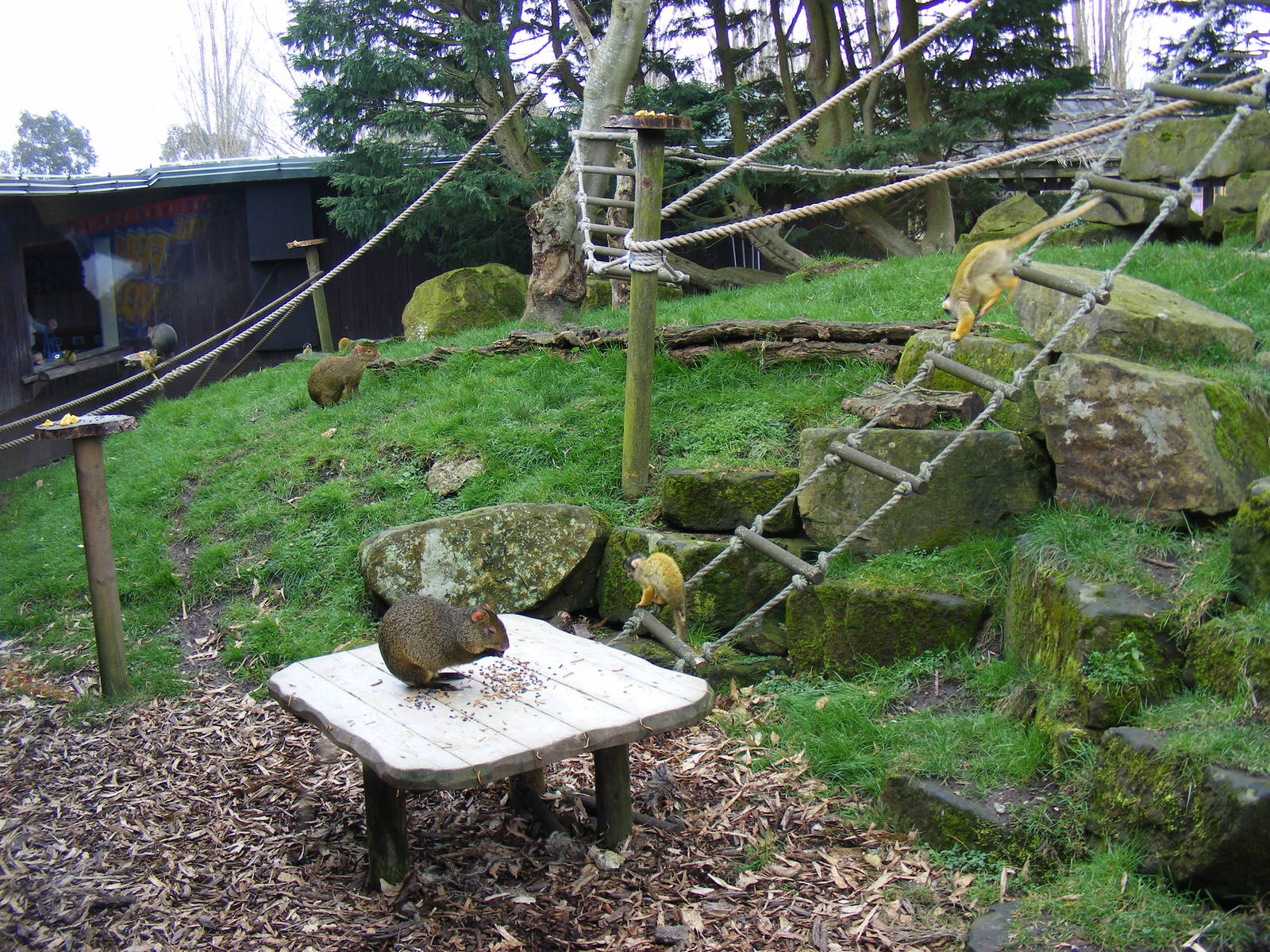
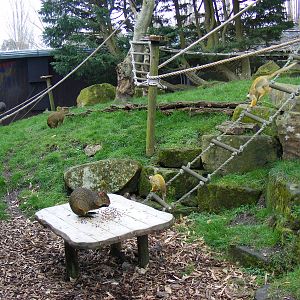
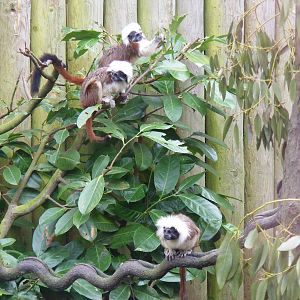
This is a long-established enclosure at Drusillas - at least 18 years - and I think it works very well. The majority fo the viewing is from the corridor that mhale mentions above, and visitors are unable, really, to see beyond the small hillock, and its trees, so no views of other visitors, or other exhibits, or other things, as one observes squirrel monkeys (and agoutis).
The enclosure was originally a behind-the-scenes 'rubbish dump' (I'm assuming hardcore, soil, wood, rather than actual food waste), which piled up to the point where the zoo decided to cover the mound in earth and turn it into an enclosure.
The agoutis were only added a few years ago, I'm not sure where they are housed in cold weather but, unusually for a primate exhibit, the monkeys access the island via underground tunnels rather than overhead, so presumably the agoutis can access the indoor housing that way.
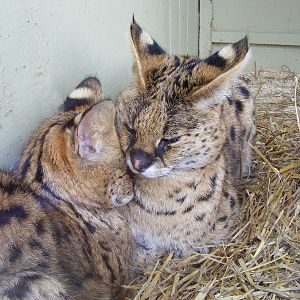
The viewing gallery forms the barrier, with electric fencing along the top as you can see in the photo. The back of the serval enclosure forms a solid wooden wall along one side, and a small pool forms the 'moat' at the front. I seem to remember a newsletter at the time saying initially at least one monkey jumped into the moat when they were first introduced to the exhibit but it was rescued by staff. The squirrel monkeys were housed in a cage for many years at the start of the old 'monkey walk' by the zoo entrance, with their indoor housing forming part of the evolution exhibit.
It is interesting to me that the zoo hasn't attempted to remove the glass panels and make the viewing gallery accessible to the monkeys.
Like many captive groups of new world primates, the group at Drusillas seemed only to produce male offspring for many years, until there were only a couple of females left. ISIS then showed them to be an all-male group for some years, although now it lists them as being 4.8