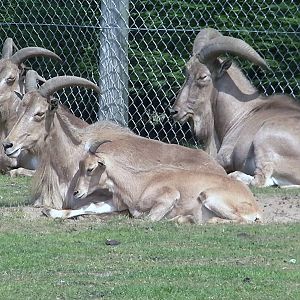
Glasgow Zoo's Barbary Sheep were seen as one of the original groups. They aquired their group back in 1968 from Edinburgh Zoo. Glasgow's bred Barbary Sheep could be found as far as Bahrain, Singapore, Blackpool, Dudley, Auchingaragh - Perthshire, and many other zoos and parks. In the UK, since the closure of the Mappin Terraces at Regent's Park, with at the time, but not so much now, that Windor Safari Park, and even Edinburgh Zoo to discontinue the keeping of such species as Barbary Sheep. Glasgow sheep were all decended from five that came from Edinburgh back in 1968. These were in turn decended from Regent's Park when they aquired them in the 1920's. In 1975/76 Glasgow supplied some of their Barbary Sheep to Cyril Grace at Blackpool Zoo, other herds went to Dudley, Paignton and Windsor. Glasgow bred the majority within the UK during the 60's 70's and 80's period, some sheep have a white patch behind the rear hoof and can be traced from Glasgow.
Glasgow Zoo's Barbary Sheep were seen as one of the original groups. They aquired their group back in 1968 from Edinburgh Zoo. Glasgow's bred Barbary Sheep could be found as far as Bahrain, Singapore, Blackpool, Dudley, Auchingaragh - Perthshire, and many other zoos and parks. In the UK, since the closure of the Mappin Terraces at Regent's Park, with at the time, but not so much now, that Windor Safari Park, and even Edinburgh Zoo to discontinue the keeping of such species as Barbary Sheep. Glasgow sheep were all decended from five that came from Edinburgh back in 1968. These were in turn decended from Regent's Park when they aquired them in the 1920's. In 1975/76 Glasgow supplied some of their Barbary Sheep to Cyril Grace at Blackpool Zoo, other herds went to Dudley, Paignton and Windsor. Glasgow bred the majority within the UK during the 60's 70's and 80's period, some sheep have a white patch behind the rear hoof and can be traced from Glasgow.
It’s interesting that so many Barbary sheep were descended from the Glasgow stock, which in turn came from Edinburgh, which in turn originated from animals on London Zoo’s Mappin Terraces.
The herd of Barbary sheep was one of the original inhabitants of the Mappin Terraces when it opened in 1913. I believe, though, that the original ancestors of that herd arrived at London Zoo decades before the Mappin Terraces were built.
It’s interesting that so many Barbary sheep were descended from the Glasgow stock, which in turn came from Edinburgh, which in turn originated from animals on London Zoo’s Mappin Terraces.
The herd of Barbary sheep was one of the original inhabitants of the Mappin Terraces when it opened in 1913. I believe, though, that the original ancestors of that herd arrived at London Zoo decades before the Mappin Terraces were built.
The Glasgow Zoo herd were one of a group, not the main group however, what I wrote was taken from Glasgow's website when it up and running. Genetically, the UK are decended from Edinburgh's five Barbary Sheep, which I do believe the herd from then on in, was from Glasgow's own stock which was the backstay of the herds within the UK from the 1960's upto the late 1980's and early 1990's.
It’s interesting that so many Barbary sheep were descended from the Glasgow stock, which in turn came from Edinburgh, which in turn originated from animals on London Zoo’s Mappin Terraces.
The herd of Barbary sheep was one of the original inhabitants of the Mappin Terraces when it opened in 1913. I believe, though, that the original ancestors of that herd arrived at London Zoo decades before the Mappin Terraces were built.
Its quite possible in that case that all Barbary sheep in the UK were/are descended from the ZSL stock. I think they only remain now at Dudley, Paignton(now very few-4?) and AA. I don't know where AA's came from but presumably one of the other groups?
Its quite possible too they have received no infusions of 'fresh blood' since the ZSL animals were originally imported, a comment I've made about a number of other ZSL/Whipsnade ungulate species too e.g. Blackbuck, Barasingha, Chital, Nilgai etc so like them, are likely to be very inbred. I know at ZSL in the 1960's mortality of the lambs born to the herd on the Mappin terraces was high, almost 100% in some years.
Its worth looking at International Zoo News for the online back issue 'September 2010 (Vol: 57/6, No. 383) - its an article on UK wild caprid species by Paul Irven. There is a lot on the history of the UK Barbary Sheep herd. The only addition I would make to what is a very comprehensive review of the history of caprids in UK collections is that I believe the last chamois, which were at Palacerigg when it was scaled down in 2006, went on to Auchingarrich Wildlife Centre, but didn't last long. I would be surprised if Auchingarrich sent them away.
I can't paste the link because its copyrighted but the online versions are immediately obvious in the left-hand scroll bar on the home page. Only the 2011 editions open as a separate file, everything else opens in your browser.
Its worth looking at International Zoo News for the online back issue 'September 2010 (Vol: 57/6, No. 383) - its an article on UK wild caprid species by Paul Irven. There is a lot on the history of the UK Barbary Sheep herd. The only addition I would make to what is a very comprehensive review of the history of caprids in UK collections is that I believe the last chamois, which were at Palacerigg when it was scaled down in 2006, went on to Auchingarrich Wildlife Centre, but didn't last long. I would be surprised if Auchingarrich sent them away.
I can't paste the link because its copyrighted but the online versions are immediately obvious in the left-hand scroll bar on the home page. Only the 2011 editions open as a separate file, everything else opens in your browser.
The Auchingarrich Barbary Sheep came from Glasgow, one of those sheep had a damaged eye, another had a hoof issue. O'Grady wrote a short article on how the genepool of the sheep held a defective gene which all B.Sheep have white on their hooves and that Glasgow's B.Sheep had this and those born and or transfered to other collection could then be traced back to Glasgow.