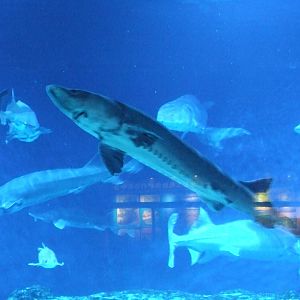
Counting at least 16 (and probably more) sturgeons in this bassin! An incredible number given that this species (Accipenser sinensis, Gray 1835) is critically endangered in the wild.
Chinese fisheries biologists actually seem to tend towards splitting into two populations (potentially even species perhaps) from the Yangzte and the Pear(l) River (hate it when translated names and no transliteration is used ..., so what river system is this).
Any attempts at captive-breeding being made or been succesfull at the Beijing Aquarium?
I know the Yangzte Fisheries Institute manages an AI breeding program with scientifically caught specimens from the Yangzte river system.
Any recent research on reproduction and ecology published in English from Chinese academies?
Counting at least 16 (and probably more) sturgeons in this bassin! An incredible number given that this species (Accipenser sinensis, Gray 1835) is critically endangered in the wild.
Chinese fisheries biologists actually seem to tend towards splitting into two populations (potentially even species perhaps) from the Yangzte and the Pear(l) River (hate it when translated names and no transliteration is used ..., so what river system is this).
Any attempts at captive-breeding being made or been succesfull at the Beijing Aquarium?
I know the Yangzte Fisheries Institute manages an AI breeding program with scientifically caught specimens from the Yangzte river system.
Any recent research on reproduction and ecology published in English from Chinese academies?
Beijing Aquarium has long-term cooperation with Yangtze River Fisheries Research Institute (Chinese Academy of Fishery Sciences) since 2005. Beijing Aquarium is used as a recuperation center for injured or young fish, and then release them to wild, but the sturgeones don't breed at Beijing Aquarium.
Sadly, in 2013 and 2014, there were not any spawning signs been found at the spawning site in the Yangtze River, so this species may had stopped breeding in the wild.
In 1983, the artificial incubation of roes collected from wild sturgeons succeeded. Then YRFRI began to release young fish to wild. More than 5 million young sturgeons has been released to yangtze river, minjiang river, and pearl river in the 30 years.
In 2009, the first filial generation (artificial incubated, parents are wild) bred successfully, which means the total artificial breeding of Chinese sturgeons realized, and we don't need to collected roes from wild sturgeons any more, and also means Chinese sturgeons can avoid extinction by breeding in captive.