.
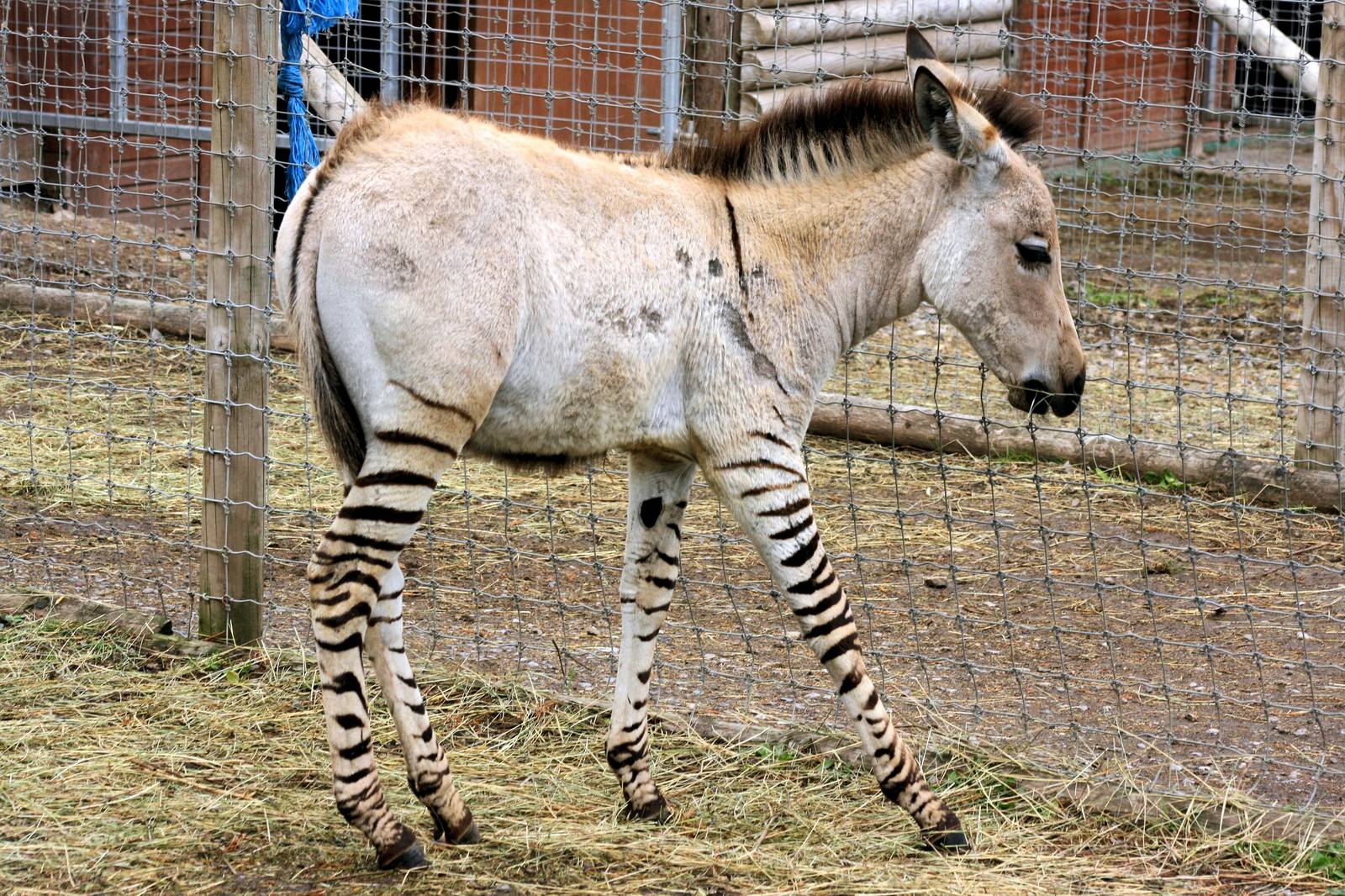
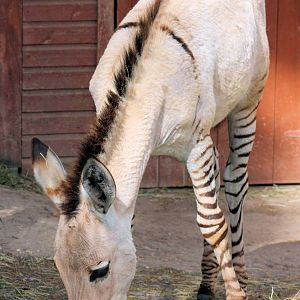
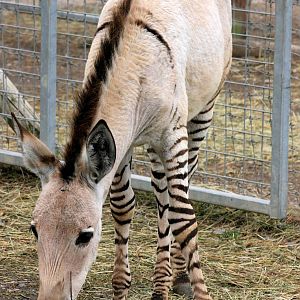
But Ewart, who only bred horse zebroids with a Burchell stallion, already remarked that often the striping varies and sometimes looks like a Grevy Zebra's and not like its sire!
Yes, of course we do not know whether the F2 zebra-zebra hybrid is really a F2. However, one other scan shows a pregnant F1! Of course the earlier F1 could have adopted a stray..
Colchester Zoo bred three zebroids from a female black donkey and a common Zebra stallion. Their faint stripe patterns all resembled Grevy's Zebra, though each had a slightly different base colour. In fact I presumed the father was a Grevy until recently I found that wasn't the case.
Re the Grevy/Common hybrids. I wonder how commonly this occurs where the species ranges overlap. It shouldn't really at all, as they have very different social structures in nature.
Ewart was of the opinion that hybrids sometimes revert to distant ancestors and that the striping pattern might be that of the original coat colour of prehistoric equines..
I do know that the Grevy Zebra is supposed to be the oldest zebra according to geneticists.
Although fossil zebras are either related to Grevy or to Plains. The last mentioned, Equus capensis or Giant Zebra, is on my Pinterest board as well as some other prehistoric zebras.
In any case that is the reason why most reconstructions of prehistoric equines show more or less striped animals. Nevertheless true prehistoric images of zebras are exceedingly rare.
The zebra-zebra hybrids often are the indirect result of human meddling. Loss of habitat and a restricted number of mates of the same species being available.
The Hartmann-donkey hybrid occurred in a wild herd of three female zebras and no male. So she took a feral donkey!
But most mammals are not exactly choosey in choosing their mates. Consider the mammut hybrid that occurred so long ago!
One last word. I know beans about feline hybrids, lion X tiger, etc.. But maybe there is the solution why F2 hybrids usually either revert to the species of the grandparent or replicate the hybrid mother/F1.
......... and I even put the scans on Facebook as well as my Pinterest page
https://nl.pinterest.com/ [/quote]
... already commented on the Colchester hybrids.
Regarding the onager x zebra hybrids that you mention:-
As is well known, after the Earl of Derby died in 1851, the animals in the Knowsley Menagerie were sold at auction and Amsterdam (Artis) Zoo acquired a female quagga.
According to the book “Natural History Essays” (Graham Renshaw, 1904) this ex-Knowsley quagga subsequently gave birth to a hybrid foal in Amsterdam, the father being an Asiatic wild ass; Renshaw does not state whether the sire was an onager or some other form of Asiatic wild ass.
Do you have any further details of this quagga x Asiatic wild ass hybrid?
No, I do not know anything about that hybrid.
I am pretty certain Lord Derby already bred a zebra to his Asiatic Wild Ass.
Long ago i saw a drawing of that hybrid but not according to nature.
(Recently i saw a picture of 4 equines in Derby's possession including an onager and a quagga.)
An Asiatic Wild Ass can only be a hemione.
Following a Japanese researcher there are 3 species; the Onager of Syria, Persia, india and Turkmenistan (Equus onager), the larger Dziggetai of Mongolia and formerly Siberia (Equus hemionus) and the largest Kiang of Tibet (Equus kiang).
Amsterdam only had onagers from Syria (extinct) and Persia at that time.
Next year i will try to visit the Library of the Amsterdam Zoo. When i ended my research in 1994 that Library was an awful mess so i preferred to go to zoological libraries of Utrecht and Leyden instead..
Yes, Lord Derby bred various zebra x ass hybrids at Knowsley.
The book “The Horse and its Relatives” (Lydekker, 1912) includes a photograph of a museum specimen of a mountain zebra x Asiatic wild ass hybrid that was born at Knowsley.
Following a Japanese researcher there are 3 species; the Onager of Syria, Persia, india and Turkmenistan (Equus onager), the larger Dziggetai of Mongolia and formerly Siberia (Equus hemionus) and the largest Kiang of Tibet (Equus kiang).
Colin Groves considers both the Indian wild ass and the now extinct Syrian wild ass to be distinct species. He lists four species in all:--
• kiang, Equus kiang
• Indian wild ass, Equus khur
• Syrian wild ass Equus hemippus
• onager, kulan and Mongolian wild ass are all listed as sub-species of Equus hemionus (althouigh he does add that whether onager and kulan are really sub-species of E. hemionus needs to be re-examined.)
Reference:- “Ungulate Taxonomy” (Colin Groves and Peter Grubb; 2011)
I no longer have Lydekker but found a curiously truncated PDF of it.
On Pinterest i have added some scans of the Knowsley Zoo but no hybrids.
And i located a PDF containing even the price of the Amsterdam quagga but no mention of offspring.
Yep, i do own the Groves book and read it with pleasure long ago.
Unfortunately it is obsolete. Groves subscribed to the theory that all existing equines already developed as a SPECIES in North America.
The modern theory is that only the true or caballine horses originate in North America and emigrated to Eurasia. The recent zebras came to life in Africa, descending from prehistoric zebras. While true asses, hemiones, the related hydruntine and yet another equine species developed in Eurasia..
Groves'ideas about hemiones(=half-asses) are a bit strange. Most hemiones suffer from habit loss and inbreeding because only relict populations have survived. The majority of modern researchers think there are two species: the kiang and the hemiones/onagers. But the article of the Japanese researcher convinced me that there are three species as the obscure Mongolian Dziggetai has too many peculiar features. (Did you know that around 1700 dziggetais still lived in the Ukraine?)
I do readily admit that the extinct Syrian Onager or Hemippe(=half-horse) was quaint but inbreeding can explain a lot. A similar case as the Cape Mountain Zebra.
In the 19th century the Regent's Park Zoo wondered why its pair of Syrian Onagers never had issue. Now they think the male was a donkey-onager hybrid..
I’m not sure what book by Colin Groves you read “long ago"; are you referring to “Horses, Asses and Zebras in the Wild” (1974) ?
I should have been more explicit and made it clear that I was referring to the relatively recent publication “Ungulate Taxonomy” (Colin Groves and Peter Grubb; 2011).
In the 19th century the Regent's Park Zoo wondered why its pair of Syrian Onagers never had issue. Now they think the male was a donkey-onager hybrid..
The site just threw my answer away as being too long.
Yes, i thought you referred to the old book, not to the new publication.
I think it is now clear i entered the equine field from the viewpoint of fossil horses.
My hobby horse is Equus hydruntinus(=from Otranto), a miniature horsey. It was even smaller than the Syrian Onager and persisted in Southern Europe till early historic times. The hydruntine was related to the hemiones but more greyish and a bit striped according to prehistoric paintings. Some think it survived in Spain till the 16th century AD and was called "cebro".