I obtained Groves' new publication as a PDF. No mention of fossil equines so i do not know his present view on that topic.
Groves' new book is vehemently attacked by other scientists. The academic world is full of verbal sharks and piranhas.
Why Groves regards the Indian Onager as a seperate species is a mystery.
No one else did so.
Nevertheless i can understand why he sees the Syrian Onager as such. In the past i used a most accurate drawing of both the Syrian Onager AND the Persian Onager in the Regent's Park Zoo and they indeed look like different species.
I see Groves still holds to his theory that the wild asses in the Sahara are at least partly genuine Wild African Asses. I can live with that but have not seen enough photographs of the animals in question..
Nevertheless i do not understand why Groves thinks the domestic donkey descends from the Nubian AND Somali Ass. The newest theory is that the Nubian and a different but unknown subspecies are the ancestors while the Somali is out of the picture. The first domestication attempts were in Egypt and West-Asia. That points to another subspecies, the extinct(?) Wild Arabian Ass. Many researchers think two equine species lived in West-Asia: the Syrian Onager and a subspecies of the true Wild African Ass. This according to early archaeological digs.
By the way, in pre-dynastic Egypt also two species have been found: the Nubian Ass and the Grevy Zebra.
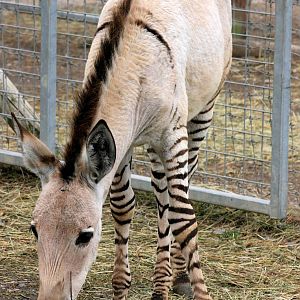
There must have been a dozen Syrian Onagers in the Regent's Zoo. Research on the bones of supposedly pure onagers found peculiarities in one of the males pointing to a donkey hybrid.
I just commented on the photo of the Israel onager hybrid on this site.
And i just remembered that many years ago the Indian authorities in charge of the reservate of the Indian Onager bred some of their captive onager stallions to donkey jennies. Some of these hybrids landed in Indian zoos.
A pity i do not have any photos on display..
Although onager-donkey hybrids were by no means uncommon in the zoos of the past..