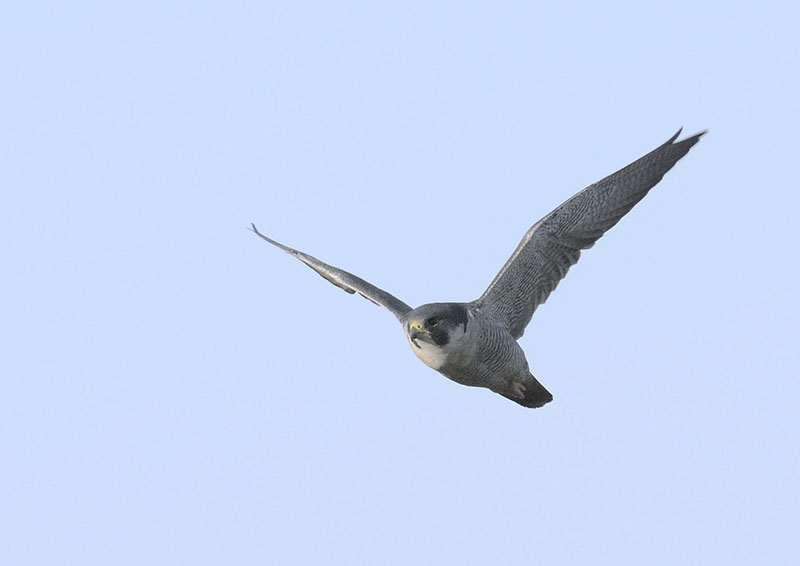
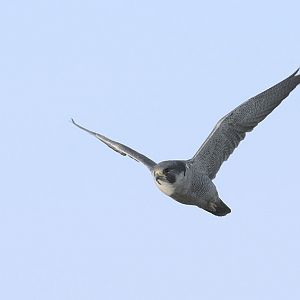
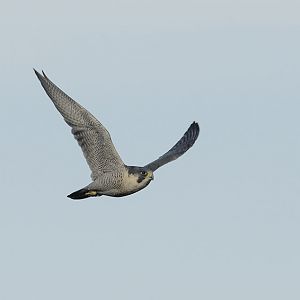
Adult male(?) in flight over Carum Field, Martin Mere WWT, 17th December 2013.
The male flew past or over the United Utilities hide three times in a few minutes. I missed his first and third passes completely, so I was glad I nailed this one.
Adult male(?) in flight over Carum Field, Martin Mere WWT, 17th December 2013.
The male flew past or over the United Utilities hide three times in a few minutes. I missed his first and third passes completely, so I was glad I nailed this one.
A beautiful shot. I took my son to see Chelsea play Crystal Palace on Saturday, and looked up at one stage in the first half to see a Peregrine soaring overhead!
Thank you for the comments. I can still remember seeing my first peregrine on the Calf of Man over 50 years ago, when peregrines were very rare birds. There is still a thrill now that they are so much more common.
I realise Crystal Palace are the Eagles, perhaps if Chelsea became the Peregrines I would have a more sympathetic attitude towards them - although I doubt if Mr Abramovich would settle for anything less than gyrfalcons.
They are quite common around me here on the South coast. Some years ago when I kept a few fancy pigeons, I was sitting in my garden one fine day and suddenly heard a rushing noise overhead. It was a Peregrine making a stoop at the Pigeons, but he saw me and aborted at house height before he could actually make a strike. They can really travel, I watched him leave and within about half a minute he was a distant speck over the downs.
The very first Peregrine I ever saw had a fine sense of theatre, stooping at incredible speed after some hapless pigeon off Land's End in 1983. In my adult lifetime it has gone from being a rarity to a species that a birder with a decent pair of binoculars might expect to see anywhere.
Sadly, urban Peregrines are a great deal safer than those living near northern English grouse moors. And those that fifty years ago had survived DDT unscathed on north Scottish seacliffs are in trouble - marine pollutants need to be tackled.
IRR and TLD are absolutely correct. The peregrine is so significant because its decline was studied by the late Derek Ratcliffe, who was able to show that the thinning of their eggshells correlated with the quantity of persistent pesticides in their environment. This was the key scientific evidence that started the reversal the environmental decline predicted by Rachel Carson in 'Silent Spring'.
I saw my first peregrine when walking with my father over undulating ground on the Calf of Man (a small island owned by the National Trust for Man), as we came over a hillock we saw a large falcon mantling a dead herring gull on the ground about 15 metres away (standing on the fresh kill with her wings outspread so their tips touched the ground). I have never seen anything as fierce and impressive. The only Manx phrase I know is yn shirragh ny ree*
The peregrine is so significant because its decline was studied by the late Derek Ratcliffe, who was able to show that the thinning of their eggshells correlated with the quantity of persistent pesticides in their environment.
I think his studies were done on the North Cornish coast? I lived in the very same area for a while in the 1980's and Peregrines were already making a comeback by then and I would see them fairly frequently. Nowadays of course that stretch of Coast has a pair on nearly every headland.