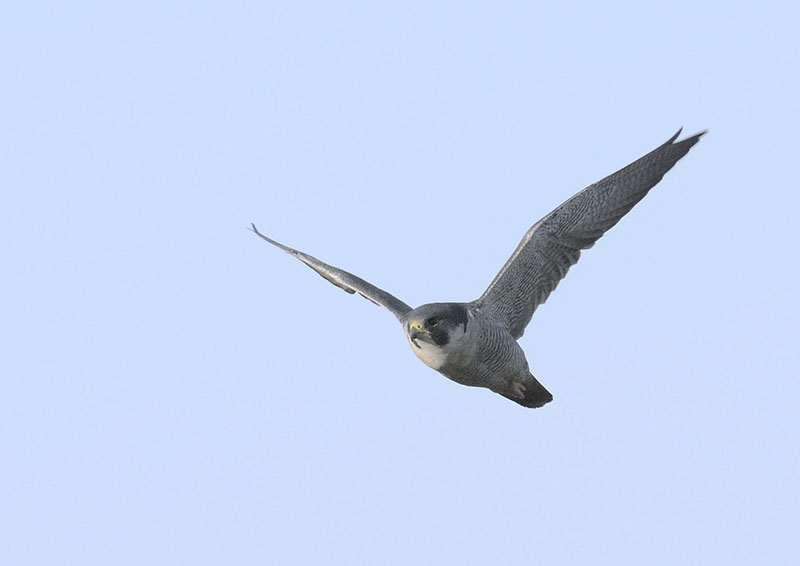
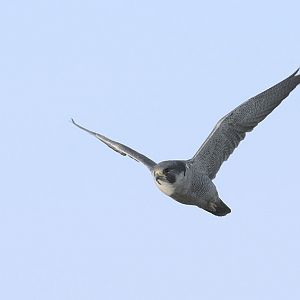
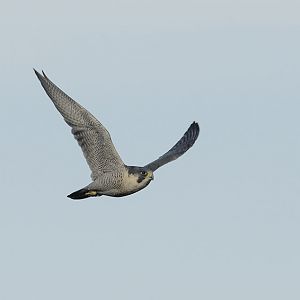
Adult male(?) in flight over Carum Field, Martin Mere WWT, 17th December 2013.
The male flew past or over the United Utilities hide three times in a few minutes. I missed his first and third passes completely, so I was glad I nailed this one.
Very much so I think. I would class the Red Kite slightly differently because of the reintroduction aspect, though its very true the Welsh population has absolutely mushroomed and presumably by now joined forces with the introduced one too. I saw half a dozen on Salisbury Plain one day last summer just with a single scan of the binoculars! And if I'm going to Whipsnade from e.g. Oxfordshire alongside the Chilterns, I can usually count into the 30's on the car journey- the Aylesbury area seems a hotspot- even in the town!
I would not be surprised if a litte illicit reintroduction by way of catching individuals and releasing them elsewhere has supplemented the expansion of polecats and otters, of course - it's certainly true that polecats in particular seem to have exploded in numbers in the northwest and northeast.
Ratcliffe's main experimental work was done with the egg collections in museum storerooms. He had to devise a way of measuring the thickness of the shell without damaging the eggs.
I always associate the study of Cornish peregrines with the late Dick Treleaven.
Yes indeed, I remember borrowing it from the local library many years ago; it was a good read with lots of good observations as I recall. Ratcliffe's monograph is far more technical, with lots of stats, but well rounded with plenty of observational and historical details - it's one of the great natural history books. I have recently bought J A Baker's book about peregrines in Essex, which is far more poetic and metaphysical; I have not started it yet, but it might be just the book I need to get me through Xmas (or I might have to resort to P G Wodehouse ).
I think the problem with Turtle Doves is twofold one they have to migrate and if feeding is poor where they over winter they won't have the strength to return and of course risk being shot on the way especially over Malta and secondly the usual suspect at the English breeding sites are magpies.
I used to especially love working in one of my gardens in summer - It's an old farm- as the turtle doves nested in an hawthorn hedge behind the veg plot and tennis court, I adore their call but it fell silent about 4 years ago in the 2 years before, the nest had been attacked by magpies. I was there one day when they found the nest and spent a futile morning or so trying to chase them off.
They tried again the next year but same thing and nothing since. I was there on Wednesday and counted 17 magpies in a single flock.
On a lighter note we saw a good number last May in Minorca, and they were very tame even allowing me to throw them grass seed heads. I think they were breeding rather than passing through.
It's an old farm- as the turtle doves nested in an hawthorn hedge behind the veg plot and tennis court, I adore their call but it fell silent about 4 years ago
Lovely birds. I lived in East Anglia(as you do) for a while about ten years ago, and noticed how common Turtle Doves still were there, in relation to other parts of the country. I know that they have 'crashed' in most areas, so in East Anglia too?
We still get them near me on the South coast each summer, but now in very low numbers. They always appear each year in exactly the same places here- namely forestry in a downland setting. They always favour the same bare/dead protruding branches above a canopy of sweet chestnut and beech trees, to perch on and 'purr' from.
I seem to remember Treleaven's book is illustrated with his own paintings and/or drawings? One I recall(perhaps it was on the cover?) depicted a Peregrine with a cliff backdrop I was familiar with, a place I visited regularly on the North Cornish coast near Cambeak- where Grey Seals breed also.