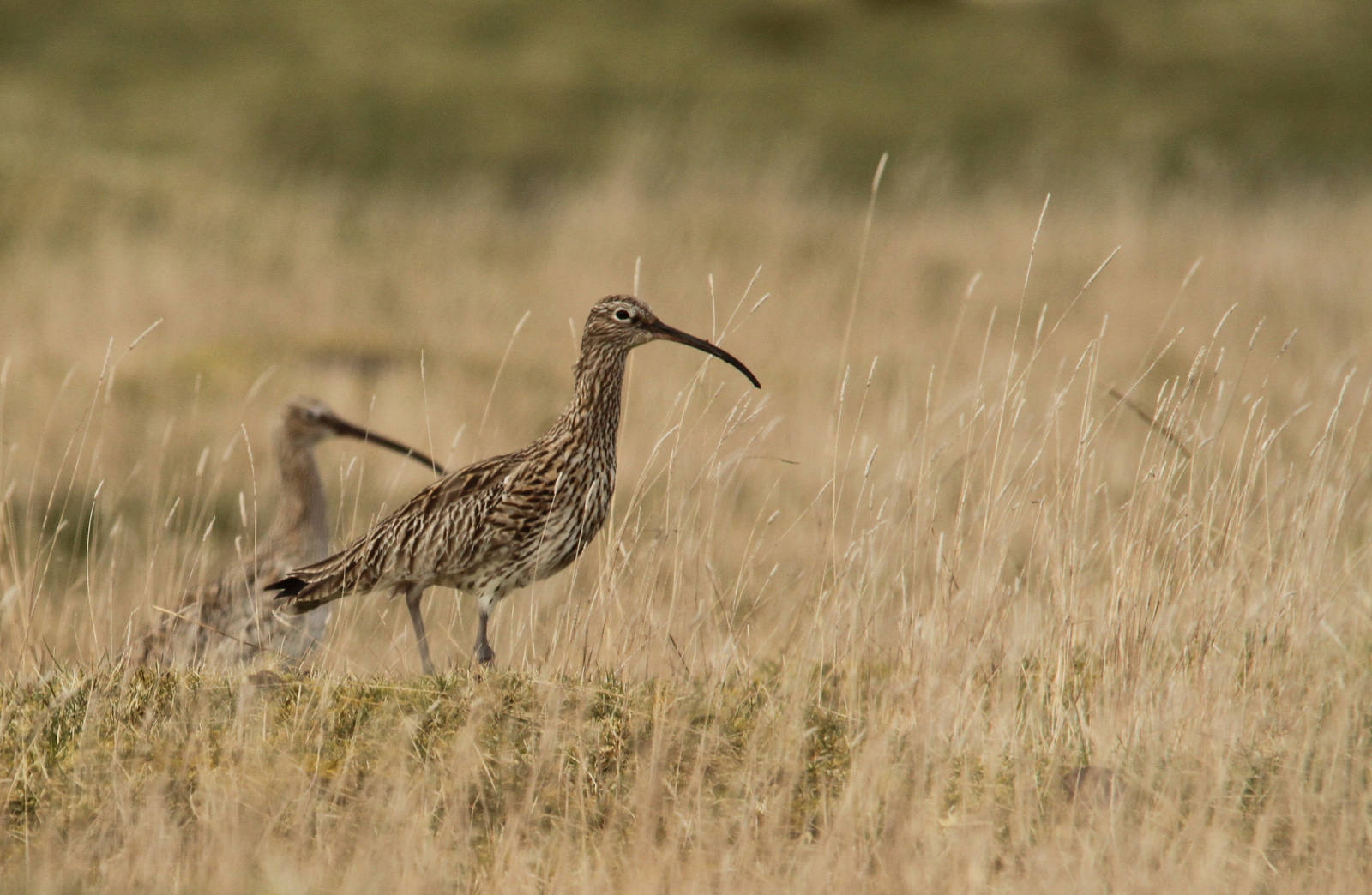
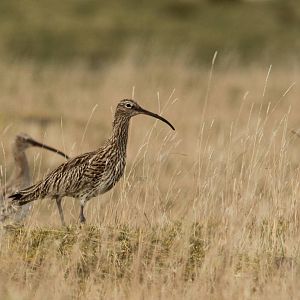
This is indeed a Curlew - other than the size, which is hard to detect from this photo, the main diagnostic criteria is that the Whimbrel is somewhat paler than the Curlew.
Might I suggest that the bird at the back appears to have a longer bill, and thus we may be looking at a pair, with the male being the bird in the foreground.
Might I suggest that the bird at the back appears to have a longer bill, and thus we may be looking at a pair, with the male being the bird in the foreground.
You beat me to it, I was going to say' how do I know they are a male/female pair?' This bill length difference is something I only discovered comparatively recently.
Similar to how can you can sex Barn Owls just by their appearance. Do you know?
In male barn owls, a strip of feathers to either side of the facial disk tend to be white, whilst the same strip tends to be a light buff-colour in females. Also, females tend to have slightly richer colouration on the back of the bird.
I didn't know the first part. Females have much heavier speckling on the head, back and wings, males are almost plain buff with just a few speckles in those areas.
If you were given a single Kakapo to examine (fat chance..) how could you tell its sex- visually that is?
Its very subtle. The leading edges on the (first ten?)primary wing feathers are barred in females, plain in males...
This is how NZ Kakapo/bird expert Don Merton first identified a female Kakapo when trapping them on Stewart Island- until then they believed the species was effectively extinct with only males left. No one had ever seen a female so they didn't know how to recognise one. He contacted a parrot breeder in the UK who had a hunch about it and advised him to compare the primary feathers of museum specimens and/or with those of a known male and---- Bingo!