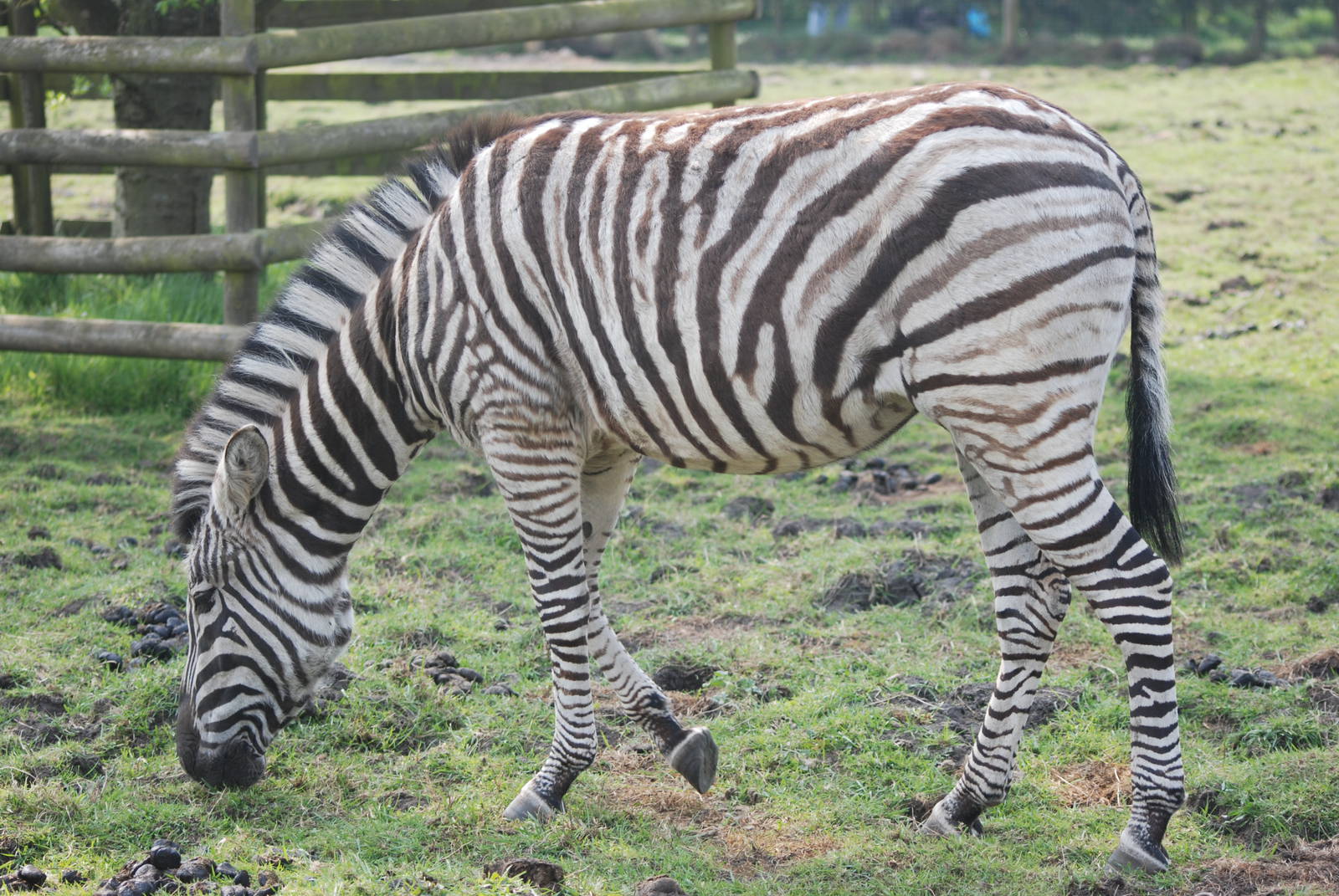
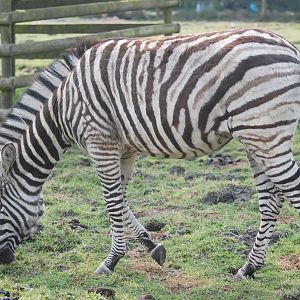
Agree. I would class that as a Chapmans Zebra. True Damaras do vary considerably in the degree of striping on the legs, but are not solidly striped down to the hoof like this. Their legs are usually much whiter-looking and the stripes on the rump are thinner and more broken-up too.
I've often wondered if the European zoo populations of Damara and Chapman's were maybe not as well separated in the past as they could have been...
It must be said though, Damaras are pretty variable and I can only assume that the studbook is happy they're pure (or at least, pure enough) if they're being brought into a breeding situation (and if I'm right with where the male is coming from the animals there look much more 'classic Damara').
I think technically the Chapman's is no longer considered a valid subspecies and is lumped in with the Bruchell's/Damara and is that is the case them my previous statement is false.
I think technically the Chapman's is no longer considered a valid subspecies and is lumped in with the Bruchell's/Damara and is that is the case them my previous statement is false.
IUCN still 'believes in' chapmanni (though it corrects the erroneous double 'nn' given when it was named, which it shouldn't do really!)
They work on 6 subspecies, one extinct:
E. q. crawshaii - Crawshay's Zebra E. q. borensis - Maneless Zebra E. q. boehmi - Grant's Zebra E. q. chapmanni - Chapman's Zebra E. q. burchellii - Burchell's Zebra (including animals formerly known as antiquorum) E. q. quagga - Quagga (extinct of course)
So, in zoo population management terms, the changes to antiquorum don't make any practical difference, as the subspecies it has merged with is otherwise extinct. Just a name change.
Maybe this is a pure Damara that's a throwback to more heavy striping. The (Damara) animals used in the Quagga project sometimes show this too- even pale legged animals sometimes produce a more heavily striped offspring than themselves, including heavy striping on the legs too. The body pattern of striping here is quite Damara like -rather broken up and wavy, whereas 'Chapman's' have thicker and regular stripes. Its the heavily striped legs which are less typical I think.