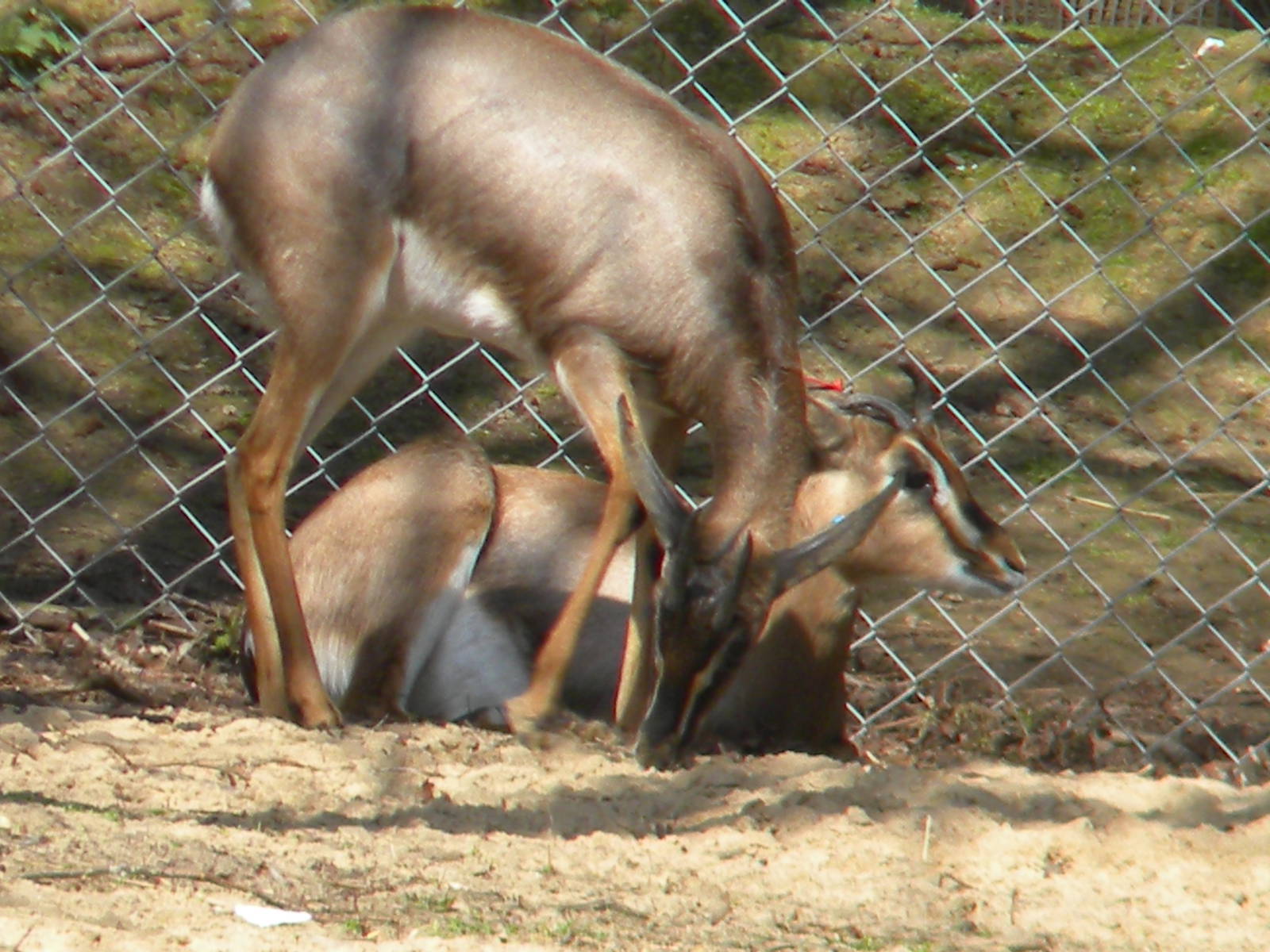
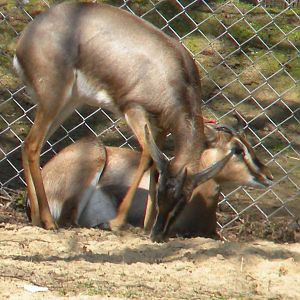
These are among the last remnants of a once much larger population of these animals in UK zoos - one of the major reasons for their decline is that no-one is quite sure exactly what they are. They were traditionally exhibited as Arabian Gazelles, Gazella arabica, but the one thing everyone seems to agree on is that this was wrong. The consensus is that they seem to be a subspecies of Gazella gazella - cora? muscatensis? Something else entirely? No-one's sure.
Interesting to note that ISIS still lists them as Gazella arabica.
S
steenbok
I always believet that the fact they were exhibited as Gazella Arabica depended on the fact they came from farasan Island, where the only specimen of the supposed (and extinct) gazella Arabica comes from. So I took for granted these were Gazella Gazella Farasani, as you say a subspecies of the Arabian Mountain Gazelle.
The colour too would be consistent with Farasani.
The problem with these gazelles is that with lack of better identification these gazelles risk crossbreeding.
Gazella gazella farasani is too rare. And at european zoo is never live.
Gazella arabica was based on a chimera and never existed as a distinct species in nature.
Bärmann EV, Börner S, Erpenbeck D, Rössner GE, Hebel C, Wörheide G (2012). "The curious case of Gazella arabica". Mammalian Biology. The curious case of Gazella arabica
Gazella gazella farasani is too rare. And at european zoo is never live.
Gazella arabica was based on a chimera and never existed as a distinct species in nature.
Bärmann EV, Börner S, Erpenbeck D, Rössner GE, Hebel C, Wörheide G (2012). "The curious case of Gazella arabica". Mammalian Biology. The curious case of Gazella arabica
I think I need to have a chat with somebody that helpped look after these for the best part of 20 years at Chester Zoo,as he did get to the bottom of exactly just what sub-species these were as they all came from just 4 animals!As he spoke with the person that brought the founding animals back to Chester and from what he found it could be only have been one sub-species found in that area!