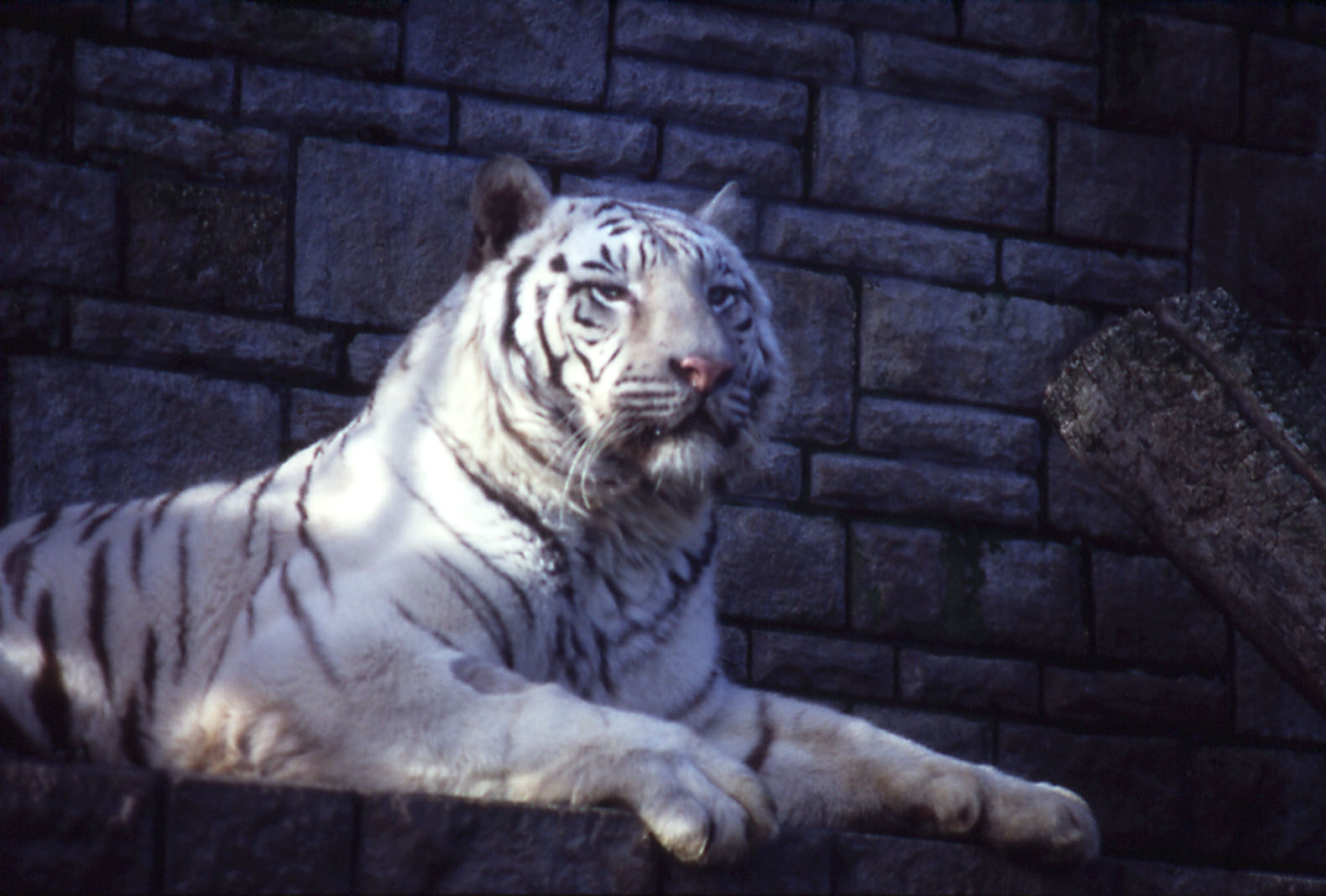
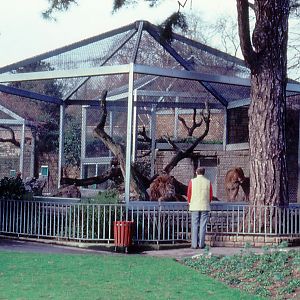
I think you'll fiind by the time you took this photo they were reduced to this one White male plus either one other or a normal Tiger. Previously they had bred a lot of White Tigers but had reached the end of that era.
All I can go on at this stage is my notes, which read:
"These cages had African Lions, Persian Leopards and the famous White Tigers. There may have been some other big cats but I can't remember because I spent all my time photographing the White Tigers."
I don't think Jaguars were displayed in those enclosures, though they were in the previous 'Lion House' ( which was on the site of the current Nocturnal House). Pumas were exhibited in these enclosures however.
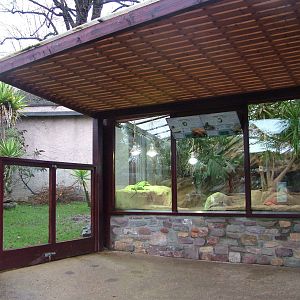
From memory I think there were five enclosures but possibly only four species;
African Lion. Tiger(white/normal). Persian Leopard. Puma. Tigers may have occupied more than one outdoor enclosure, though I can't remember if any tigers were born in these enclosures. I know most or all of the Bristol litters of white tigers were bred in the previous house.
In c.1986 they apparently had white males Roop (imported from Delhi Zoo) & Akbar II, and white females Sumati & Nanda. No new whites had been raised since 1977. ('Tigers of The World' Ist ed p.385).
In c.1986 they apparently had white males Roop (imported from Delhi Zoo) & Akbar II, and white females Sumati & Nanda. No new whites had been raised since 1977. ('Tigers of The World' Ist ed p.385).
I remember the arrival of 'Roop'- he was acquired to bring new blood into their white Tigers as the other three were all closely related. 'Roop' would still have been related in some way but more distantly. Do you know if he fathered any cubs at Bristol?
(I'm trying to ascertain which was the last purebred Indian tiger in the UK and where it was).
Roop was apparently exchanged for a female because there were no males left at Bristol. The females were all direct descendants of the original pair from Rewa, Champak & Chameli (3rd litter of Mohan & Radha).
There's a genealogical chart in the book but it's so small & badly printed I need a magnifying glass to read it, so apols for any mistakes!
Roop had a litter of 3 with Sumati (5-1975) who all died after a few days.
Roop & Sumati had another litter of 4 (6-1976) of whom Akbar II (m) was the only one to live any length of time.
Roop and Nirmala had twins (6-1976) - 1 infant death, 1 male lived 2 & half years.
Roop & Nirmala had another pair (7-7-1977), females Sita (died 11-1982) and Nanda (still alive at time of writing in 1986). These would have been the last raised whites.
Which of the 4 living in c 1986 (Roop, Sumati, Nanda, Akbar II) survived the longest I couldn't say of course. 3 orange white carriers from Bristol later formed the basis of the Longleat line, of whom Zia & Zena are still cutting a dash on the IOW.