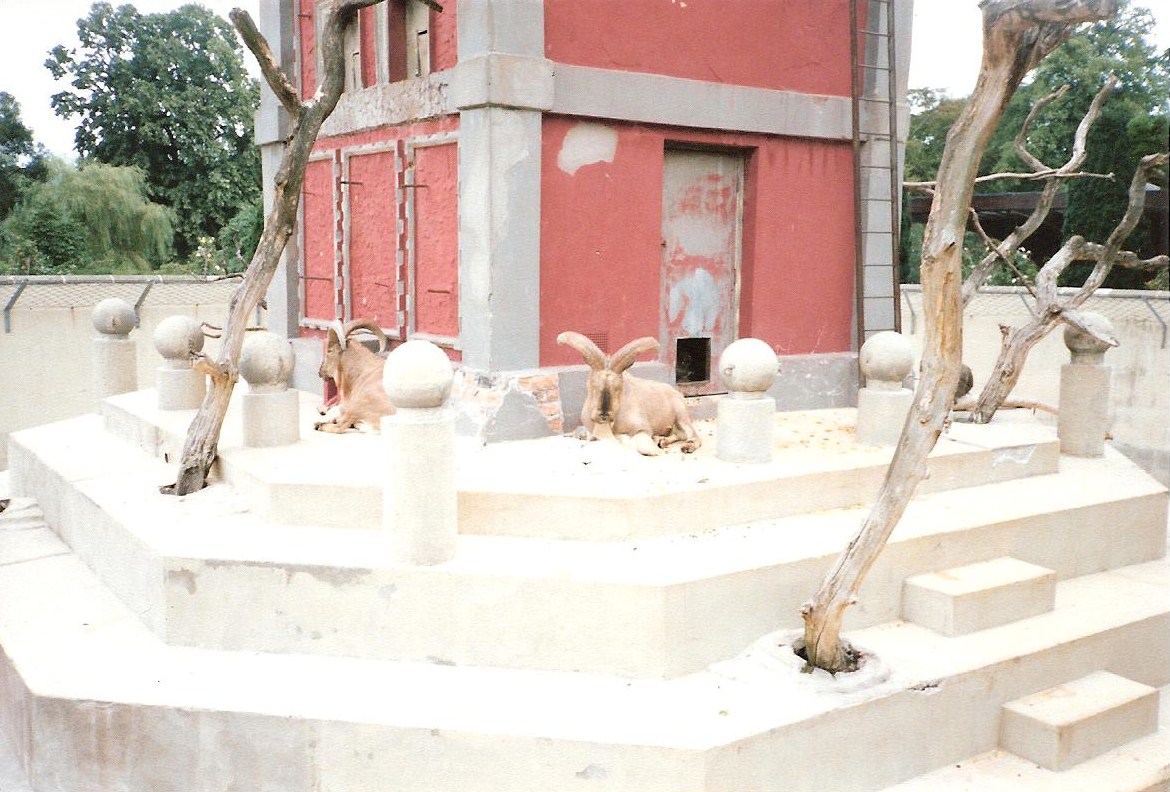
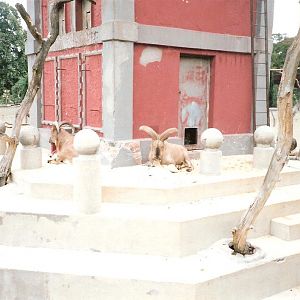
For most of its life the 'Monkey Temple' contained a big group of Rhesus Macaques. Like any other primate colony it was an excellent and successful display in its heyday. The 'temple' was obviously designed to represent an Indian temple around which wild Rhesus troops sometimes live, while the 'ugly' steps actually gave the monkeys a lot more area to run about on. The younger ones in particular would race around the temple, and chase up and down the steps. I think(?) there was a low post and chain decorative barrier around the actual building which they would jump and swing on too.
The domed roof was another feature. The dominant male would sometimes do a funny bouncing 'dance' on top of this, the highest point of his domain. I think there's an old clip of him doing it on an old 'Animal Magic' film of the zoo.
It seems after hours on light evenings some monkeys would sometimes jump out and run around the perimeter wall, but they stayed in the temple during visitor hours.
The display went downhill IMO after the Macaques left. The Barbary sheep were a static, dull display and looked out of place in here.
I never heard the Sumatran Tigers were kept in here. I would not have thought it was safe to contain them.
I don't recall the post-monkey period when only Barbary Sheep were held. I remember it as a mixed exhibit. I thought it was Crab-eating Macaques though I could be wrong. I'm pretty sure that when the Temple was vacated, the remainder (or some of them) of the macaques went onto one of the islands in the pond (which would suggest, actually, that they weren't M.fascicularis!).
Its been painted a brighter colour at some stage too. In the Rhesus colony days it was stone-coloured/grey like the walls and floor/steps.
Those stone bollard things with the round tops are what supported the decorative chain that went around the Temple. I think you can see the chain holes in the round top stones.
I don't recall the post-monkey period when only Barbary Sheep were held. I remember it as a mixed exhibit. I thought it was Crab-eating Macaques though I could be wrong. I'm pretty sure that when the Temple was vacated, the remainder (or some of them) of the macaques went onto one of the islands in the pond (which would suggest, actually, that they weren't M.fascicularis!).
Paul Irven has confirmed that the exhibit did house Crab-eating Macaques in the most recent edition of International Zoo News in his very interesting article on Caprines in British Zoos.
I never liked this enclosure. It's a concrete monstrosity, which is also a parody of a Hindu temple. I think it may have been constructed to illustrate Kipling's Jungle Book. But it was out of date when I first saw it nearly 40 years ago. The fact that it housed macaques quite successfully is a tribute to the hardiness of macaques, not the quality of the enclosure.
The dreadful thing is that it wastes one of the best sites in the zoo. The current display of plants and recycling is very boring, and it cramps the aviaries near by, which actually house an interesting collection of birds at the moment.
Frankly the whole area needs redevelopment and I certainly look forward to the demolition of the 'Monkey Temple'.
The dreadful thing is that it wastes one of the best sites in the zoo. The current display of plants and recycling is very boring, and it cramps the aviaries near by, which actually house an interesting collection of birds at the moment.
Frankly the whole area needs redevelopment and I certainly look forward to the demolition of the 'Monkey Temple'.
It certainly uses up a whole corner of the zoo which could be given over to a new animal exhibit, especially as Bristol has always suffered from a shotage of 'animal space', most exhibits seem to be fitted around the lawns and gardens, rather than the other way round!
Maybe the old Monkey Temple has got a preservation order on it though?
According to 'The Good Zoo Guide' by John Ironmonger, published in 1992, the plans to redevelop the Monkey Temple as an enclosure for Sumatran tigers were part of a 1990 20 year plan for the zoo. Clearly this wasn't followed in this respect.