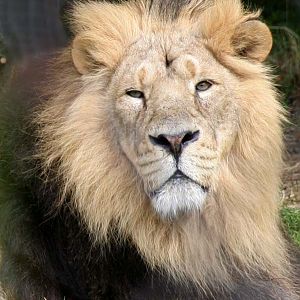
Chester's breeding male Asiatic lion (Jake) was moved to France in 2000 where he died not long after arriving. His mate Chandani stayed on at Chester until her death in 2005 but she wasn't bred again due to having 14surviving cubs! The 1998 litter was 2:1. Masala, the female was moved to Spain in 2000 but her brother's Naseek and Asoka stayed on until 2003 and 2010 respectivly. Asoka became Chester's breeding male but only sired 1:0 surviving cub. This was Tejas from the 2007 litter of 2:0. His brother died at just a few days old. Tejas is doing well at Besancon and has recently been intergrated with one of the zoo's two females.
Ahhh, good news . The gap is understandable (and I forgot that Asoka was born at Chester), how come so few of his cubs with Asha survived? I've heard with Jaguars that the first 2 or 3 litters will likely always fail, so is this a similar story for most cats?
Asoka and Asha's cubs seemed to be particularly prone to genetic deformities (even survivor Tejas was affected by this) - I think they were just not a good match.
As you can see, Jake and Chandani were very much a good match! Just shows how much comes down to pairing animals well.
Asoka and Asha's cubs seemed to be particularly prone to genetic deformities (even survivor Tejas was affected by this) - I think they were just not a good match.
As you can see, Jake and Chandani were very much a good match! Just shows how much comes down to pairing animals well.
Yeah, its not just putting a male with a female like people think. Is it possible that Asha and Asoka were distantly related? Or is it possible that there is an unclassified subspecies of Asian Lion and that cubs from them could be a hybrid? I mean species are being split by the smallest genetic difference all of the time, so is it possible?
Yeah, its not just putting a male with a female like people think. Is it possible that Asha and Asoka were distantly related? Or is it possible that there is an unclassified subspecies of Asian Lion and that cubs from them could be a hybrid? I mean species are being split by the smallest genetic difference all of the time, so is it possible?
Given the fact that all the founders of the Asiatic Lion breeding program came from the wild in India I would be very surprised if any are Hybrids!As for the problems with the Chester youngsters it more likely to be that they are to closely related given how few animals started the program.
The population and range of the remaining Asian Lions are so small that there's practically nil chance of any significant (i.e. subspecies-level) divergence within them. Also, hybrids are often actually better at surviving as individuals than pure-breds ('hybrid vigour' - like how a mule is stronger than a horse or a donkey). Their being related is a possible reason, but I've no idea if that's the case. More likely they've just got an unfortunate combination of genotypes!
Ahhh right. Genetics isn't one of my strong points ;p.
By the way, I wasn't talking about lion subspecies in general, but possible subspecies within the Asian ones particularly (ie. there are African Lions, but they are split into Cape and Barbary (and maybe others, not sure), but you're unfortunatly right that there is too small a population for any real genetic divergance.
In fact, some recent studies suggest there are only two extant lion subspecies - African (as P. l. leo) and Asian (P. l. persica) - and all the splitting of African forms is an error. Whether that'll become accepted or not is a different question!
Ahh, I didn't know that. I know that a few zoos I've seen websites for talk about 'Barbary Lions,' so I think it is still accepted that the African's are further split. These things change all of the time, it is hard to keep up-to-date with what is commonly accepted subspecies wise.
Indeed - as I say, this hasn't gained currency yet, and it may never do so. I think krugeri and bleyenberghi and all the rest will continue to be used unless there's overwhelming evidence otherwise (even by taxonomy standards, subspecies limits are pretty subjective).
Ahh right. I know recently that they found the Malayan Tigerm, which had been exhibited as either Indochinese, Bengal or Sumatran (can't remember which). Just goes to show how things can change.