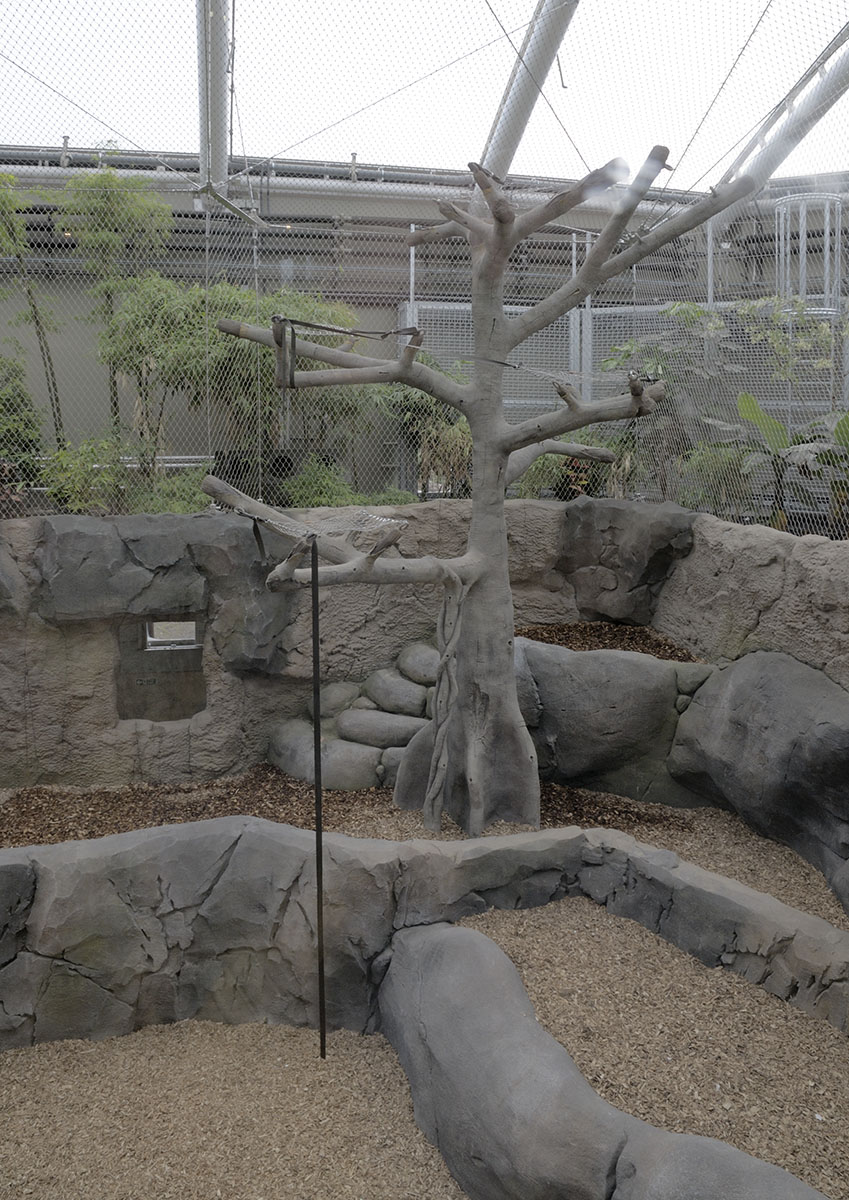
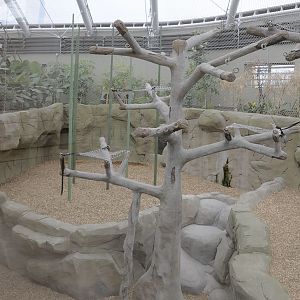
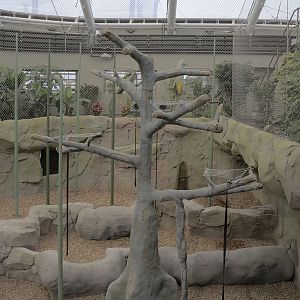
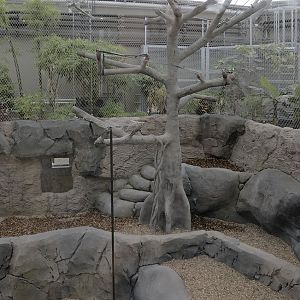
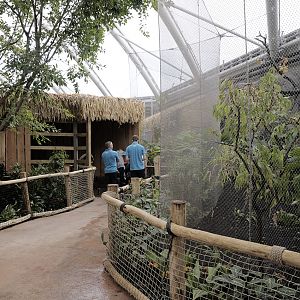
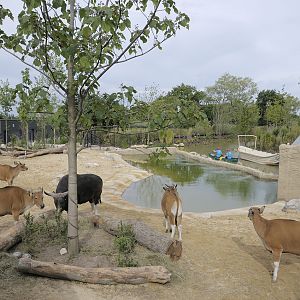
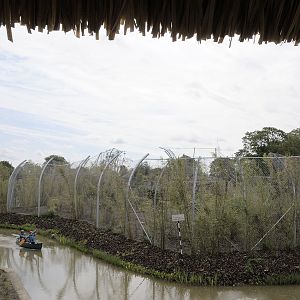
Not the space leading to the southern outdoor exhibit; the construction of the mesh chutes and slides is causing the delay. Islands, Chester, 19th August 2015
for me that raises the question of why bother with an extravagantly immersive scheme for the rest of the complex then? Why not just stick to being utilitarian with a focus on animal welfare without immersion?
Obviously I haven't seen any of it in person but the indoor primate enclosures do seem to let down the rest of Islands.
I'm not widely travelled as far as orang indoor enclosures are concerned, having only seen a few. Chester is far superior to any of the other indoor exhibits I have seen. Which collections do a better job of indoor enclosures?
ZooChatters should realise that these enclosures are designed with the welfare of the animals as the primary concern. Visitors' aesthetics come some way down the list of priorities.
I agree with Shirokuma; if the quoted assumption was the case, why invest money in abundant fake rocks and trees whose main (single) role is said immersion effect for the visitors? Btw.: this isn't limited to Chester, but the many newer exhibits in other zoos.
'Immersion' is never more than an illusion created in the mind of a visitor. There is no way that a zoo can replicate more than a tiny fraction of the experience of seeing an exotic animal in the wild. Imagine glimpsing an orang 50 metres away, at least 15 metres above your eye level, with a thick screen of leaves in the way - add plenty of mud and wet leaves to the path to conceal bumps, potholes and stray roots plus some sharp leaved plants, lots of aggressive ants and stiflingly high humidity. That would be much more immersive, but not too popular with the public
Go to the most popular exhibit in your local zoo and watch the visitors as they watch the animals. What you will see is fascination. I think that should be the keyword for zoo exhibits.
At Chester, the busiest exhibit is usually RotRA because people enjoy watching the Sumatran orangs which are very active - the females caring for their infants, the juveniles playing and swinging or spinning on the straps, the adults climbing and moving more sedately. These enclosures will be better because the viewing windows are larger and the addition of the sway poles and the wired outdoor enclosure will give the orangs and gibbons more opportunities for avtivity. I am sure that it will be very popular with visitors because it will be fascinating.
'Immersion' is never more than an illusion created in the mind of a visitor. There is no way that a zoo can replicate more than a tiny fraction of the experience of seeing an exotic animal in the wild. Imagine glimpsing an orang 50 metres away, at least 15 metres above your eye level, with a thick screen of leaves in the way - add plenty of mud and wet leaves to the path to conceal bumps, potholes and stray roots plus some sharp leaved plants, lots of aggressive ants and stiflingly high humidity. That would be much more immersive, but not too popular with the public
Go to the most popular exhibit in your local zoo and watch the visitors as they watch the animals. What you will see is fascination. I think that should be the keyword for zoo exhibits.
At Chester, the busiest exhibit is usually RotRA because people enjoy watching the Sumatran orangs which are very active - the females caring for their infants, the juveniles playing and swinging or spinning on the straps, the adults climbing and moving more sedately. These enclosures will be better because the viewing windows are larger and the addition of the sway poles and the wired outdoor enclosure will give the orangs and gibbons more opportunities for avtivity. I am sure that it will be very popular with visitors because it will be fascinating.
Of course "immersion" is nothing more than an illusion. But as every magician can tell you, the success of an illusion depends heavily on whether it makes the viewer believe in it to be the "real thing". Woodland Park Zoo's grizzly bear exhibit is a positive example for this. The gallery of Zoochat is full of negative ones (like that tiny Egyptian cobra tank with fake Egyptian artefacts).
Active great apes always attract and fascinate people-even more so if the exhibit carters to their needs, allowing them to display their behaviour. Instead of investing money in unconvincing fake rockwork immersion elements (that does make it look like a movie set), why not invest in stuff that would benefit animals and keepers more, and thereby the visitors, too?
I remember a joke made on another zoo forum several years ago that for a true rainforest immersion exhibit, you'd have to dose the visitors with cold water, mud, mosquitos, leeches and ticks, let them drink contaminated water and lead them through hostile vegetation, without showing them any animal at all in the end. Even though I'm pretty sure that there would be an audience for this kind of experience , I do acknowledge that the majority of zoo visitors wouldn't fall for it. Finding a good combination, pleasing most if not all involved, is key, and, as mentioned above, has been achieved at least in some cases. I just wish zoos would try to be more original when creating new exhibits, and steer away from the TMFR-(Too Much Fake Rocks)-syndrome.
After my second day's visiting at the Monsoon Forest, I must correct an error here. This enclosure has just this single tree and no sway poles, in spite of being longer than the others. Some extra straps have been added in the past week and I don't know if extra equipment will be added before the orangs move in. I apologise for getting the orang enclosures a little confused.