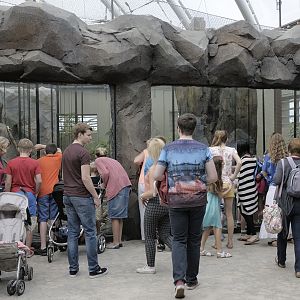
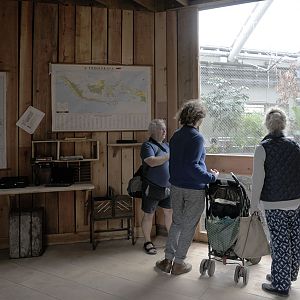
Yes-by using more natural elements (more wood, real rocks, real plants etc.) instead of that fake rock overdose. And camouflage necessary elements, such as doors, may it be by clever strategic positioning and by taking account of the visitors's pov. Several exhibits of various species have accomplished this all over the world, sometimes decades and more ago.
I've yet to encounter fake rockwork in zoos that gives off the "feel" of real rocks. Some of Burger's Desert rockwork is among the closest I've seen so far. Still, nothing beats the real stuff...
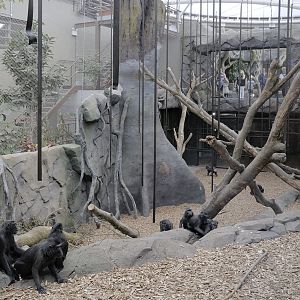
How do you keep live plants in an indoor exhibit for macaques or apes? Chester tried in RotRA and failed completely. Wood would also be destroyed and splinters might be swallowed, besides being difficult to keep clean. Suitable natural stone is heavy, cold, hard to work and very expensive: it's not a viable alternative in this sort of situation - look at all the fake rockwork in the Monsoon Forest and the associated outdoor enclosures - the basic alternatives are fake rockwork, plain concrete in '30s Tecton or '60s brutal style or fencing with several megawatts of hot wiring. I don't think that's a difficult choice.
Design can conceal some things, and CZF's photo shows that the prime view of this exhibit is from the larger upper window, but I like having this alternative too, largely because it gives closer views of the animals.
I await details of your beautiful examples
Oh, you await them eagerly, Alan? Then let me tantalize you a litter longer...
I already mentioned the Atlanta example; replace them again and again. And give them time to settle in, like Woodland Park Zoo did (with the outdoor exhibit, respectively). As for the danger of swallowing wood splinters: sorry, that's a weak excuse, especially in correlation with the already used woodchips. There are different kind of suitable wood already in use in captivity. Sure, cleaning them would be more demanding-but you wouldn't have to create an whole exhibit out of it.
Of course you could use natural stone, but for the same money you'd have to choose smaller enclosures or fewer enclosures - neither is acceptable in this case. Nor are concrete or hotwires, as you virtually admit by ducking my question.
I don't think it's possible to create an indoor environment which resembles the natural habitat of these macaques, without compromising the husbandry and welfare of the animals, or making extraordinary demands on the zoo's resources and staff. In time the outdoor enclosures, planted with evergreen shrubs and small trees, with dead tree trunks and sandy areas will come reasonably close to nature. The climate of north west England does not match Atlanta's - so that comparison is hardly valid.
BTW properly treated bark chips do not splinter.
Funny enough, I've seen animals injuring themselves with splinters from allegedly fine bark chips. You'll never know. Don't focus too much on natural stone, as this would be anything but another element, yet not the prevalent one. I do think that it is possible to create a modern adequate exhibit for the animals in question, without it having to look like an unnatural fake rock desert, by using more natural ingredients. You would probably see that yourself if you weren't blinded by your love and passion for Chester zoo, making it impossible for you to accept critique by some snooty foreigner. Just ask yourself: does a monsoon forest look anything like that? As for plants in indoor primate exhibits: have you ever been to very untropical Munich, Germany?
Funny enough, I've seen animals injuring themselves with splinters from allegedly fine bark chips. You'll never know. Don't focus too much on natural stone, as this would be anything but another element, yet not the prevalent one. I do think that it is possible to create a modern adequate exhibit for the animals in question, without it having to look like an unnatural fake rock desert, by using more natural ingredients. You would probably see that yourself if you weren't blinded by your love and passion for Chester zoo, making it impossible for you to accept critique by some snooty foreigner. Just ask yourself: does a monsoon forest look anything like that? As for plants in indoor primate exhibits: have you ever been to very untropical Munich, Germany?
I'll never know if you don't tell me!
If natural stone is not the prevalent element that you prefer, what is?
I assure you that I am far more critical of Chester than I am of many other zoos, but I try to ensure that my criticism is constructive, reasoned and based on evidence. I hope that other ZooChatters will try to do the same: so I will not use or consider ad hominem arguments, but neither will I accept assertions without explanation or evidence.
Of course Chester's Monsoon Forest is not much like a real monsoon forest, visitors would hardly see any animals if it was and they would certainly complain about the humidity and the mud Like many of the zoo's other exhibits, it has been given a silly name.
I have visited Munich, a long time ago, the climate data confirm my impression that at this time of year it is significantly hotter and wetter than Chester. Looking at the Tierpark Hellabrun website and our Gallery here, I have found one photo of a palm tree in the Diana guenon indoor enclosure. Is this what you are referring to? Is the indoor part of their new Drill exhibit planted in any way? The outdoor section looks small and bare compared to the mandrill island at Chester. Apart from grass, are there any plants in the orang exhibits now?
The enclosure is badly named it isn't either monsoon or forest, which will put an immediate sense of disillusionment into the mind of on any one expecting a literal translation
I wonder why they didn't paint the wire black and when it is then less visible use plants behind the wire to blend it in, trees in pots or living walls of climbers on mesh with the odd dead tree on each side to blur the boundary and fool the eye more.
The man made tree trunks etc behind the viewers in the window have a more natural finish, why has the buttress roots and branches in the enclosure been left grey? or shaded the same colour as the stone work?
The stone work could have been tinted and coloured to give a more natural effect too It looks as if it has been rushed which is a pity as it looks a large and well meant set up.
But in the end it is an indoor enclosure and that is alien in it's self as the apes don't have such a thing in the wild. Let's give it time to settle in and see what happens.
Sorry for being a wisenheimer, but to honestly assess the quality of fake rockwork, I have to see and feel it in person. The photos I've seen so far don't impress me that much.
@Alan: both one of the chimp indoor exhibits as well as the Diana monkey exhibit sport live plants-without any of the animals injuring themselves on them. This year's summer in Munich has been far from the norm temperature-wise, like in many other parts of Germany. Maybe you should visit the city more often to see that it hasn't become part of the tropics out of a sudden.
A smarter mix of different materials is what I'd prefer. Instead of an orgy of unfavourably placed fake rocks. This could be wood, natural rocks-and wven and also aesthecially and practically employed concrete/fake rocks, metal bars, wires etc.. If you want to see that as an ad hominem insult, so be it; your replies so far have been anything but constructive, but came about as rather condescending. This includes your statement regarding the "monsoon forest": most visitors have and will never see a monsoon forest. This doesn't have to mean that you have to present them primates in another artificial rock enclosure; this is neither educative (a purpose I was told personally by a high-ranking member of Chester Zoo staff this May was of great importance for the enclosure complex) nor aesthetically pleasing or original (as already mentioned by other Zoochat members).
@Alan: both one of the chimp indoor exhibits as well as the Diana monkey exhibit sport live plants-without any of the animals injuring themselves on them. This year's summer in Munich has been far from the norm temperature-wise, like in many other parts of Germany. Maybe you should visit the city more often to see that it hasn't become part of the tropics out of a sudden.
A smarter mix of different materials is what I'd prefer. Instead of an orgy of unfavourably placed fake rocks. This could be wood, natural rocks-and wven and also aesthecially and practically employed concrete/fake rocks, metal bars, wires etc.. If you want to see that as an ad hominem insult, so be it; your replies so far have been anything but constructive, but came about as rather condescending. This includes your statement regarding the "monsoon forest": most visitors have and will never see a monsoon forest. This doesn't have to mean that you have to present them primates in another artificial rock enclosure; this is neither educative (a purpose I was told personally by a high-ranking member of Chester Zoo staff this May was of great importance for the enclosure complex) nor aesthetically pleasing or original (as already mentioned by other Zoochat members).
I apologise for using the phrase ad hominem, which you obviously do not understand. I am trying to be constructive because I am struggling to understand your reasoning. I accept that you don't like the appearance of this enclosure and of some of the others nearby. I agree with you that the educational value of this exhibit is somewhat limited by its appearance. On the other hand I think this disadvantage is outweighed by the opportunity to observe the social behaviour of this large group of macaques. I have complained elsewhere that the educational opportunities of the whole Islands development have been largely neglected so far, I hope that this will be corrected soon.
But I cannot understand any other reason why you prefer the materials you mention - I repeat that I think that this mix of materials is expensive and hard to maintain. I don't think that saying 'Monsoon Forest' is a silly name is condescending but I apologise if I have unwittingly offended you by doing so.
I should have explained more clearly that Chester has special expertise in managing large groups of primates: the group of macaques in the photo is over 12 individuals and, as Chester Zoo Fan has explained, this number will rise when a new adult male is introduced; likewise the orang enclosures may need to house up to 10 adults, infants and juveniles. These enclosures are designed to meet the requirements of these animals and of their keepers, who were closely involved in the specifications and design of the exhibits. They have to live and work with these enclosures; I am sure it is right that their practical requirements have driven the designs.
Another example of an unnecessary condescending remark of yours.Superbientem animus prosternet...Do you think I'm too stupid to see what you tried to do in your previous post? You & "other Zoochat members" = constructive critique, based on "evidence"(?). Batto="ignorant foreign bellyacher". That's not constructive critique; it's an attempt to silence an opposing view, hardly concealed by pretending to be friendly and polite. The "excuse" combined with an insult is a great example for this. You should be old enough and a better person to be beyond this.
If being snarky, I could remind you that you could also observe their behaviour in an old-fashioned cage-which would be also as practical for animals and keepers and save money, without having to spend a lot of money on fake rockwork. Given the expertise you have mentioned, I'm not the only one to wonder why it couldn't have been made to be more aesthetically pleasing or original. Let's see whether its appearance will improve over time-or not.