This is my last comment in this thread for the time being.
I have tried to research the housing of chimps and Roloway guenons at Tierpark Hellabrun as suggested above. There are some live plants in the indoor enclosures for these species. I have not found out how many Roloways are kept, but it seems that there are only about 6 chimps. I think these enclosures may be relatively large because Munich is so cold in winter that the animals cannot go outside very much, which would help the survival of the plants. I also suggest that, in general, guenons are less destructive than macaques and I am sure that chimps do less damage to their surroundings than orangs, whose destructive abilities I have personally witnessed.
I submit two final pieces of evidence: in 2009 Chester published a Powerpoint presentation about RotRA. It may be downloaded at PPT - Realm of the Red Ape A New Approach to Orang-utan Husbandry PowerPoint Presentation. Slides 18 to 20 show the original planting of the indoor Sumatran orang enclosures. Likewise the ZooLex page for RotRA ZooLex Exhibit has a photo of this vegetation showing wear and tear about a year after the building was opened. After two years very little remained.
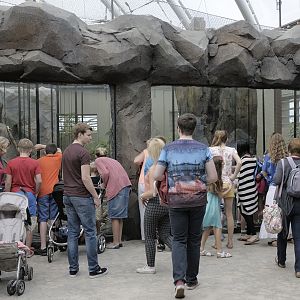
It's just not living plants, Alan. As mentioned by Jurek7 in another thread, the whole exhibit complex looks quite unfinished, bleak and even somehow outdated. And I'm just tired of the same mold exhibits are made these days. Let's see how it will look after some time has passed. Personally, I'll be happy when the whole "fake rock elements" fashion in zoos will make room to something more naturalistic and useful.
No hard feelings...
Great if you spend lots of time visiting zoos all over the world. This is the only thing on this scale in the UK. Although I cannot stand Colchester and its fake rock. Chester even though its use have been quite extensive in recent developments seem to make it work.
Great if you spend lots of time visiting zoos all over the world. This is the only thing on this scale in the UK. Although I cannot stand Colchester and its fake rock. Chester even though its use have been quite extensive in recent developments seem to make it work.
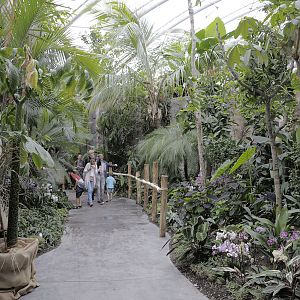
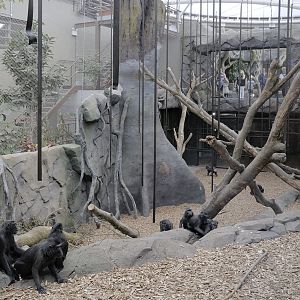
I think this exhibit needs to be seen in the context if the entire Monsoon Forest which, as the photos on this gallery demonstrate, is largely comprised of dense tropical planting. In the run up to this exhibit visitors pass through a tree top walkway, and the planting surrounds almost the entire perimeter of this enclosure. From the photo alone it does look like a lot of fake rock work...but it's setting sits within the surrounding forest.
Rejoice, as long as you can. And it's certainly not just German zoos who indulge in "mockrock" (nice phrase, @lintworm ), as illustrated by many examples in the Zoochat Gallery.
@ChesterZooFan: I see your point. Maybe it'll look better in person at my future visit of Chester Zoo.
The overall appearance is very stark at this point, but I've also learned from experience that newly opened exhibits often change quite dramatically (plants growing, added tree stumps, minor fixes, paint, etc) and often only reach their full potential a year or two after opening. Sure zoos could chose to postpone openings, but there's always a demand to get visitor access as fast as possible. I can't say where this will end when things have become more settled, but can say I've been wrong before when I was a bit too fast in judging brand new exhibits.
@temp, you are certainly right about that. This will easily be the largest crested macaque enclosure in the world, but it needs some more furnishing I would say and it appears that one can oversee the whole enclosure from one point, which doesn't seem right to me...
For this exhibit I think it would already have worked better if they had used a darker shade of grey for the mockrocks (there should be about 50 shades, so enough choice...). Now everything looks a bit pale...
For this exhibit I think it would already have worked better if they had used a darker shade of grey for the mockrocks (there should be about 50 shades, so enough choice...).
I wouldn't criticise Alan's photographic skills for all the tea in China, but his images do have an under-saturated style in contrast to the over-saturated norm these days, which in this instance may be contributing to the impression of "stark" and lighter shades of grey.