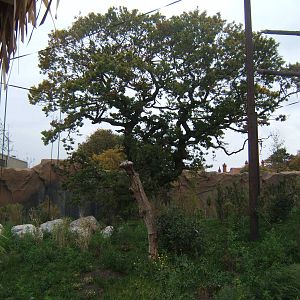
None of them will have seen a live tree before( Puluh came from Perth which has very modest enclosures). They may be nervous of the completely new surroundings to start with but once they have overcome that, will then soon explore it I think. But in a few years time only the dark main structure of trunk and thickest branches is likely to remain.
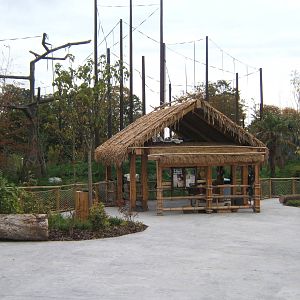
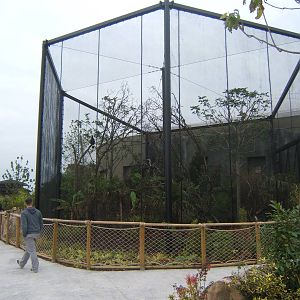
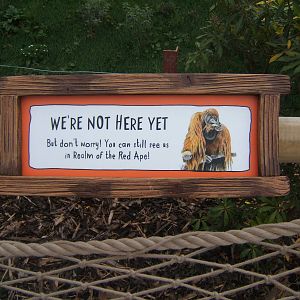
The plants inside RotRA were destroyed, but the ones outside seem to have survived pretty well omn the whole, although I reckon they would all be counted as shrubs rather than trees. I think this tree stands a chance - partly because this photo only shows about half of this enclosure, which is much larger than the other open-topped enclosure or the netted one.
I also wonder if the Bornean orangs may prove more destructive of the shrubs in the RotRA enclosures than the Sumatrans were.
Sooner or later all but the most timid orangs will get into it. Adults will destroy it. Juveniles would be fine in it. If the tree were carefully pruned it might stand a chance. As it is, not terribly long for this world, IMO. Of course, it may yet get protected, right?
Why?
Orangs in zoos usually spend far too much time on the ground. So if you are designing an enclosure for a large breeding group of orangs you must try to give them as many opportunities for climbing as possible. If your site has a large tree in the middle, you want them to climb it. Hot-wiring a tree in an orang enclosure is as sensible as refrigerating the water in a crocodile pool.
Of course you could cut it down and then set the trunk in concrete, or cut it down and build an artificial tree, but why bother? Prune it bit, leave it and see what happens: if the tree survives it's wonderful, if it dies you've still got the other alternatives and the orangs have had splendid enrichment in the mean time.
Note this photo shows that this enclosure also has telephone poles with webbing straps (like RotRA) and on the right hand side are the ends of the branches of a large artificial tree whose trunk is outside the frame. If I remember rightly there were sway poles on the plan too
That would depend on the purpose the tree serves - it may be hot wired if it were meant for aesthetics or for shade. But neither of these seem to be important considerations for UK zoos.
I'd actually be more concerned that the tree branches can't bear the weight of the apes and they hurt themselves when falling.
When I saw it they had ripped them up already. Nothing on this scale though. But don't think it will be able to withstand the use of six/seven Orangs longterm without killing most of it off. Still, it will be interesting to see the outcome.
Paignton's big (Willow) trees on their Orang island have been drastically cut back and now appear dead, though they flourished for a number of years with the Orangs using them( only two animals mostly, not six/seven, and several trees, not one). Increasingly though the broken branches the Orangs had snapped, died and became unsafe, the reason for the 'surgery'.