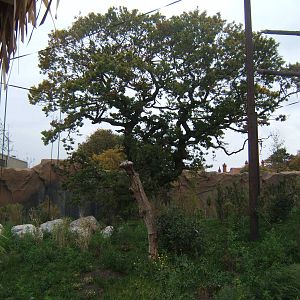
When I saw it they had ripped them up already. Nothing on this scale though. But don't think it will be able to withstand the use of six/seven Orangs longterm without killing most of it off. Still, it will be interesting to see the outcome.
Paignton's big (Willow) trees on their Orang island have been drastically cut back and now appear dead, though they flourished for a number of years with the Orangs using them( only two animals mostly, not six/seven, and several trees, not one). Increasingly though the broken branches the Orangs had snapped, died and became unsafe, the reason for the 'surgery'.
It will be a very interesting comparison, because there are several different factors. Chester's Sumatrans may behave rather differently from Paignton's Borneans. If Chester continues with their current management policy, their orangs will have unrestricted access to 3 indoor and 3 outdoor enclosures, plus the more confined spaces of the chutes between them plus, possibly, 2 off-show indoor dens too - while Paignton's orangs spend their whole day in the same enclosure. And don't forget that the Navy Board yards used huge amounts of oak, but I don't think anybody ever made a ship of the line out of willow
This is the million pound question I think. Given that none of these orangs have learnt to test branches from their mothers, will they be able to keep themselves safe? Chester must have good reason to think so, because they wouldn't risk it otherwise. Are there examples of orangs in other zoos who are captive born being introduced to trees?
I didn't realise Chester managed them in one group. I had thought that perhaps access to the tree might be limited to protect it.
It should be noted that the design team made the decision to save this tree. You don't plan and build such an enclosure and miraculously, coincidentally, a large oak survives the construction unscathed. So there were discussions among team members and staff about this tree. They expect SOMEthing. Perhaps that it will just be lucky and survive. Perhaps that whether it lives or dies it will engage the animals and the eventual expense of removing it when it becomes dangerous will have been worth it. Perhaps they will protect it for a period. Perhaps, with pruning, they will restrict which animals can get into it (yes, that would work).
We don't know what the team was thinking.
But be certain that the zoo has an idea of what they expect to happen. Maybe they'll be right. Maybe not. That's one of the great moments in designing something new that extends your experience and comfort zone. As Dr. William Conway (WCS/Bronx) said on the completion of Congo Gorilla Forest, The animals will soon show us where we made mistakes.
Given that none of these orangs have learnt to test branches from their mothers, will they be able to keep themselves safe? Chester must have good reason to think so, because they wouldn't risk it otherwise. Are there examples of orangs in other zoos who are captive born being introduced to trees?
I think the ability to 'test' branches is at least partially instinctive. Orangs are cautious creatures by nature anyhow. I think problems are only likely to arise because of overuse of the tree- which eventually creates dead and dying branches which the animals will probably still go on using just because they are confined in an enclosure with limited(however good) climbing opportunities. Once the tree gets to that stage, cutting back is the only real option, both for safety and appearance.
Paignton's Orangs are/were all Zoo born. The original animals came from London Zoo and had lived all their lives in conventional cages. Most of them, particularly the oldest ones were habituated non-climbers and rarely if ever used the trees on the outdoor island at Paignton, probably the reason the trees stayed in pristine condition for so many years after the exhibit opened. Only after the arrival of a younger, fitter and more adventurous pair from Germany did the exhibit start working as it was really meant to, with the Orangs looking entirely natural high up among the foliage.(See the many photos in the Gallery taken of them from this period). It is mainly that one pair's continuous use of the trees over some years that has eventually lead to the stage where the branches were lopped and the remaining tall trunks now appear dead.
I think at Chester it will be the same thing- just a quicker process perhaps because there is a larger group and only a single tree. Being Sumatrans of all ages, this is an active group of fit animals and I doubt they will be hesitant about using it either. Of course they will have plenty of other climbing equipment and other spaces to use, but the foliage in the tree is bound to act as something of a magnet.
I'm sure the zoo have planned for all this, the inclusion of this tree for climbing being seen as an added feature of the design. That's unless of course they are planning to hotwire it, either before or after the enclosure comes into use.
The Philadelphia Zoo has three large sycamore trees in its Sumatran Orangutan/Lar Gibbon habitat, and the adult female orangutan and baby (now juvenile) orangutan are able to scale the ropes and climb the trees without damaging the branches.