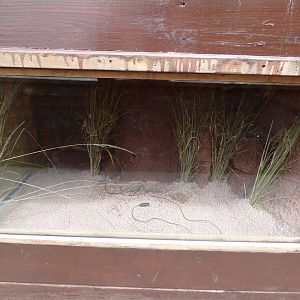
To answer an earlier question, the work seems to have stalled. No real progress has been made in a month or so, the fences are still unfinished and the tools/steps etc. are still in the enclosure.
True; the confusion arises because the Siberian Lynx is a distinct subspecies of the Eurasian Lynx and is restricted to the taiga and tundra of northeast Siberia - the two names are not synonymous with one another.
On a related note, given how drastically different the Siberian Lynx - the easternmost subspecies of Eurasian Lynx - looks when compared to the Carpathian Lynx - the westernmost subspecies - I have long-suspected that the two taxa represent opposite ends of a species chain, possibly with the Canadian Lynx and Iberian Lynx continuing the chain at either end.
Nothing has been confirmed as yet, so the speculation is still wide open. Just a pity that Bwassa's suggestion of Brown Hyena is extremely unlikely given how low the European population is....
True; the confusion arises because the Siberian Lynx is a distinct subspecies of the Eurasian Lynx and is restricted to the taiga and tundra of northeast Siberia - the two names are not synonymous with one another.
Has that actually been determined and the Siberia-specific population individually classified? I was under the impression that there were regional variations in diet and behaviour as there are with many species, but that the species was essentially the same as Lynx lynx.
Pointers to any recent studies would be appreciated (again, sorry to go OT).
Has that actually been determined and the Siberia-specific population individually classified? I was under the impression that there were regional variations in diet and behaviour as there are with many species, but that the species was essentially the same as Lynx lynx.
Pointers to any recent studies would be appreciated (again, sorry to go OT).