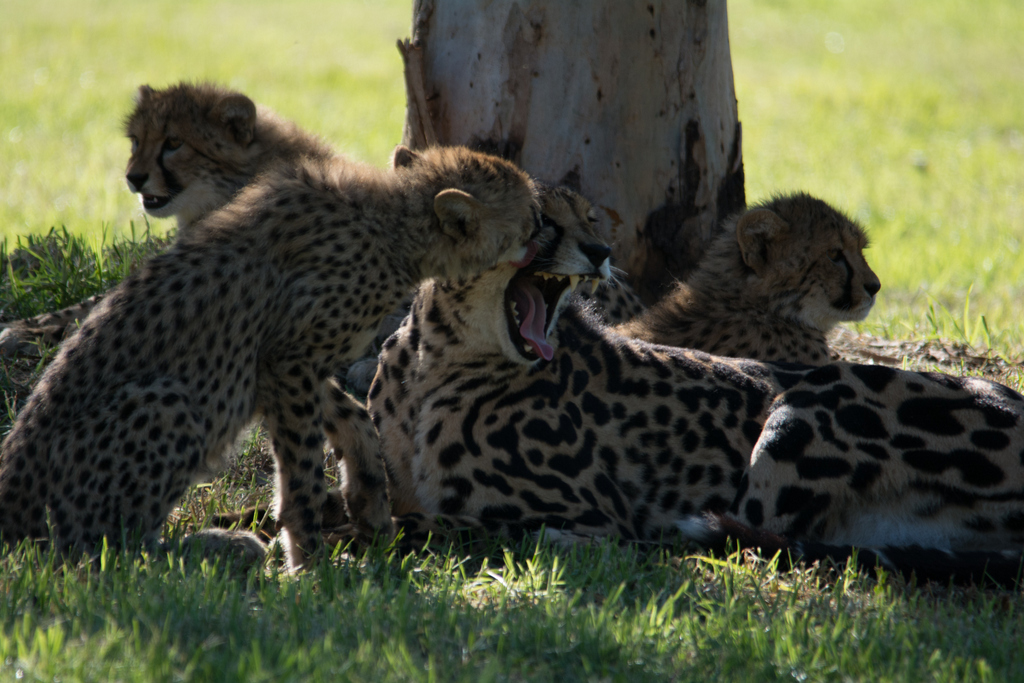
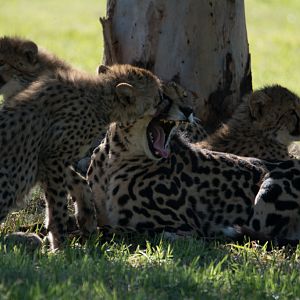
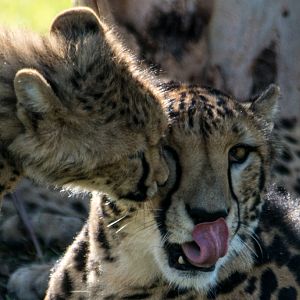
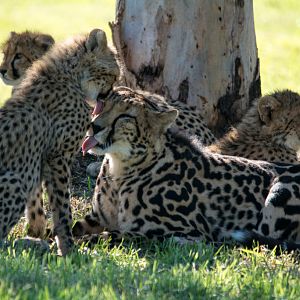
yes the mother was a king and none of the 3 cubs were king.
I hadn't been up to Dubbo for about 10 years. She was the main reason I had been trying to find a spare moment to get up there. So it was good to be able to see her out in the open although she did spend a lot of the time at the back gates.
that is correct. This female is called Halla. She was born at Taronga Western Plains Zoo in October 2009 as part of a litter of four, two of which were king cheetahs (the other is a male called Kyan). Both the parents were "normal" cheetahs.
This litter of cubs (all "normal") was born October 2013, the father being a "normal" cheetah imported from New Zealand in 2012.
The two king cheetahs (Halla and Kyan) are the only ones in Australia, and both are still at Taronga Western Plains Zoo. There was until a few years ago an unrelated one at the National Zoo And Aquarium in Canberra called Juma. I'm not sure where he came from or what year he died.
I'd be interested in knowing what 'causes' a King Cheetah. Is it a recessive gene? Do both parents have to carry it? Why does it occur so rarely? It's interesting that Halla and Kyan were born to 'regular' parents and Halla has 'regular' babies. I wonder if any of the other in the litter produced a 'King'...
As far as I know it is a typical autosomal recessive mutation, indigenous to southern Africa. (Then again, until recently, I thought black jaguars were also recessive).
A form I have never seen... Not that I'm advocating it, but they could presumably quite easily fix the gene by breeding the brother and sister 'Kings' together, or the cubs from this litter for that matter. Perhaps better that they just allow it to express itself naturally though.
I have heard in the past suggestions that these stripes/joined up spots represent an evolutionary trend for Cheetahs toward a more forested environment(being better camouflage than spots).
As far as I know it is a typical autosomal recessive mutation, indigenous to southern Africa. (Then again, until recently, I thought black jaguars were also recessive).
Oh, well, a typical autosomal recessive mutation. That explains it all. Silly me. hahaha. I know human genetics, not animal. I will have to read up on that, but thank you for giving me a 'jumping off' point, I appreciate it.
I have heard in the past suggestions that these stripes/joined up spots represent an evolutionary trend for Cheetahs toward a more forested environment(being better camouflage than spots).
that was a theory that king cheetahs were evolving towards being a distinct species, supposedly with different morphology and behaviour as well. It's all nonsense.
that was a theory that king cheetahs were evolving towards being a distinct species, supposedly with different morphology and behaviour as well. It's all nonsense.