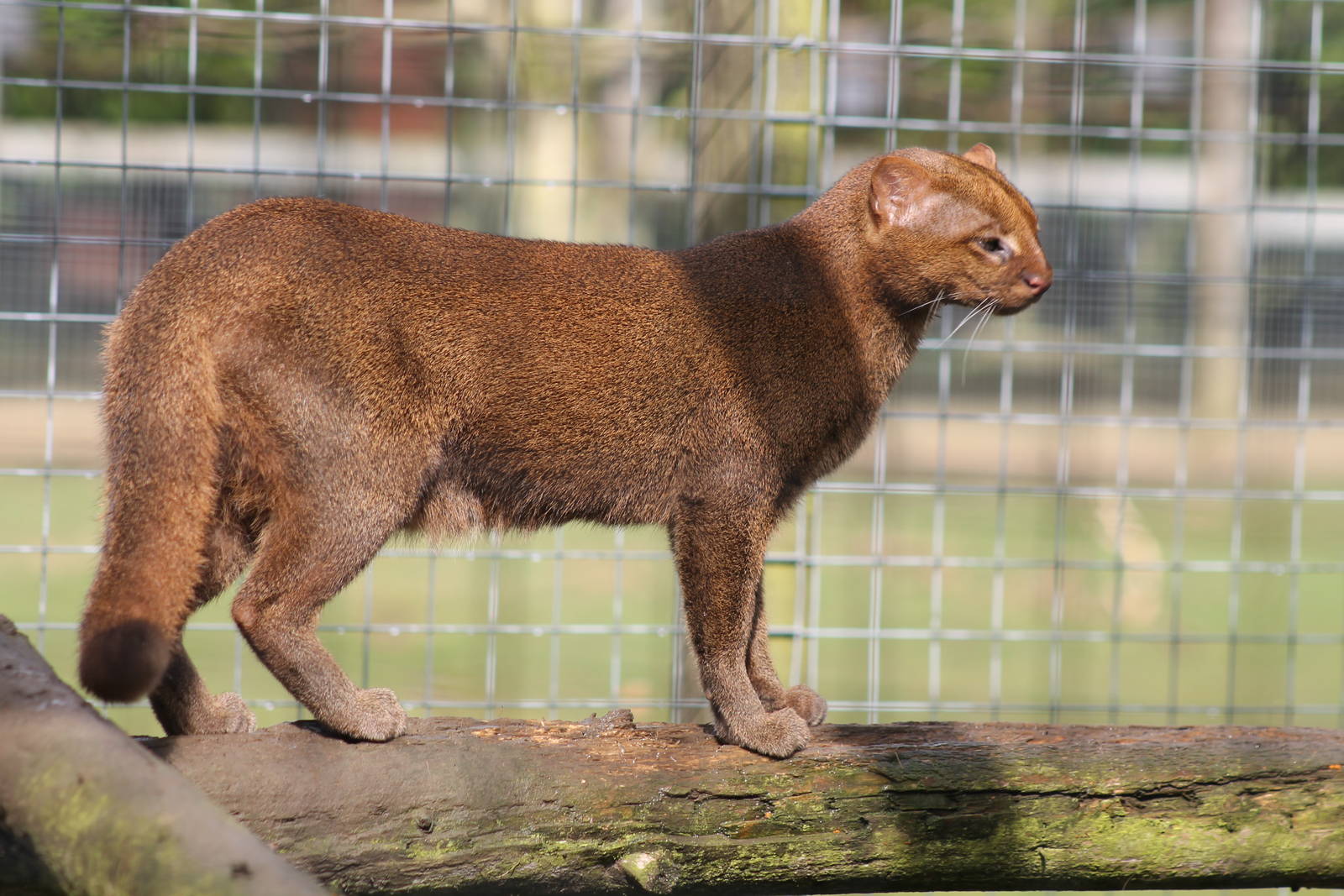
Not the only. Most modern authors avoid genus Puma for it and put it in genus Herpailurus. But I keep still in genus Felis as all the other "small cats".
Not the only. Most modern authors avoid genus Puma for it and put it in genus Herpailurus. But I keep still in genus Felis as all the other "small cats".
Of course, the problem with lumping the cats to such a wide extent is that the logical result is for the entirety of the cat familiy to comprise only two genera, Felis and Panthera - Neofelis split from the line leading to Panthera much more recently than the splits between most lineages in the Felinae, and Acinonyx is deeply nested within the Puma lineage of the Felinae.
By the by, Herpailurus is not the majority term, having been deprecated in favour of Puma some time ago.
Much more than two genera! I consider: Acinonyx, Felis, Leptailutus (too different in shape for be in Felis), Lynx (including Caracal, as a subgenus), Neofelis, Panthera, Puma (with only P. concolor) and Uncia (better spilt from Panthera). Appart of Barbourofelis, Homotherium, Machairodus, Meganterion, Promegantereon and Smilodon, hehe
Anyway it would be no problem in be a family with few genera. Many families are reduced to only one genera, or very few, even having lots of species.
Much more than two genera! I consider: Acinonyx, Felis, Leptailutus (too different in shape for be in Felis), Lynx (including Caracal, as a subgenus), Neofelis, Panthera, Puma (with only P. concolor) and Uncia (better spilt from Panthera).
Lynx and Caracal are about as distantly related as members of the Felinae get, genetically! Just because the latter genus has tufted ears does not mean it belongs with the most famous group of cats with tufted ears if you were to lump Caracal with anything, you should lump it with Profelis and Leptailurus, as they form a monophyletic clade.
Incidentally, I hope you are willing to accept the ramifications of splitting Uncia from Panthera - to wit, in order to get both to work as monophyletic groups you would have to include the tiger in the former genus, removing it from Panthera. Using Felis as a dumping ground for any smallish feline would cause a similar issue with Pardofelis, as this is the most basal of the entire Felinae - if you include this within Felis, you have to include *all* of the Felinae within the one genus, Acinonyx included.
Well, I just don't put all my faith in DNA analysis. I think that it can be helpful sometimes but other times it can lead us to wrong results. Caracal shares with Lynx more than a tufted ears: short tail, same size, head form, leg and body proportions... and for sure much more caracters that I don't know, maybe in skeleton anatomy. I think that is just a tropical/desert adaptation result of the lynxes, enough different to put it in its own subgenus (I think that vertebrate zoologists often forget the existence of intermediate taxons, such as subgenus).
About the snow leopard, I just think that it's impossible that it evolves from the ancestor of tiger more closely than with the ancestor of leopard I just accept Uncia because is the most accepted taxonomy for it since many, many years.
Oh, not felines???? Sorry for the mistake then :-( What are they? Nimravids???
yes, Varanus is a good example. Or Conus (sea snails), or Chaetodontidae (few genera and most species in Chaetodon, with a looooot of them). About Anolis (including Norops et al) is the largest genus of what I consider Iguanidae (yes I know, you will take a fight on me again for considere it as iguanids hehehe), with few more genera with few species. Really they look like different from the rest of iguanids but this option has long been accepted before so I keep in it (at the moment).
Caracal shares with Lynx more than a tufted ears: short tail, same size, head form, leg and body proportions... and for sure much more caracters that I don't know, maybe in skeleton anatomy.
The short tail found in Lynx and Caracal is also shared by Leptailurus - which the genetic information demonstrates is the closest relative, along with Profelis, of the latter genus.
The single species of Caracal is slightly smaller in body length than Lynx pardinus, but significantly smaller when compared to the other three species found in the genus.
Cranially, Caracal is much more gracile than Lynx, with a skull which is almost identical to that of Profelis and incredibly similar to that of Leptailurus. Moreover, it is less derived when one looks at characters such as the morphology of the teeth - although reduction in the number of post-canine teeth is not uncommon in cats, Lynx has the lowest tooth-count of any felid, with those teeth it does have showing considerable hypertrophy.
In terms of leg and body proportions, this is the easiest to refute by far; Caracal, again along with Profelis and Leptailurus, form a clade of long-legged, extremely gracile cats - approaching Acinonyx and the extinct Miracinonyx in their gracility. Conversely, although Lynx also possesses long legs, the skeleton as a whole is much more robust - this cannot be put down as merely due to Lynx being a cold-climate genus as the smallest and most robust of all species - the Iberian - is also the most southerly.
They *were* long assumed to be Nimravids, but now are classed in a monophyletic family of their own, the Barbourofelidae, which forms a clade with the Prionodontidae and the Felidae.
Well, I see that you studied deeply these cats. What can I say... I usually (almost always) guide my taxonomic considerations on what has been mostly accepted during long time. Since the modern taxonomy of felines is too recent for me, I will keep the things as before (at the moment... I'm always open to possible future changes, for example I already reordered my files of angiosperms according mainly with the modern taxonomy).
Anyway... well, I never go to zoos with a metric rule for compare caracals with servals, hehehe. But I have the impression that they're quite different. Servals have much smaller nose/mouth area, much longer legs (maybe a caracal can look long-legged compared with Iberian lynx, but for me is the same long-legged than a boreal one)