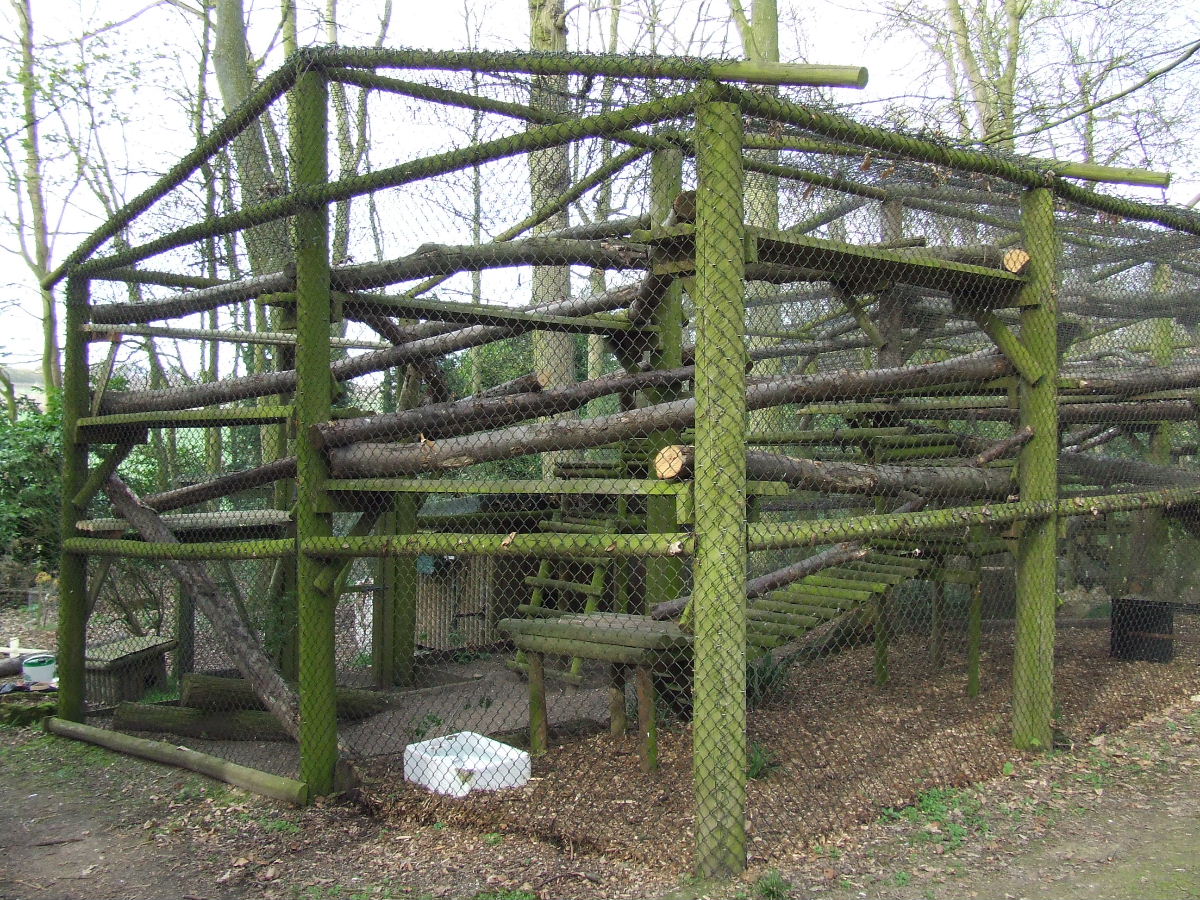
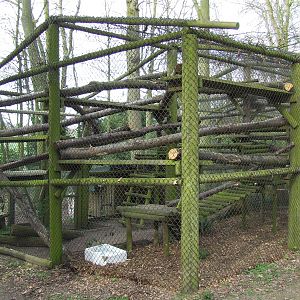
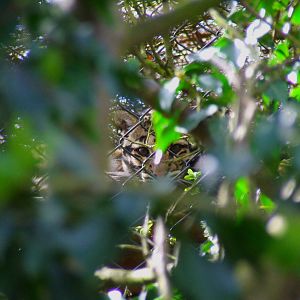
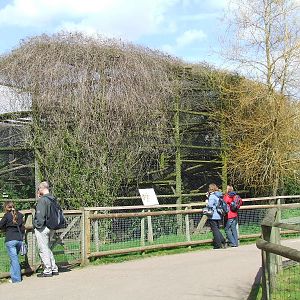
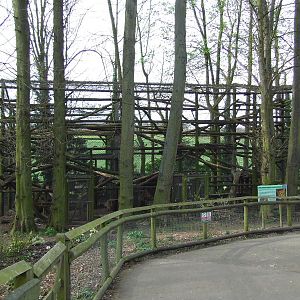
The Howletts fishing cat enclosure looks as if it has a labyrinth of climbing frames for the cats, but is it naturalistic? Of course not, but all you Howletts fans settle down because I still feel that it is an effective enclosure for the cats. The experience is not immersive for the visitors as there is no recreation of the natural environment of the cats, but nonetheless it is still possible to praise the wire and wood enclosure.
*sigh* Here we go again. However good those enclosures may look, I don't think any of them can add up to the Aspinall Park's on the animal's own feelings to the enclosure. Animal over Aesthetics.
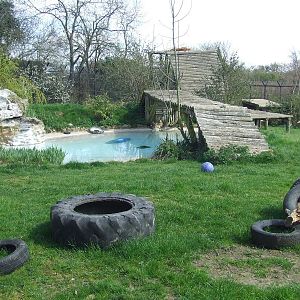
See, to me this looks better than the San Diego enclosure. Sure, SD's has more plants and a bigger pond, but this one has so many more climbing and scratching opportunities.
Fine if this was an off-exhibit breeding facility. As an exhibition it sends all the wrong messages to the public. And since the chances of fishing cats ever being "saved" through re-introduction from captive breeding situations is nearly zero, then the only rationale for keeping these animals in captivity is education. Functional but ugly enclosures like this defeat any educational outcome that might come from having these animals on public display.
That might be great for a Clouded Leopard, or an another predominately arboreal species (or even your domestic cat), but for a species that likes densely vegetated swamp/mangroves near streams, ponds and lakes, this enclosure appears to be NOT be ideal for this species.
There is a white box in the enclosure - I hope that is not it's water bowl.
The only education that the public will receive is that a beautiful species of cat can be kept in ugly wire and wood cages that can be constructed for a few thousand dollars. There is no sense of creating a natural environment, with flowing water, a pool, thick bushes, trees and other foliage...instead what is left is a CAGE and not anything particularly noteworthy. I have a friend on a Canadian farm that has similar kind of chicken wire cages for guinea pigs, rabbits and chickens.
That might be great for a Clouded Leopard, or an another predominately arboreal species (or even your domestic cat), but for a species that likes densely vegetated swamp/mangroves near streams, ponds and lakes, this enclosure appears to be NOT be ideal for this species.
There is a white box in the enclosure - I hope that is not it's water bowl.
I guess you're right with that, and the cages at the other park seemed more suited to this species. One was even built around a small river. And it wouldn't kill them to get an actual water bowl lol, although I think this cage had a pond aswell if that's what you mean.
But I fail to see how keeping it in a cage with enrichment etc is a bad thing...? If the education signs are up to scratch then surely they'd do enough in terms of education? 90% of the public probably wouldn't read them anyway, and would be happy as long as they saw the cats regardless of how they're displayed. Hell, half of them wouldn't even know what a fishing cat is
And how are gorillas being "saved" through captive breeding? Yes, there have been a few Howlett's-born animals "returned" to essentially captive situations in Africa (with no small level of controversy about possible disease transmission to wild gorillas etc.), but the only real contribution to gorilla conservation zoos have made is through making the public aware of the need to save African forests that are the home of gorillas. And the money that has been raised to support these activities, utilizing captive gorillas as "ambassadors." Zoos have for the most part moved past the unjustifiable self-declaration of being "arks," knowing full well that the opportunities for successful reintroduction are far and few between. It's all about education, and that includes showing animals in a context that supports the message that animals and habitats are inseperable if the animals are to survive as wild creatures. And that is a message that can be conveyed even if the visitors totally ignore the signs--if the exhibit itself tells the story.
A fishing cat in a chicken coop doesn't do the trick.
Wow, the start of your post sounds like you work for born free. Just guessing, but I think the gorillas returned to Africa probably underwent a lot of health checks etc before actually being put back in the wild (lets face it, what part of Africa isn't a nature reserve owned by people?)...
And at least Howletts is trying, my point being it was thought years ago gorillas would be extinct by now and that they were impossible to breed. Years on, hundreds of births and 6 captive born gorillas breeding back in the wild, isn't bad going.
Could you tell me how many people you see actually reading the educational material in zoos, and how putting some plants in an enclosure would suddenly increase their knowledge of a species?