It's photographs of ugly cages in zoos (whether or not they meet the needs of the inhabitants) that feeds Born Free and other misguided "animals rights" groups. And smart zoos have learned not to over-promise how their breeding efforts are "saving" species.
My point, obviously lost, is that the unconscious messages zoos send are more important than the (usually unread) graphic panels etc. And the most critical of these messages is the space the animals are seen in (and in some cases the visitors themselves are in)--if it accurately reflects the animal's natural habitat, then the signs are superfluous. The medium is the message.....
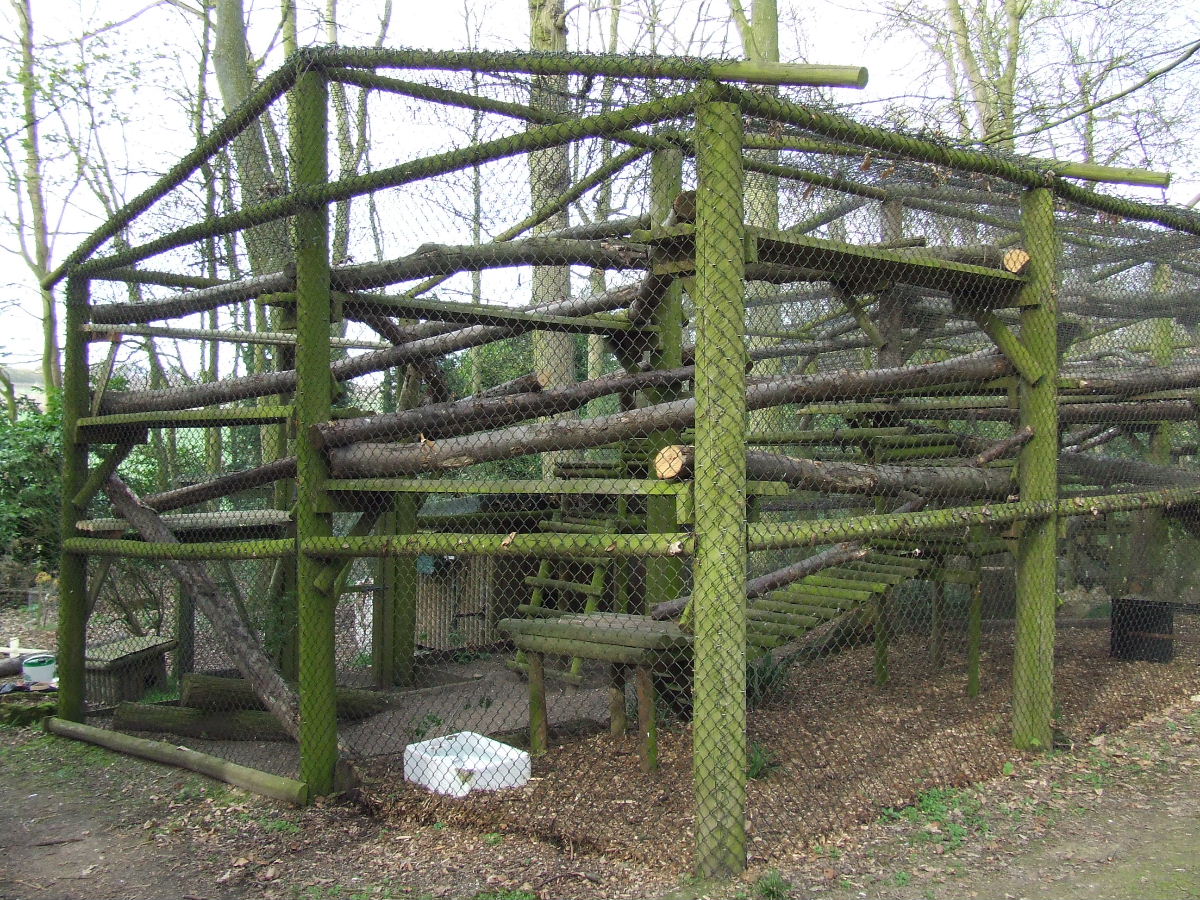
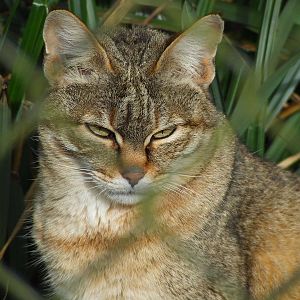
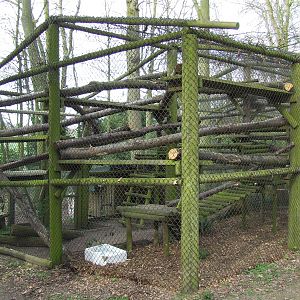
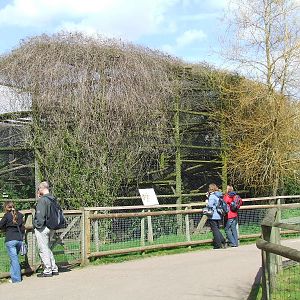
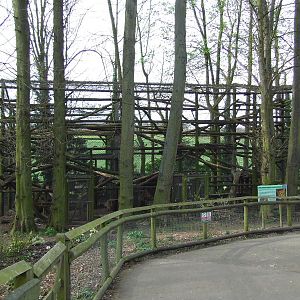
I may be wrong, but I don't think this enclosure was built for fishing cats, although it may hold them at the moment. It's a typical Howletts wood and wire enclosure, which must be under trees as there's no ground vegetation.
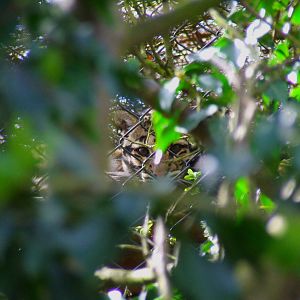
It is ugly; it is hard to see the animals and virtually impossible to photograph them, but snowleopard is right, it provides them with plenty of opportunities for climbing and with plenty of security. In addition, the various compartments make it easy to introduce, mix and separate the animals (very important with cats).
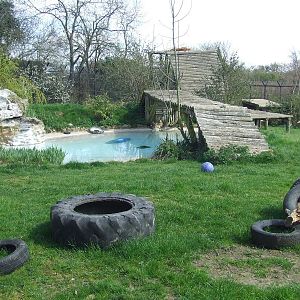
ashley-h is quite right to contrast this cage with the fishing cat enclosures at Port Lympne, which are not extra large, but have natural vegetation and a stream running through them - with a viewing window. One of my most memorable zoo experiences of recent years was watching the female playing with her young cubs in a shallow patch at the edge of the stream. It's a much better display and one of my favourite exhibits at one of my favourite zoos.
@Alan: I appreciate your responses to these criticisms of Howletts and RSCC, as I know that you are a fan of the former and somewhat disappointed by the latter. It is interesting that the fishing cat exhibit has different compartments, and there is certainly a wealth of climbing opportunities for the cats. When I have seen fishing cat exhibits at the San Diego, Taronga or National zoos I've seen beautiful lush enclosures with huge pools, brightly-coloured goldfish, and thick green bushes and rocky ledges. At Howletts I see what reduakari calls a "chicken coop", and regardless at how functional the enclosure is at the end of the day the educational value of creating an environment is zero and the enclosure might be more appropriate for a type of primate.
Overall I guess it's just left over from the private zoo days, and it proved functional and affective, so they just got left. Seems to work though with breeding and that, and Howletts is probably one of, if not the best zoo in the UK.
@Alan: I appreciate your responses to these criticisms of Howletts and RSCC, as I know that you are a fan of the former and somewhat disappointed by the latter. It is interesting that the fishing cat exhibit has different compartments, and there is certainly a wealth of climbing opportunities for the cats. When I have seen fishing cat exhibits at the San Diego, Taronga or National zoos I've seen beautiful lush enclosures with huge pools, brightly-coloured goldfish, and thick green bushes and rocky ledges. At Howletts I see what reduakari calls a "chicken coop", and regardless at how functional the enclosure is at the end of the day the educational value of creating an environment is zero and the enclosure might be more appropriate for a type of primate.
Actually I am far from being a fan of the Howletts enclosures - but I am a great admirer of the skills, experience and dedication of their staff and of their success with sensitive and endangered mammals. I completely disagree with you about primates, in my opinion they need a richer and more stimulating environment than any cat, plus they need more space because they both more social and more active. Unfortunately at Howletts most of the primate enclosures are larger versions of this one - although to be fair they have built three large open-topped monkey enclosures plus a walk-through lemur enclosure in recent years.
Under UK and EU law, zoos must have both an educational and a conservation role - which is absolutely right. A zoo enclosure must be secure and safe for the public and the zoo staff, and it must be suitable for the animal housed, which is of course a more subjective judgement. There is a panel of zoo inspectors, which includes experienced zoo managers, vets and animal welfare experts to make these judgements on behalf of local and national government. Aesthetics are extra, which is understandable, if regrettable.
I think that the big difference between our viewpoints is that I feel that making every enclosure a synthetic representation of its occupant's environment is of very little educational value. It may look nice, for part of the year at least, but it may also be expensive, difficult to maintain and of no benefit to the animal. Of course if it's possible and practical, it should be done - but compromises always have to be made and I'd rather that the animal should have a suitable space which does not resemble its natural habitat in any way, than an unsuitable one which does. Zoos use signs, guidebooks, presenters and websites to fulfil their educational role - because they can present and explain much more sophisticated and interesting ideas that way.
it seems quite a USA vs UK debate, in the US most of the enclosures i've seen (photos) are highly imersive and aesthetically pleasing whereas most of the aspinall enclosures are functional and pratical as are enclosures from many UK zoos.
whilst the aspinall parks may be some of the best in the uk for members of zoochat, i dare say it wouldn't be for the average zoo-goer.
i think that enclosures should be functional and for the animals first and made more attractive second. I highly doubt the educational function of immersive exhibits (not saying theres is none, cause there definetly is) over that of good signs.
I strongly disagree, the public at the Aspinall parks seemed some of the most interested I have ever seen. I believe their enclosures (especially those for the gorillas) do have a role to play as they bring out natural behaviours which are both entertaining and educational. I watched the Gorillas for an hour, but many were there longer than I was and they certainly didn't seem like serious zoo-goers. This natural behaviour is, in my opinion, far more important then some plants and mock-rock attempting (and often failing) to re-create an animals natural habitat. I don't disagree with the idea of immersion exhibits, but unless the zoo has the masses of money needed to create a good one, they should go for the Howletts aproach.
I don't disagree with the idea of immersion exhibits, but unless the zoo has the masses of money needed to create a good one, they should go for the Howletts aproach.
I am glad to hear that the other Aspinall park has more appropriate Fishing Cat enclosure, hopefully I can visit this zoo in next month.
First of all, I am talking about this Fishing Cat cage and not another enclosure at Howletts.
Please do not underestimate the value of landscape (or habitat) immersion exhibits. A really good habitat exhibits are not only give the right message to the public (as reduakari wrote correctly), but meet the needs of zoo animals as well (note I am talking about those are really habitat exhibits not only look like that). Of course in several cases creating this type of exhibit is so expensive, and several zoos are simply not able to create them ... But in this case I am not talking about expensive and brilliant exhibit design, what I want to see in this cage is only a proper sized pool and some vegetation (a climbing structure, the bared tree-trunks do not give adequate privacy for the cats, and Hix was right, in front of the cage this is a water bowl) … these are not in order to delight the visitors and only decorate the space … first of all for the needs of the cats. I do not think so it would be very expensive and it would make easily to do the enrichment work what I am sure the keepers provide for the animals in this zoo.
Probably there will be no vegetation inside this cage in summer due to its location in the zoo. Of course I do not want to distribute advices and ideas to this zoo, but I think it would be great if they send their Servals to an other zoo (otherwise this species does not suit for the concept of Howletts keeping only rare and endangered species) and put the Fishing Cats into this exhibit. I am talking about their current