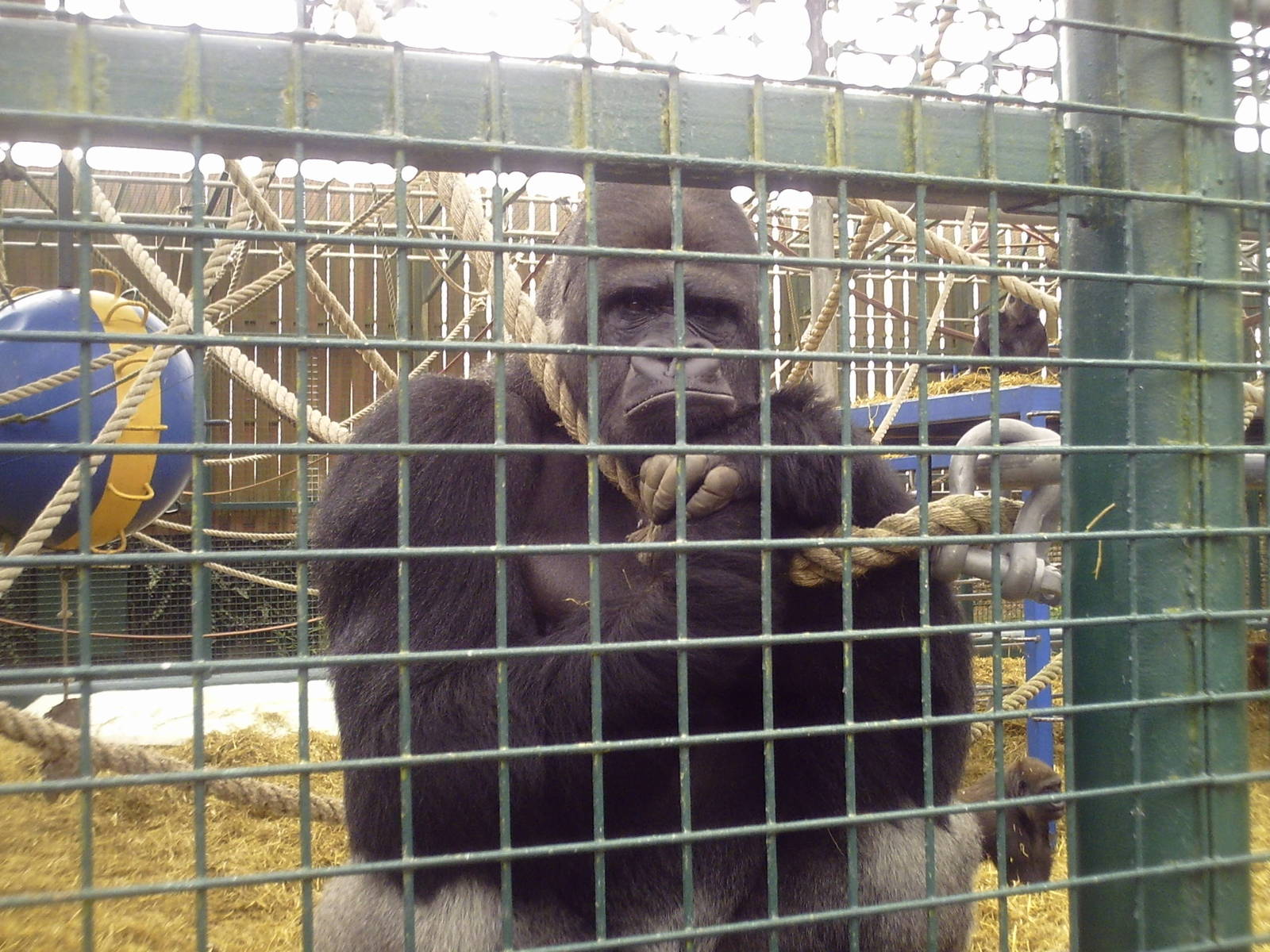
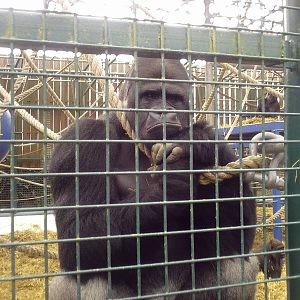
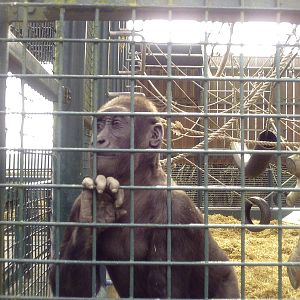
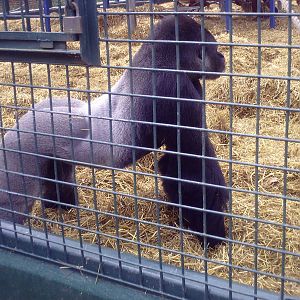
There is no such thing as a perfect enclosure or a perfect species to put in it. As a photographer, I passionately hate the Howletts enclosures, which make it almost impossible to take the sort of photos I want to take: but I have no doubt whatsoever that the gorillas like them.
Yes, this enclosure really makes me appreciate the grandeur and the marvelous adaptations to the African rain forest environment of the lowland gorilla..NOT!!
Reduakari is partly correct, but his/her point is simplistic: Darwin explained 150 years ago that species are superbly adapted to their environments - I don't need to visit a zoo tell me that. On the other hand, I can see a gorilla's grandeur better at Howletts, because I can get closer to the apes and because I can watch the social behaviour of a whole group and because they have five groups (yes that's 5) I can even compare one group with another to start to understand the individuality of the apes.
In my opinion, Mr Aspinall's main innovations were keeping gorillas in large groups with the same basic structure as wild gorilla groups and using a deep litter of straw which allows the apes to forage and play in a way which has strong similarities to their lives in the wild. Other zoos (even in the USA) have started to learn the first lesson, but has anyone else taken the second on board?
It's a shame Chessington is the only zoo outside Aspinall that has taken this design approach, and as members have noted it all comes down to what the public want to see; it seems the message for big zoo exhibits is immersion. To be honest, I think the average visitor doesn't mind too much about the design, they just want to see the animal, but trends are noticable nowadays. It would perhaps be undermining for a zoo like Chester to build an Aspinall Cage, but if one of the more 'nostalgic' collections that just wants to make sure the animals are well - say Longleat or Cotswold - were to build a gorilla enclosure, they coul perhaps pull it off better.
And I just want to add that I have seen the Aspinall Cages, and I feel they are handsdown the best gorilla enclosures I will ever see.
I have seen the Aspinall cages too and I still feel the best gorilla enclosures are those in Apenheul and Melbourne (and Bronx, although I havn`t seen those), large areas with plenty of mature trees and shrubs and climbing and hiding opportunities. These enclosures offer as much enrichment as the Apsinall cages and give a much more naturalistic picture of how gorillas live in the wild.
Unfortunately, most zoos seem not able nor willingly to realize that apes hate open spaces and only do well in outdoor enclosures if it`s either a cage or forest-like. I like the "ugly" Aspinall cages a 100 times better then the apparently "naturalistic", but open "immersion" enclosures like in Hannover, Lisboa, Munich, L.A. ect.!!
I'm finally going to once again respond to some of the comments on the Howletts photos. I get along and privately message a number of British ZooChatters, and so I understand that everyone is completely free to write down their personal thoughts. However, why do some people continue to praise CAGES? It is entirely possible to construct naturalistic exhibits (and they don't have to be immersion-style at all) without creating images such as this photo that evoke thoughts of a human prison. There are only a small selection of these outdated and completely degrading, metal and steel hamster boxes left in the zoo world because all the rest of them have been demolished. Of the 220 AZA zoos in the U.S. there is one left (strangely enough at the Columbus Zoo) with a Howletts-style gorilla metal contraption. In Australia there are only 2 zoos with gorillas, in large naturalistic exhibits, and across Europe there aren't many of the Howletts-style barred enclosures left. Howletts is practically the last of its kind FOR A REASON, and nothing creates better enrichment than something that not everyone supports: grass, trees, bushes, shrubs, logs, ropes, vines, etc. What a concept, having grass in a gorilla enclosure instead of hay and rusty metal bars. Sheesh!
It is entirely possible to construct naturalistic exhibits (and they don't have to be immersion-style at all) without creating images such as this photo that evoke thoughts of a human prison.
But it's completely unnecessary when the cages work this well. I fail to see how someone can argue that some hotwired artificial jungle is more enriching and "natural" than these cages? No they ain't pretty but they show you how gorillas work much better than ANY other gorilla exhibit I've seen. And the public don't care, most of them just want to see the "monkeys", so it's better to have them behaving like they should, having all the different age ranges, the babies playing, the silverback knocking his kids into line when they get cheeky etc.
Because they believe they are good homes for the animals they house. And from my experience (a single visit to Port Lympne some time ago) I would tend to agree.
It is entirely possible to construct naturalistic exhibits (and they don't have to be immersion-style at all) without creating images such as this photo that evoke thoughts of a human prison.
Of course. But that doesn't automatically make them better for the animals. This desire to not be reminded of a prison seems more to be a sap to the conscience of visitors than out of any consideration for the animals.
There are only a small selection of these outdated and completely degrading, metal and steel hamster boxes left in the zoo world because all the rest of them have been demolished. Of the 220 AZA zoos in the U.S. there is one left (strangely enough at the Columbus Zoo) with a Howletts-style gorilla metal contraption. In Australia there are only 2 zoos with gorillas, in large naturalistic exhibits, and across Europe there aren't many of the Howletts-style barred enclosures left.
and nothing creates better enrichment than something that not everyone supports: grass, trees, bushes, shrubs, logs, ropes, vines, etc. What a concept, having grass in a gorilla enclosure instead of hay and rusty metal bars.
There's no more grass or ropes in Congolese rainforests than there is hay or bars. I (aesthetically) prefer the grass, trees etc approach but that doesn't blind me to the fact that the animals clearly do very well (probably better) in these exhibits. It is impossible to state that a planted exhibit offers automatically better enrichment than more artificial forms at Howletts/Port Lympne, because it will always come down to individual cases.
Aspinall's politics have nothing to do with this. I'm not sure exactly how you mean 'privately-owned' - almost no British zoos are publicly owned (ie by local government), so I don't see how this is a factor. The enclosures have not been demolished because the animals do well in them. Whatever you or I think of the look of them. That is why they are kept, and why people leap to their defence.
And I have a genuine question about "naturalistic" enclosures: How many of the trees and bushes AREN'T covered with hotwire in, for example, Bronx? I know Disney's aren't but that's another story lol.
Edit: Regarding fashion, IMO this fashion for islands is oh so wrong
Oh well, the debate can rage for another day, and it is probably the # 1 most interesting discussion on this website as it is seemingly endless. I'm philosophical about the situation, as I do truly understand that gorillas prefer to be under a canopy of some kind and I am not supportive of ALL the naturalistic ape enclosures at various zoos. I've been bashing the Los Angeles Zoo's $19 million gorilla habitat because it is far too open, as is the awful Pittsburgh Zoo enclosure. I just feel as if all this talk about enrichment (soccer balls, hay, straw, playground slides, etc) is actually NOT as effective as what I listed before (trees, grass, logs, branches, etc) and surely that is the crux of the matter. People are arguing that the Howletts-style cages are filled with more enrichment than found at other ape enclosures around the world, but the gorilla jungles at the Bronx and Disney zoos have large sections with no hotwire whatsoever. The gorillas there display natural behaviours just fine, and are in beautiful surroundings. To me that is the best of both worlds. One last thing: as far as the breeding record is concerned that is meaningly to me. Many zoos breed great apes in rubbish enclosures (Perth Zoo's orangs for example) and as long as there are large quantities of animals with a high degree of male potency then mammals will consistently breed in cement hellholes at many zoos worldwide.
As Gentle Lemur says, this place is a non-starter for photographers, but in all other aspects it is a superb gorilla exhibit. Those who have not seen it might not fully appreciate the impact which it has on those who do see it - but they should recognise the impact it has on the gorillas who live there, who breed and thrive as few gorilla groups elesewhere do.
Snowleopard: I disagree with many things you say on zoos, but that is fine - it would be a very boring place if we all felt the same way. And I find your apparent belief that your view is the 'right' view and all others are 'wrong' a little troubling, but then most of us probably see things in these terms, from time to time at least. But I think it is irresponsible, ungentlemanly and ignorant of you to start throwing insults around at "Aspinall", as you do. It is unclear from your grammatical construction whether you are calling the late John Aspinall - erstwhile owner of Howletts - a "fascist", or suggesting that Damian Aspinall - current owner (sort of) - is a "late fascist"; either way, what you say is potentially libellous, and it does not reflect well on you.
@Sooty: I sent you a brief private message earlier, and I just checked out many of your comments on photos in the past. You have on numerous occasions defended zoo enclosures that are bars, grottoes or metal cages, while I have championed award-winning, naturalistic exhibits and condemned what I see as outdated examples of poor exhibitry. You have stuck up for the old-style ways of showcasing animals and we obviously see things quite differently, but so do many others on this site. That is what makes ZooChat consistently enjoyable.
I'm happy to report, at least from my point of view, that naturalistic, realistic zoo "habitats" are winning the battle and gradually metal cages, pits, grottoes, cement mountains and other outdated enclosures are being weeded out of all the major zoos. Eventually there will be no bars or cages to defend as they simply won't exist at all. I honestly believe that day has already arrived for many top zoos, and so the anti-zoo crowd has less and less power in the 21st century. It's difficult to claim that zoos are prisons when many top-notch collections have nothing but lush, green zoo enclosures.
I meant no offense with the remark that the late (ie: deceased) John Aspinall had fascist leanings, which in truth has nothing to do with his metal animal cages. He was definitely dodgy with politics, but is often highly regarded with his animal parks. I should have not brought politics into the fray, and in fact I think that I better leave the Howletts-debate alone. Looking back through my comments I have praised Howletts many times, but far more often been sorely disappointed in the utilitarian wood/wire/metal cages that crop up at that zoo. I've voiced my opinion once too often, and the fact that I'd prefer to see gorillas on grass and with trees around them is something that I'll avoid mentioning in regards to Howletts.