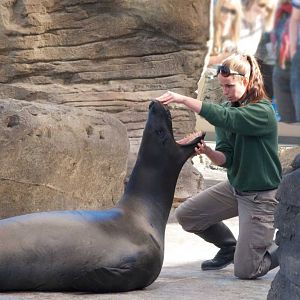
they certainly are magnificent animals. The ones at Taronga weren't doing much when I was there but they are nice to see. If you look in the New Zealand Wildlife Gallery I've got some photos on there that I took of a wild leopard seal a couple of years ago.
I would love to see more Leopard Seals in zoos. And I hope we don't stop exhibiting species just because they are not endangered, many of us would never have the chance to see hundreds of non-endangered species if it were not for zoos.
I don't know why they bother with this species. They are in NO danger of extinction. There are millions of them in Antarctica thanks to whaling increasing their food supply of krill. QUOTE]
Technically both of you are correct as well as the original comment. Young Leopard Seals, have a primarily krill based diet with the molars described by Pygathrix. Young leopard seals, do also eat small fish and squid. However as they start to mature their jaw develops more into one that is specialised in eating larger items of prey - penguins and occasionally seals. The penguins they tend to eat are Kings, Rockhopper, gentoo, Adelie and Emperor. The only seal they have been recorded to eat are the Crab-Eaters.
OK fair enough, although as EvilKittie says above krill is more important for younger than older animals (I have read 45% rather than 50%, but I guess that depends on interpretation of data and sample size from studies). Up to 30% of the adult diet is other pinnipeds (not just crabeater seals), which is roughly a third of their diet.
Just as an aside I read a statistic that said that an estimated 78% of adult crabeater seals have scars from leopard seal attacks.