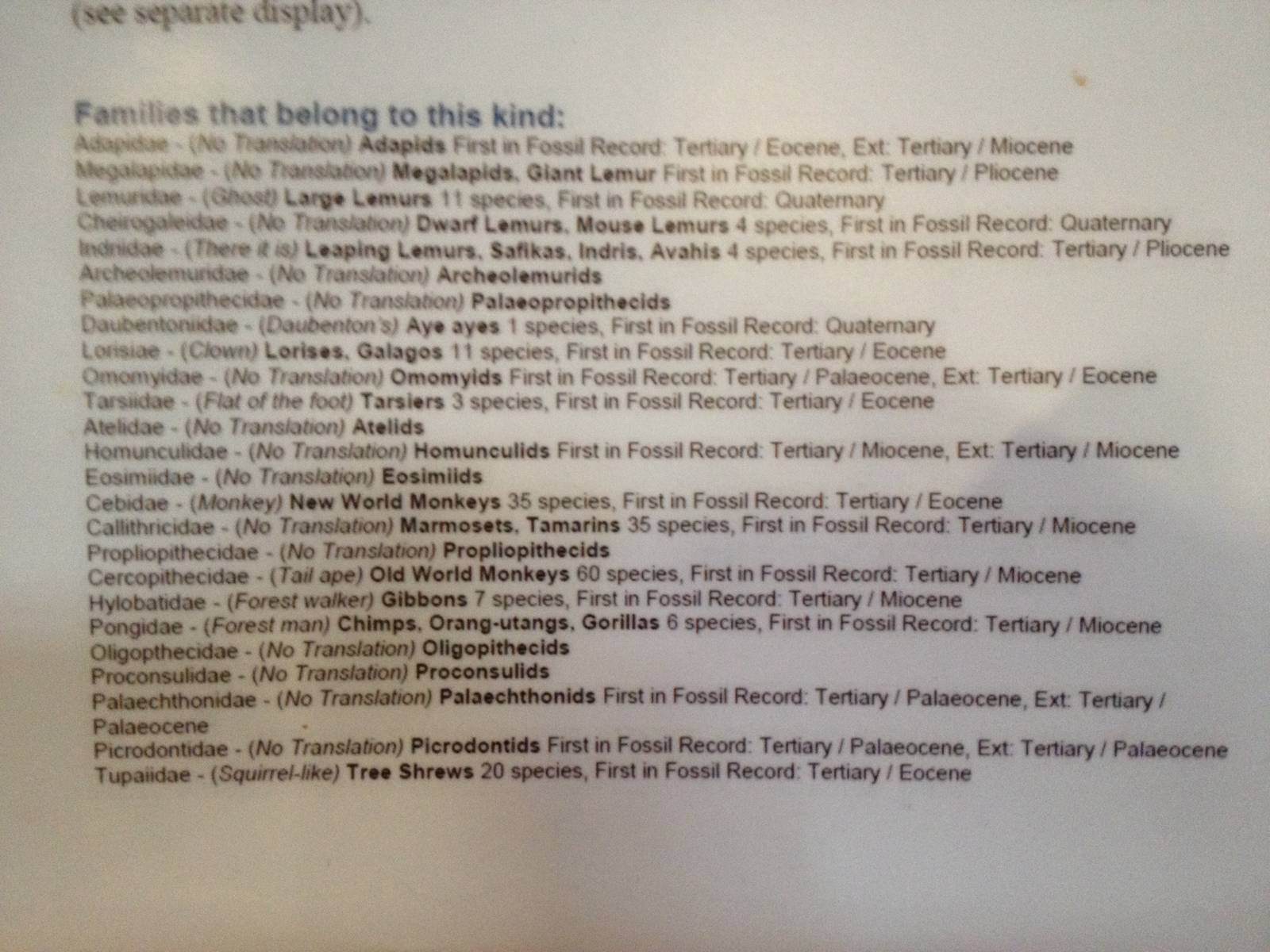
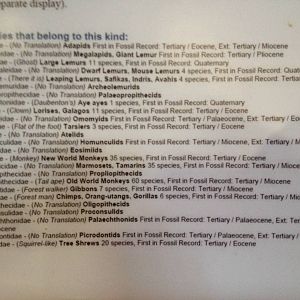
On a sign about mammalian 'kinds'. If I gathered correctly, members of the same kind were allowed to be phylogenetically related. Evolution beyond that: think again.
On a sign about mammalian \'kinds\'. If I gathered correctly, members of the same kind were allowed to be phylogenetically related. Evolution beyond that: think again.
Yeah, this is just weird. I can't understand how they can accept that a chimpanzee and a treeshrew share a common ancestor, but not a chimp and a human. I mean, come on!
Appart from a bigger number of species for some families and that some "no translation" names have a translation (Homunculidae = "little man", Callithricidae = "beauty hair"...), and not counting in that not everybody can be agree in that taxonomy (like in every group of animals or plants on Earth, for example I would prefair to join many of these families into Lemuridae).... there is not errors in this signage. Why this is put as an error??? Just because they don't included family Hominidae???
As you point out, there's lots wrong with this one. It should also include Dermoptera, for instance. But yes, I think the most glaring point here is the exclusion of Hominidae. How would that not constitute an error?
my favourite part of this sign is actually all the "translations" which are just given with no care as to whether they make any sense, whether it means anything to the reader, and then also with so many obviously-translatable ones left proudly untranslated.
"Cheirogaleidae ...?" [scratches head] "Nope, no clue .... um, Atelidae, that's a funny word, shall I look it up? Naah, can't be bothered, I'd have to type eight whole letters into Google .... Let's see ... Homunculidae? Pfft, that's definitely like no word I've ever heard! What's it say here ... "little human"? Erm, hmm, um, no I'm not putting that in there. Next ..."
Why they should include Dermoptera? They're less closely related to primates than Scandentia are. So the group including Scandentia + Primates are natural even excluding colugos.
And, well... it says "families that belong to this kind", not "all families that belong to this kind". So, we hominids could be excluded
To Chlidonias:
Cheirogaleidae, as far as I can deduce, means something like "weasel with arms", but what's mean Ateles? Maybe it comes from some american native language? I only know a bit about scientific names with latin or greek roots
Cheirogaleidae, as far as I can deduce, means something like "weasel with arms", but what's mean Ateles? Maybe it comes from some american native language? I only know a bit about scientific names with latin or greek roots
Why they should include Dermoptera? They're less closely related to primates than Scandentia are. So the group including Scandentia + Primates are natural even excluding colugos.
And, well... it says "families that belong to this kind", not "all families that belong to this kind". So, we hominids could be excluded
I'd be interested to know what 'kind' Dermoptera would fit into on the Noah's scheme. Creationists generally use the word 'kind' to represent the fundamental units that cannot (in their view) evolve into each other - hence how humans are not listed in this 'primate kind'.
As Maguari points out, the signs were clearly supposed to be comprehensive. As for your placement of Dermoptera, I disagree. Morphological data have typically supported Scandentia + Primates, but molecular data now overwhelmingly favours Dermoptera + Primates. The most recent papers I've read kick Scandentia out entirely, although the relationships arguably remain unresolved. Regardless, the poor old colugos didn't appear anywhere else, so this does seem to be the appropriate spot.
@Maguari: I don't know about Genesis, but we might be about to see a whole load of new colugo species created!