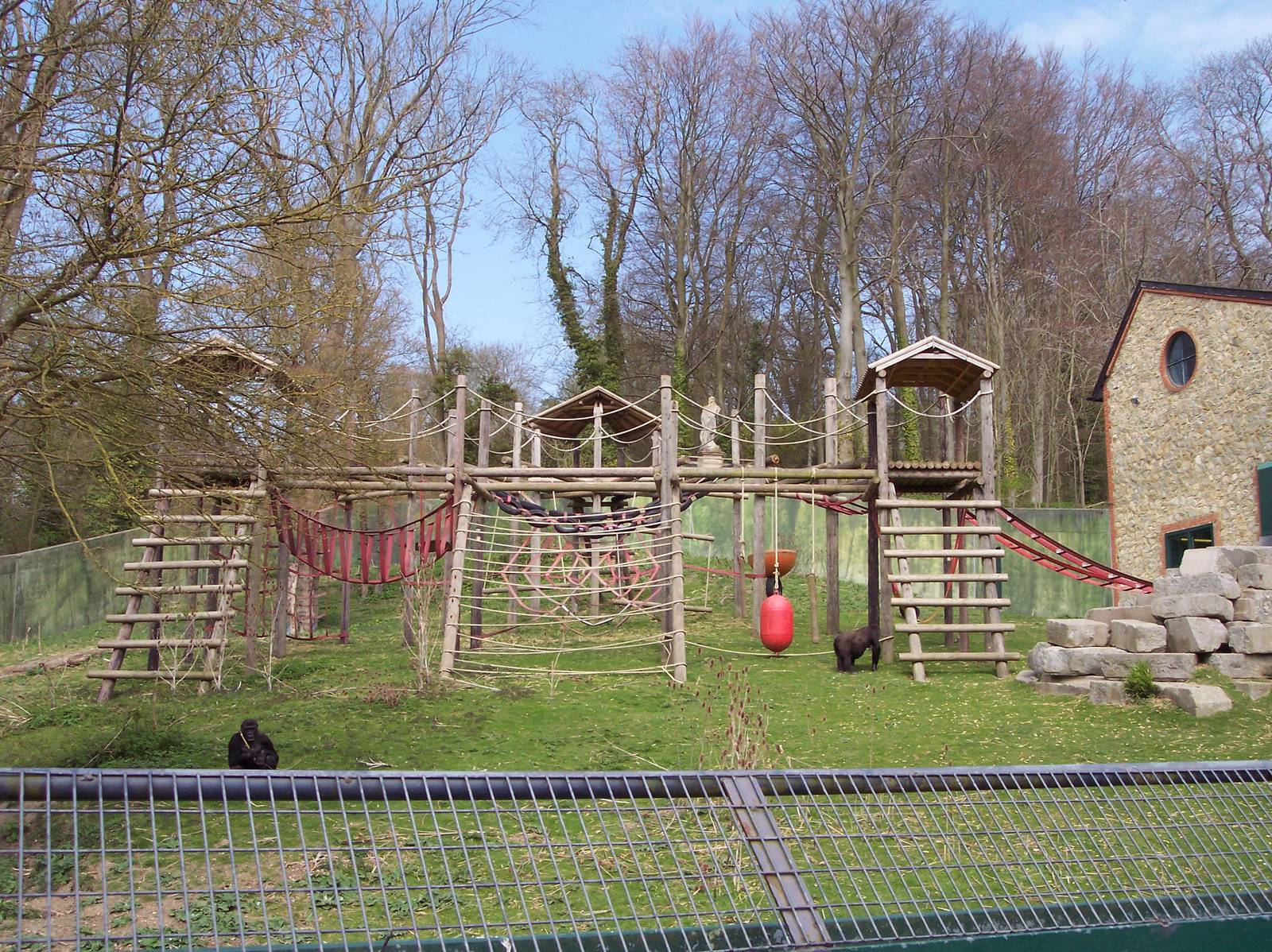
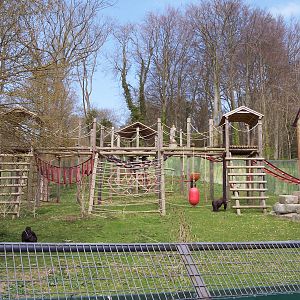
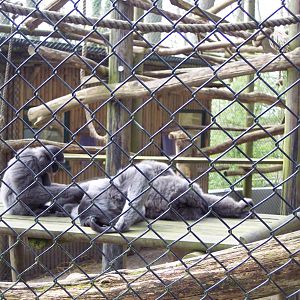
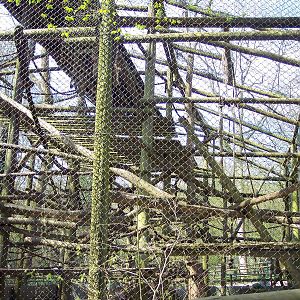
About half of the one acre Garden of the Apes, adjacent to Palace of the Apes. This shows the large climbing frame that they have to play on. April, 2009
But doesn't the fact that Aspinall owns a million-or-so acre reserve in Gabon where gorillas have been successfully released back into the wild teach visitors enough about the importance and inspiration to save gorillas than sticking a few hotwired plants in would?
There is a hypnotising mystique about watching the gorillas at Howletts and Port Lympne that I haven't felt at any other zoo.
But doesn't the fact that Aspinall owns a million-or-so acre reserve in Gabon where gorillas have been successfully released back into the wild teach visitors enough about the importance and inspiration to save gorillas than sticking a few hotwired plants in would?
There is a hypnotising mystique about watching the gorillas at Howletts and Port Lympne that I haven't felt at any other zoo.
The reintroduction efforts are marvelous and commendable--but how much stronger a story could be told if the zoos from which the reintroduced animals originated could provide a better sense of what a African equatorial rain forest was like to the hundreds of thousands of visitors who will never have the chance to experience the real thing?
Aspinall has limited funds: The amount of upkeep required for the huge number of large stock at both parks, the amount gone into overseas conservation such as the Gabon reserve and it's secluded location creating low visitor numbers compared to similar-sized zoos make money a precious thing, and the best they can do is renovate what the animals have already. For example, the elephant barns at the parks badly need renovation, but that won't happen for a while, so the last thing they'd want to do is use immersion for the benefit of vistors.
That said, Aspinall are very good at creating very natural exhibits without spending £stupid: Just look at the Malayan Tapir Paddocks and the African Experience.
Your use of the epithet "gringos" is very inflammatory and insulting (as I suppose you intend it to be). I'd hate to resort to the many equivalent phrases one could use to refer to Mexican citizens, so I will refrain....
I'm fine with the fact that you and others may believe these rudimentary enclosures are appropriate for the animals that reside in them. Just don't try to argue that they are good EXHIBITS. That is a very different thing....
Actually reduakari i think your being slightly hyper sensative , being a latin american and a Mexican i can tell you that the word gringo doesnt usually have a offensive conotation it is simply a word used to describe a national of your country , other names are estado unidense ,norte americano , americano etc but gringo is the most used and often it doesnt carry any bad feeling with it , it is only offensive when used to offend and i assure you i wasnt intending to offend , i was just pointing out that North american zoochatters were complaining about the Aspinall parks again , if you prefer next time i will use the name American or Americano when referring to citizens from your country. Oh and you dont have to restrain yourself if you wish to describe Mexicans or Latin Americans by one of the names you friendly, hospitable , intelligent ,god fearing , athletic neighbours of the north call us , it runs like rain of my back amigo , i and several members of my family including my wife and my youngest son of 7 years old have been called Spic , beaner , Greaseball ,dago, illegal alien, wet back ,spaniard,greasy etc a great number of times , more then i can count , when visiting familly in the United states , so like i said reduakari you dont have to restrain yourself use whichever one of the ones above which takes your fancy , and i dont agree with your definition of the enclosures of the Aspinall parks but i must say im happy for Arizona docent who has the decency to come and see the Aspinall parks and base his criticisms on what he sees firsthand that i respect , i invite you to do the same , like i said to Arizona docente im sure his perspective will change once he visits , and i think yours would to
But doesn't the fact that Aspinall owns a million-or-so acre reserve in Gabon where gorillas have been successfully released back into the wild teach visitors enough about the importance and inspiration to save gorillas than sticking a few hotwired plants in would?
There is a hypnotising mystique about watching the gorillas at Howletts and Port Lympne that I haven't felt at any other zoo.
Indeed marwell darlek my friend i am in agreement with your statement about the atmosphere of the gorillas in Howletts , i have visited so many of the American zoos whose success with gorillas reduakari champions and i have come away thinking Howletts and port lympne are 100 times better , i loved to watch the gorillas foraging for their food amongst the hay in the Howletts gorilla pavilions and im saving up for a trip to see the parks again,Dian fossey an American conservationist im sure dear reduakari is familiar with was always impressed with the Aspinall parks and had a grudging respect for John Aspinall , however she wrote very disparingly of the enclosures of other zoos in europe and particulary in the United states
reduakari if your so keen on the natrualistic enclosures , and changing the zookeeping and animal welfare community , a good place to start would be in your own country instead of criticising the Aspinall parks because i dont think they need your great expertise they can get along just fine, for example what about preaching your message to the owners of the 100s of terrible and foul little roadside zoos all over the USA i always see loads in Texas state , and there are a few in california also , or how about preaching the message of natrualistic enclosures , to the people in this documentary who keep monkeys as children in such a degrading and humiliating conditions and ways
,[ame="http://www.youtube.com/watch?v=pH1jhhpQ_bo"]YouTube - My Monkey Baby | Primate Princess | Channel 4[/ame] ,
[ame="http://www.youtube.com/watch?v=uP4k1imPy54"]YouTube - My Monkey Baby | Silly Willy | Channel 4[/ame] ,
[ame="http://www.youtube.com/watch?v=VqGdSmcUicU"]YouTube - Ontario Roadside Zoos - Barren Cages, Empty Lives by WSPA[/ame]
I will continue to hold that zoos should not only provide enriched and stimulating habitats for their animals, but should also create visitor experiences that support the most critical conservation message of all: that animals and environments are inextricably linked; and that to "save" animals their natural habitats must be saved as well. Showing animals in a human garden/playground runs counter to that basic point, no matter how much the animals may presumptively "enjoy" living in it, or how much people may take pleasure in seeing them in such incongruous settings.
This is my final contribution to this debate.
In my opinion the argument quoted above is irrational: it is the same argument that anti-zoo campaigners make, except that they take the final logical step of saying that animals should never be kept outside their natural environments. This ignores all the other reasons for keeping animals in zoos, which I need not rehearse here.
The argument is also irrational because it relies on an aesthetic and emotional response to a superficial resemblance between the artificial habitat of the display and the natural habitat of the species displayed. If this were to become the sole criterion for judging the success of an exhibit we would neglect more rational criteria, such as good husbandry and providing as wide a range of educational opportunities as possible.
In my 'grumpy old man' moments, my favourite word is procrustean - which describes a pernicious and increasingly pervasive attitude in the modern world - the view that only my position is correct, and everyone else must be forced to accept this by distorting or eliminating disagreement to make them into fit into my scheme of things.
I believe in plurality; reduakari is entitled to choose what he thinks is 'the most critical conservation message of all' - but there are plenty of alternatives (global warming, human overpopulation, conservation of water and other resources etc) and we are all entitled to agree or disagree with him.
However it is procrustean to denigrate the visitor experience at Port Lympne while dismissing all the arguments of the people who have actually visited the place. It is a deliberate distortion of the truth to describe the 'Palace of the Apes' as rudimentary or to describe it as a human playground/garden or indeed to deny that it is an exhibit. In my previous post I suggested that reduakari should look at all the relevant images in the Gallery; I now invite all members to do this to get some impression of the real visitor experience at this exhibit, including the signage and the behaviour of the gorillas, and to judge for themselves on merits and its faults. I don't deny that it has faults, including a silly name and the incongruous appearance of the climbing frame in this photo, but I have watched one or two of the apes climbing on it and I am glad it is there for them to use.
As a pluralist, I am not suggesting that all gorilla exhibits should look like this. Different designs will suit different groups of gorillas at different zoos in different climates visited by different people. Vive la difference as the mythical hero Theseus might have said, if he had spoken French, just before he killed Procrustes.
Indeed marwell darlek my friend i am in agreement with your statement about the atmosphere of the gorillas in Howletts , i have visited so many of the American zoos whose success with gorillas reduakari champions and i have come away thinking Howletts and port lympne are 100 times better , i loved to watch the gorillas foraging for their food amongst the hay in the Howletts gorilla pavilions and im saving up for a trip to see the parks again,Dian fossey an American conservationist im sure dear reduakari is familiar with was always impressed with the Aspinall parks and had a grudging respect for John Aspinall , however she wrote very disparingly of the enclosures of other zoos in europe and particulary in the United states
reduakari if your so keen on the natrualistic enclosures , and changing the zookeeping and animal welfare community , a good place to start would be in your own country instead of criticising the Aspinall parks because i dont think they need your great expertise they can get along just fine, for example what about preaching your message to the owners of the 100s of terrible and foul little roadside zoos all over the USA i always see loads in Texas state , and there are a few in california also , or how about preaching the message of natrualistic enclosures , to the people in this documentary who keep monkeys as children in such a degrading and humiliating conditions and ways
,YouTube - My Monkey Baby | Primate Princess | Channel 4 , YouTube - My Monkey Baby | Silly Willy | Channel 4 , YouTube - Ontario Roadside Zoos - Barren Cages, Empty Lives by WSPA
As I've stated several times on this forum, the US is full of substandard animal "exhibitions," and there is no excuse for their continued existence. Conversely, there are fantastic institutions and facilities world-wide, from which many US zoos should take the opportunity to learn.
Jose, my dear friend, I certainly agree with you that the United States has for over a hundred years been an often unfortunate influence--directly and indirectly--on the politics and culture of the planet. Your criticism of the "US style" of zoo exhibit design is, however, misplaced. First of all, it is a mode of exhibition that originated in Europe (Hagenbeck), and which has been used worldwide, often in far better ways than is commonly the case in the US. Zoos in Holland, Switzerland, Germany are predominantly developed today using the principles of naturalistic design (including the oft-abused concept of "immersion"). Excellent examples can be found world-wide, from Prague to Valencia to Belize City, including some recent developments at "your" Chapultepec zoo.
And to Gentlelemur's comments--first of all thank you for the succinct lesson on the origin of the phrase "procrustean." Secondly, I think you hit the nail on the head by discussing the "aesthetic and emotional" response that a well-done naturalistic exhibit experience can create. It is well documented that very few visitors read signage, much less retain any cognitive information from their visits. It IS about creating emotional responses, and I will continue to maintain that displaying wild animals in the context of suburban yards or agrarian pastures provides the basis for inappropriate (or at least inaccurate) "take-home messages," where the distinction between the good work of Aspinall can be unintentionally conflated with the charlatanism of the likes of Craig Busch, "Lion Man."
Thanks for the tip about free wi-fi in Europe, but my camera backpack is already heavy enough without trying to add a laptop computer. Plus I only have one week to see both England and France (well, small pieces of them) so I won't have any "free time" to chat online.
Once I am home, I will post some thoughts and hopefully bring some objective comparisons to this thread, which has suddenly turned somewhat nasty.
What intruges me about the outdoor Gorilla enclosures at Port Lympne is that they are all expensively kitted out with lavish artificial climbing equipment- such as in this picture. It seems needless expense, like the peculiar loft in the original bachelor quarters which is probably totally unused
nowdays.
On the other hand they are prepared to leave other 'special' primates e.g. the Drills living in an old fashioned cage without extending their enclosures.