On the subject of members of the Rallidae, one of the things that most surprised me about my visit to Auckland was seeing quite a few Pukeko. I find it intriguing that they're so successful and their congener the Takahe so rare. Is it all down to the ability to fly?
On the subject of members of the Rallidae, one of the things that most surprised me about my visit to Auckland was seeing quite a few Pukeko. I find it intriguing that they're so successful and their congener the Takahe so rare. Is it all down to the ability to fly?
to some extent, yes. Basically (as I'm sure you're aware) the takahe were almost totally exterminated across the entire country by Maori for food, and by the time Europeans arrived they were more-or-less restricted to a very small area in Fiordland -- and even here Maori made specific trips into the interior to hunt them despite the very similar pukeko being common elsewhere (as always with humans, the rarer it was the more it was sought out, and this effect was probably also a factor in complete extinction of other NZ birds such as moa). The pukeko is probably in fact a fairly recent colonist of NZ, within the last 1000 years or so, and has benefited from the opening up of the countryside, originally by Maori burning off the forest and then by Europeans doing the same. That it is quite new to NZ also benefits it -- the takahe is K-selected so breeds slowly with few young because it had relatively few predators, whereas the pukeko is r-selected and has very large clutches and breeds rapidly.
to some extent, yes. Basically (as I'm sure you're aware) the takahe were almost totally exterminated across the entire country by Maori for food, and by the time Europeans arrived they were more-or-less restricted to a very small area in Fiordland -- and even here Maori made specific trips into the interior to hunt them despite the very similar pukeko being common elsewhere (as always with humans, the rarer it was the more it was sought out, and this effect was probably also a factor in complete extinction of other NZ birds such as moa). The pukeko is probably in fact a fairly recent colonist of NZ, within the last 1000 years or so, and has benefited from the opening up of the countryside, originally by Maori burning off the forest and then by Europeans doing the same. That it is quite new to NZ also benefits it -- the takahe is K-selected so breeds slowly with few young because it had relatively few predators, whereas the pukeko is r-selected and has very large clutches and breeds rapidly.
Would takahe do better in a food-richer environment than Fiordland?
Ne-ne ended up in volcano craters in Hawaii, and red kites in woods in mid Wales because they'd been wiped out elsewhere, not because either were terribly well suited to these environments..
the funny thing with takahe is that some of the ones on the islands have had problems with developing "gout-like" symptoms from feeding on the rich introduced grasses there. The Fiordland mountains are probably a marginal habitat for them, as they were for kakapo when they still lived there, but they are still adapted for feeding on native tussocks and seeds. They also still, even on the islands with good food sources, have low fertility and low chick survival rates which is potentially caused by inbreeding in the low population. The big problem for them nowadays of course is the introduced predators, same as for the nene in Hawaii. Even if takahe weren't as scarce and inbred as they are, they would still never be as successful as pukeko simply because they could never breed fast enough to keep up with today's predation levels. On the other hand, if there were no mammalian predators or competitors here (this being imaginary!!) then takahe would do just fine and they would be seen wandering along the roadside verges like pukeko are now. But then of course there would also be kakapo and tuatara in my garden
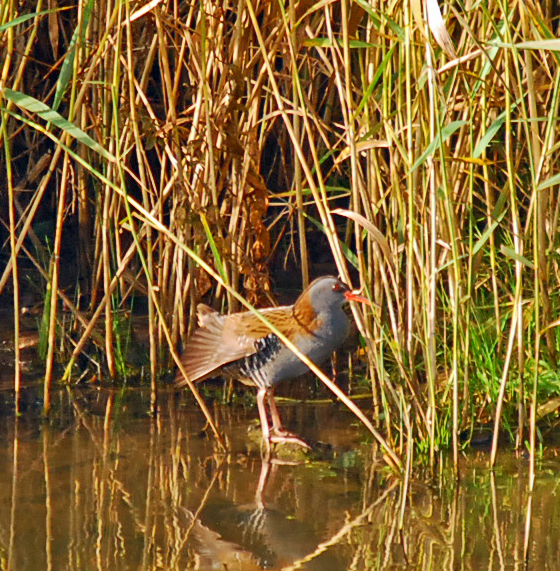
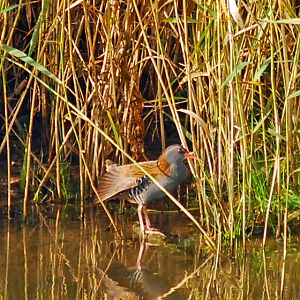
The interesting thing about this Water Rail is that he(or she) is completely relaxed, standing with wings extended(sunbathing or drying them) which you never normally see as the birds just scurry away. Obviously WWT reserves are good places to observe Water Rail.