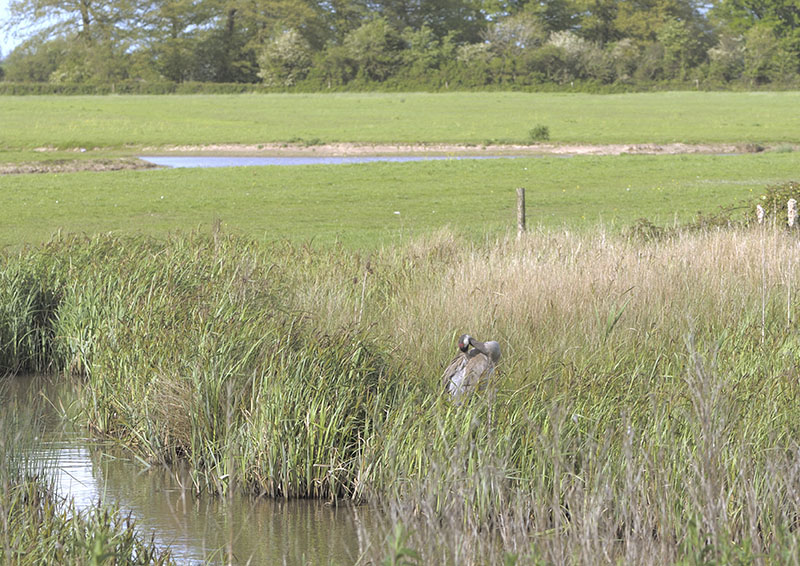
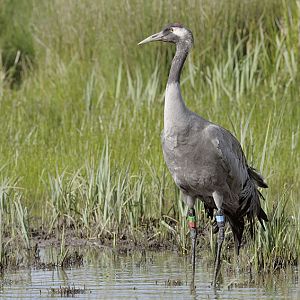
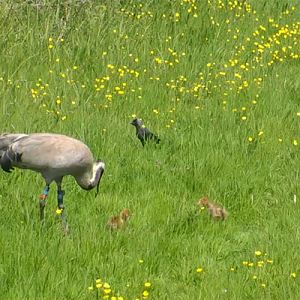
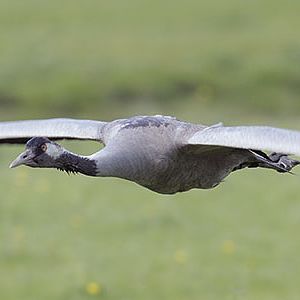
Chris on the nest in the corner of Tack Piece directly in front of the Martin Smith hide. The webcam was mounted on the fox-proof fence to the right (dividing Tack Piece from the Rushy Pen). Slimbridge WWT, 12th May 2014.
The latest Wildlife Weekly video from Slimbridge shows how the cranes are trained to avoid foxes, plus video of Monty and Chris protecting their chicks and of the incident when a fox probably took a chick from the nest when they were roosting.
I think the Bustard people used a similar training method, and also squirted the young birds with a water pistol at the same time to reinforce it. Maybe it has helped prevent mortality, maybe not.
Strange how concentrated the Crane pair's filmed attack on the fox was yet how they 'stood back' rather during the surprise raid on the nest. As I think I said before, the blighters are very persistent- they will keep on trying. It will be after the other chick as well I would wager. The only safe measure really is if they can nest where Foxes can't reach them (like deep marshes or in this case, inside the fox-proof Fence....)
Strange how concentrated the Crane pair's filmed attack on the fox was yet how they 'stood back' rather during the surprise raid on the nest. As I think I said before, the blighters are very persistent- they will keep on trying. It will be after the other chick as well I would wager. The only safe measure really is if they can nest where Foxes can't reach them (like deep marshes or in this case, inside the fox-proof Fence....)
It looked to me as if they were surprised by the fox's attack when they were roosting on the nest and unfortunately both adults left in the same direction, creating the opportunity for the predator.
The current nest is very near the pair's first one last year (when they didn't actually lay). Their second nest was at the far end of the Rushy pen, inside the fox proof fence, so if they lost their chick to a predator it wasn't a fox.
I wouldn't be surprised if WWT got a JCB on this area this autumn to extend this scrape in the corner of Tack Piece, making the areas with the long vegetation into islands and leaving the far margin fairly bare. If Chris and Monty like this area so much, it would be easy to make it much more secure for them, without affecting any of the other wildlife significantly (except for hungry foxes of course).
Their second nest was at the far end of the Rushy pen, inside the fox proof fence, so if they lost their chick to a predator it wasn't a fox.
I wouldn't be surprised if WWT got a JCB on this area this autumn to extend this scrape in the corner of Tack Piece, making the areas with the long vegetation into islands and leaving the far margin fairly bare.
Its a pity they didn't plump for the same site, or very close to it again and a bit ironic given they had healthy chicks this year. I am sure they will try and reduce the fox danger for them after this, whether they raise their surviving chick or not.
Yes, I think the Fox surprised them and they sort of jumped off the nest and their view of what was happening was perhaps obscured by the rushes. And the bad thing is it knows it can succeed using this method now.
I find common cranes fascinating and I am happy they get much interest and support from general public in the UK.
On the other hand, I question the decision to reintroduce them into UK by using hand-reared birds that won´t show the typical migration pattern.
The species is doing very well in Europe. Last counts show +300.000 cranes migrate through Germany and circa 200.000 through Hungary, the numbers increase each year. The species breeding range have already spread to eastern Slovakia, southern Bohemia, Bavaria till northern Alps and Holland. Also the population in eastern UK is growing.
I don´t want to say the reintroduction is bad per se. Just that those resources could be spent on species in more urgent need of protection/reintroduction. Cranes would have returned on their own, with just a bittle bit patience, I think.
I find common cranes fascinating and I am happy they get much interest and support from general public in the UK.
On the other hand, I question the decision to reintroduce them into UK by using hand-reared birds that won´t show the typical migration pattern.
The species is doing very well in Europe. Last counts show +300.000 cranes migrate through Germany and circa 200.000 through Hungary, the numbers increase each year. The species breeding range have already spread to eastern Slovakia, southern Bohemia, Bavaria till northern Alps and Holland. Also the population in eastern UK is growing.
I don´t want to say the reintroduction is bad per se. Just that those resources could be spent on species in more urgent need of protection/reintroduction. Cranes would have returned on their own, with just a bittle bit patience, I think.
I don't know how migratory the native British cranes were, it's an interesting question and I will look into it. Judging by place names they were widespread through the country, for example Tranmere (on the Wirral, near Chester Zoo's old quarantine station) means 'crane bog'.
The cranes in East Anglia have certainly recolonised naturally over more than 30 years, but the process has been very slow compared to other colonising species such as little egrets. The birds have never spread into apparently suitable habitat in the west.
There are now quite a lot of wetland reserves in Somerset and great white egrets have recently bred for the first time, there seem to be more prospecting species too, such as glossy ibis and spoonbill: this seems like an appropriate time for the reintroduction project, perhaps interest has been boosted by the success of the projects in Scotland with white-tailed eagles and in several places with red kites.
They already did, with a small breeding population in East Anglia. That is non-migratory also. Seeing how they established successfully, but very slowly, may have encouraged this extra scheme to try and help them get a better foothold in the UK. There has already been the odd movement between the (still very small) East Anglian group and the newer Somerset birds.