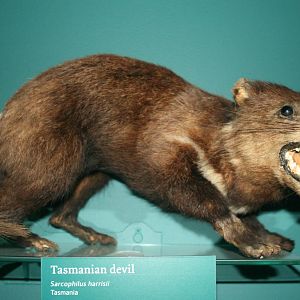
I am somewhat surprised that my Tasmanian devil photograph has generated so many comments.
I agree, of course, that this specimen is poorly mounted and very faded. Nevertheless, I thought it was an interesting shot as it gave a good view of the teeth.
Like the majority of specimens in this fascinating museum, I assume that this one is very old. I don’t know when this particular specimen was acquired but Lord Walter Rothschild, who founded the museum, died in 1937 and most of the museum’s display material was obtained decades before his death.
It's a long while since I last saw a living Tasmanian devil. I've seen the species many times at London Zoo and also several times elsewhere (Cologne, Rotterdam, Los Angeles); unfortunately, I doubt I'll see one again in the near future, unless I make a trip to Copenhagen.
It's a long while since I last saw a living Tasmanian devil. I've seen the species many times at London Zoo and also several times elsewhere (Cologne, Rotterdam, Los Angeles); unfortunately, I doubt I'll see one again in the near future, unless I make a trip to Copenhagen.
It is interesting that they are so rare in the zoo world. There was one in San Diego in the fairly recent past (less than 10 years ago). I wonder why there are so few? With the disease crisis threatening them in the wild this seems like a species that zoos could genuinely serve as a backup population for.
Do they not do well in captivity outside of Australia in terms of longevity and/or not reproducing?