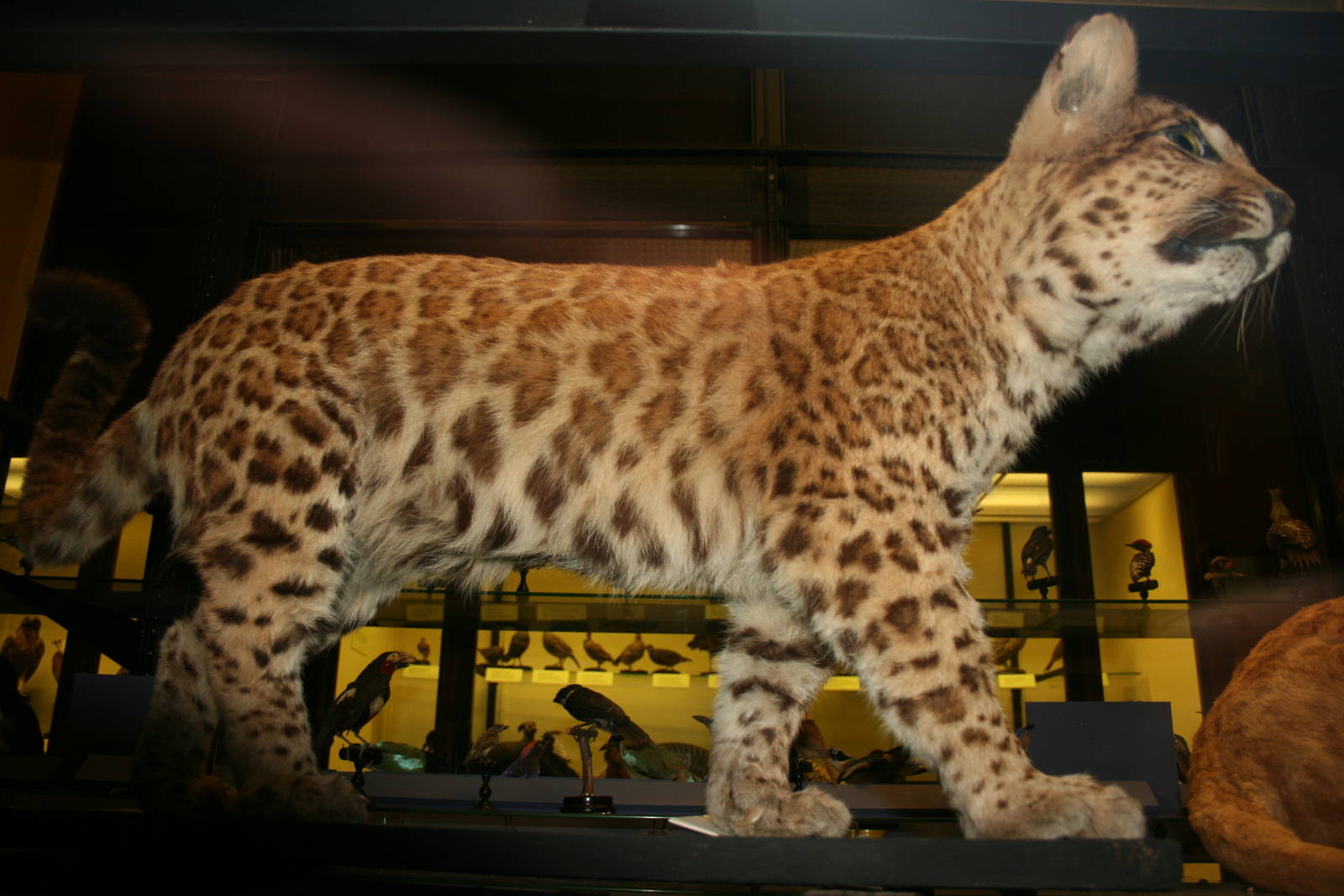
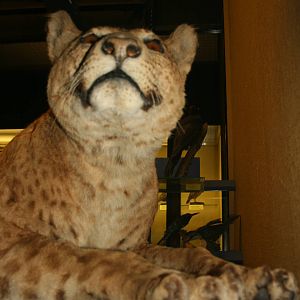
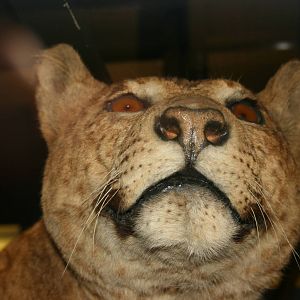
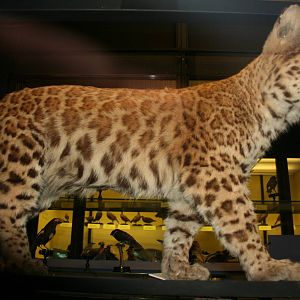
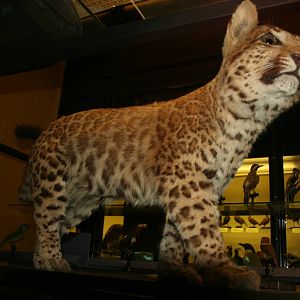
that's really interesting - I find a leopard X puma somewhat more surprising than a lion X jaguar (or any other Big Cat hybrid). It looks very young. Any idea where this one was bred?
that's really interesting - I find a leopard X puma somewhat more surprising than a lion X jaguar (or any other Big Cat hybrid). It looks very young. Any idea where this one was bred?
Interesting question; puma x leopard is obviously a rare hybrid.
“Living Animals of the World” (Editor C. L. Cornish; no date but early 1900s) depicts a photograph of a living leopard x puma hybrid credited to Carl Hagenbeck, Hamburg. The caption states that this animal is now dead and may be seen at the Tring Museum.
Both “Cats of the World” (Armand Dennis; 1964) and “Mammalian Hybrids” (Annie P. Gray; 1975) record that Carl Hagenbeck bred a leopard x puma hybrid in Hamburg around 1900 which was successfully reared by a fox terrier bitch.
However, in Carl Hagenbeck’s autobiography “Beasts and Men” (English translation, 1909) he writes:-
A cross between a panther and a puma was undertaken, at my suggestion, at a small English menagerie. A number of young ones were born, but they all died except one, and there was nothing very noteworthy about the survivor.
Frustratingly, Hagenbeck doesn’t provide the name of the zoo where the hybrid was born although possibly the original German version provides more details. Assuming the information other authors provide about the Hamburg born hybrid is true, it does seem astonishing that Hagenbeck does not mention this.
I just happened across this photo again, and thought I'd google puma hybrids: the first link that came up was Wikipedia (as always), which provides more information: [ame=http://en.wikipedia.org/wiki/Pumapard]Pumapard - Wikipedia, the free encyclopedia[/ame]
In the late 1890s/early 1900s, two hybrids were born in Chicago, USA followed 2 years later by three sets of twin cubs born at a zoo in Hamburg, Germany from a puma father and leopard mother. Carl Hagenbeck apparently bred several litters of puma x leopard hybrids in 1898 at the suggestion of a menagerie owner in Britain; this was possibly Lord Rothschild (as one of the hybrids is preserved in his museum) who may have heard of the two hybrid cubs bred in Chicago in 1896 and suggested Hagenbeck reproduced the pairing.
Hagenbeck's puma/leopard hybrids may have been inspired by a pair of leopard x puma hybrid cubs born in Chicago on 24 April 1896 at Tattersalls indoor arena where Ringling Brothers Circus opened its season. Details about the two cubs were published in The Chicago Chronicle on 25 April 1896: Two tiny cubs which look like young leopards were born at Tattersall's where Ringling Brothers circus is housed, yesterday (24 APR [18]96). They are not leopards, however. Their mother is a mountain lion or cougar and their father is a leopard. They take after their father decidedly, and are the daintiest little members of the cat family ever born in captivity. In fact they are the only ones of their kind, so far as known, ever born, either within the confines of a cage or anywhere else. These black and yellow youngsters were on exhibition yesterday and were admired by all who saw them. They will probably be on view the rest of the time the circus exhibits in Chicago.
A similar hybrid was reported by Helmut Hemmer. These hybrids had puma-like long tails and sandy or tawny coats with chestnut leopard-like markings and puma-like cheek markings. Another was described as resembling a little grey puma with large brown rosettes.
In The Field No 2887, April 25, 1908, Henry Scherren wrote "There was, and probably is now, in the Berlin Garden an Indian leopard and puma male hybrid, purchased of Carl Hagenbeck in 1898. In his "Guide", Dr Heck described it as "a little grey puma with large brown rosettes." Another hybrid between the same species, but with a puma for sire and a leopard for dam, was recently at Stellingen; it resembled the female parent in form as may be seen from the reproduction from a photograph taken there."
According to Carl Hagenbeck (1951), a male puma and female leopard produced a hybrid male cub that was reared by a Fox Terrier bitch at Hagenbeck Tierpark, Hamburg (fostering being normal practice at this time). This male hybrid was intermediate between the puma and leopard in colour and pattern, having faint leopard spots on a puma-coloured background. The body length was much less than either parent while the tail was long, like the puma. A further male hybrid from a mating of male leopard and female puma was described as a little grey puma with large brown rosettes. Hagenbeck apparently bred these hybrids at the suggestion of an unidentified menagerie owner, however, the hybrids were considered dull and uninteresting. Modern geneticists find them more interesting because the leopard and the puma were not considered to be closely enough related to produce offspring.
H Petzsch (1956) mentioned that puma/leopard hybrids had been obtained by artificial insemination. H Hemmer (1966) reported the hybrid between a male Indian leopard (P pardus fusca) and female puma as being fairly small with a ground colour like that of the puma and having rather faded rosettes.
The hybrids were additionally reported by CJ Cornish et al. (undated), R Rörig (1903), T Haltenorth (1936) and O Antonius (1951).
Thanks very much for the additional information, Chlidonias; extremely interesting.
It is intriguing that the Wikipedia article states Hagenbeck bred puma x leopard hybrids at the “suggestion of a menagerie owner in Britain” while in Hagenbeck’s autobiography he writes that they were born “at my suggestion at a small English menagerie”.
(Lord Rothschild wouldn’t normally be described as a “menagerie owner” although, in addition to his famous Ting Zoological Museum, he did keep some live animals at Tring Park – cassowaries were his favourite.)
As I mentioned in my earlier response, it does seem strange that Hagenbeck’s autobiography made no mention of leopard x puma hybrids born in Hamburg. It would be interesting to read what the original German edition of Hagenbeck’s autobiography states on the subject (instead of the abridged English translation).
Not to wander too far off topic, but Tim or anyone else, have you ever seen "Motty" the Asian-African elephant hybrid? I've read that he is in one of the UK natural history museums.
Not to wander too far off topic, but Tim or anyone else, have you ever seen "Motty" the Asian-African elephant hybrid? I've read that he is in one of the UK natural history museums.
Not to wander too far off topic, but Tim or anyone else, have you ever seen "Motty" the Asian-African elephant hybrid? I've read that he is in one of the UK natural history museums.
sure, genetically, but there's quite a size difference. Also I hadn't heard of that hybrid before, so it is automatically more interesting than one I had heard of previously