Chlidonias

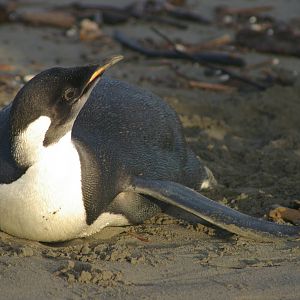
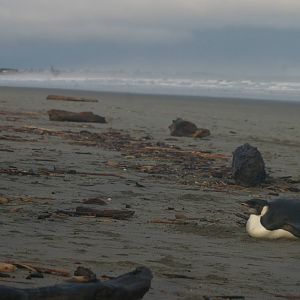
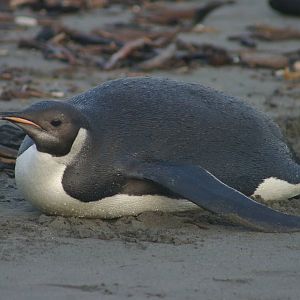
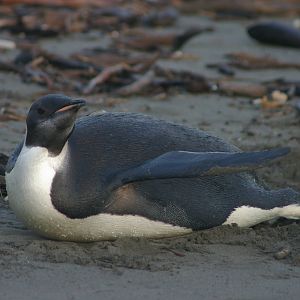
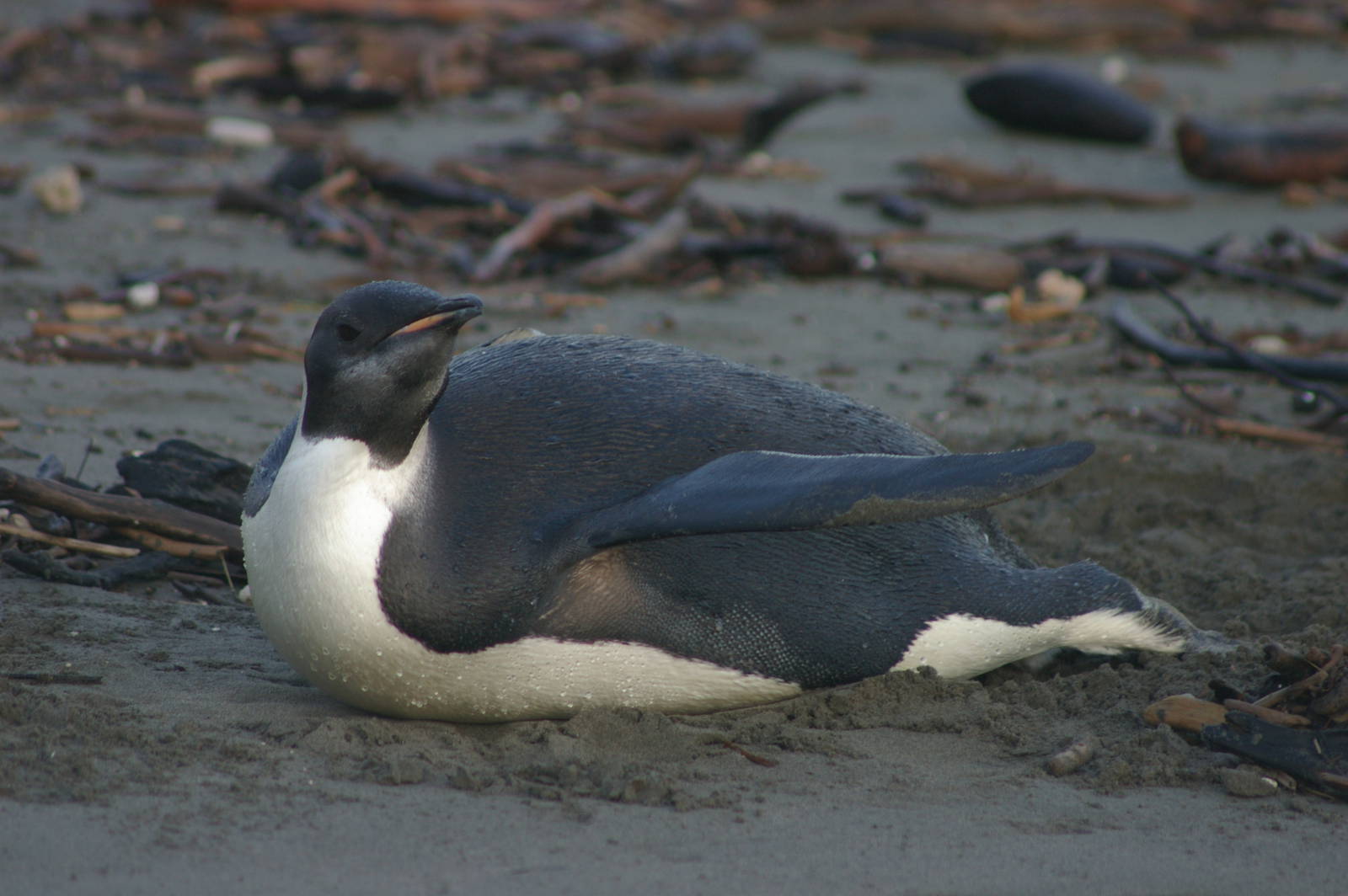
Emperor Penguin (Aptenodytes forsteri)

More information on this individual here: http://www.stuff.co.nz/environment/5172214/Rare-NZ-emperor-penguin-appearance

Basically, the bird was first spotted at Paraparaumu beach (just north of Wellington) on the afternoon of the 20th, then moved up to Pekapeka beach that evening. The news got out to the birdwatching community and also the general media on the 21st. I went up on the morning of the 22nd (today) hoping he would still be there, and fortunately he was, and most fantastic he was too even if he did stay prone upon the ground rather than standing up and strutting his stuff. Seriously, a magnificent bird. Can't help but feel sorry for the penguin though, completely lost with no idea what to do. Yesterday he was observed eating wet sand, apparently under the impression it was snow. Although he looks more-or-less fine at the moment I have a feeling he may end up at the Wellington Zoo hospital for recovery, and then he'll get shipped back to Antarctica where he belongs. Unless he just vanishes into the surf before then or, hopefully not (!), gets killed by a dog.

The first record of an emperor penguin on the NZ mainland (in 1967) was actually a ship-assisted bird so this current one is really the first proper record. Its also probably the most northerly emperor penguin on record. New Zealand is really a very long way north of anywhere they occur normally.
  • Like
Reactions: amur leopard
DoC is stuck in the proverbial position between a rock and a hard place. Damned if they do and damned if they don't.

Really there's only one way the story was ever going to end. I mean, an emperor penguin massively north of its range in a totally unfriendly climate for it, eating sand which will be compacting in its gut, no way to get it home...... its very sad but whatever people say there's nothing DoC could have done in the first place.

I honestly can't see it surviving even if it does get taken to the hospital. Hope I'm wrong though.
 
DoC is stuck in the proverbial position between a rock and a hard place. Damned if they do and damned if they don't.

Really there's only one way the story was ever going to end. I mean, an emperor penguin massively north of its range in a totally unfriendly climate for it, eating sand which will be compacting in its gut, no way to get it home...... its very sad but whatever people say there's nothing DoC could have done in the first place.

I honestly can't see it surviving even if it does get taken to the hospital. Hope I'm wrong though.

Well, it looks like it is heading to hospital anyway:

LATEST: Conservation Department staff and penguin specialists are discussing ways of moving a lost emperor penguin to Wellington Zoo or Massey University after his condition deteriorated.

DOC biodiversity manager Peter Simpson said a meeting with veterinarians and Massey University penguin specialists has talked at the scene and were now considering ways of moving the penguin while keeping it cool.

While Massey has heaps (heaps) of temperature-controlled rooms they could probably convert to a penguin home, I don't think they have any pools. Having said that, I imagine temperature may be more important than water for the penguin, so Massey may be better (I'm asuming Wellington doesnt have any suitable temperature-controlled rooms).

EDIT: 'Happy Feet' has been taken to Wellington Zoo now, "in a chilled box."
 
Penguin 'still strong' but given 50/50 chance | Stuff.co.nz
The emperor penguin taken from Peka Peka beach is to undergo surgery tomorrow, with zoo staff giving it a 50 per cent chance of recovery.

'Happy Feet' was earlier taken to Wellington Zoo in a chilled box from the Kapiti Coast after the penguin's behaviour changed markedly in the last few days.

Veterinary staff at the zoo said the bird was dehydrated and was suffering from heat exhaustion.

It needed to be stabilised before being operated on, but would this afternoon undergo a manual procedure to try to clear its throat, which seems to be blocked.

Wellington Zoo vet science manager Lisa Argilla said he was a spirited bird and the team was doing their best for him.

"He's still strong and he's got a lot of fight in him, which is good," Argilla said.

"Every animal is important to us. We don't really want him to suffer.

"I'm hoping its just a piece of driftwood that we can reach down and pull out."

As for the future, the zoo was still discussing the best course of action with the Department of Conservation (DOC).

While the best solution would be a return to Antarctica, there was also a facility in the USA which deals particularly with emperor penguins.

Returning the bird to Antarctica was not feasible because there was no transport there in winter and experts advised that large birds could suffer trauma if transported long distances.

Zoo staff said the last emperor penguin to come to New Zealand was released in Foveaux Strait.

DOC biodiversity manager Peter Simpson said the penguin had been eating sand, which may have been an effort to cool itself down, as penguins normally eat snow if they get too hot.

Simpson said it had become lethargic and that it might have an infection from eating sticks.

The bird was first spotted on Peka Peka Beach on Monday afternoon by resident Chris Wilton, who nicknamed it Happy Feet, and has since attracted local and global interest.

A cordon was put up around the penguin during the week, keeping people about 40m away due to high numbers of sightseers, with a group of residents even keeping guard on the beach overnight.

Kapiti Coast District Council also assigned a security guard to prevent harm to it.

It is the second recorded incident of an emperor penguin on New Zealand shores.
 
'Touch and go' for Antarctic emperor penguin - Yahoo! New Zealand News
The next 24 hours are critical for an young Antarctic emperor penguin who turned up on a Kapiti Coast beach, say Wellington Zoo staff who examined the bird.

The emperor penguin swam about 3200km from its Antarctic home to Peka Peka beach, about 60km north of Wellington. Its health was ailing before it was transported to the zoo today.

Wellington Zoo spokeswoman Kate Baker said the penguin was put under anaesthetic, while vet staff used water to flush out sand from his throat.

An x-ray had showed a lot of sand in his throat and stomach.

It was also possible he had ingested drift wood, though none had showed on the x-ray, she told NZPA.

Zoo vets woke up the animal late this afternoon and planned to monitor him over night, Ms Baker said.

"It's still touch and go. It will really depend on how the next 24 hours go."

The penguin would be given medication and fed food and water through an intravenous catheter, she said.

A treatment room at the zoo had been chilled with ice and an air conditioner for him.

"Basically unless something goes wrong, he'll kind of be left to recover for a bit -- for at least the next 24 hours.

"So they won't anaesthetise him again tomorrow unless they absolutely have to. And then they'll see how things go from there."

Vets had also taken blood samples, which would be tested for any infection or other health issues, Ms Baker said.

"At the moment it's looking at treating that sand and making sure that he's fed and hydrated."

Experts think the penguins may have eaten the sand because the birds normally eat snow for hydration and to keep cool.

The bird was first spotted at Peka Peka on Monday.

A decision has not been made about its future.
 
Happy Feet over first hurdle - national | Stuff.co.nz
The young emperor penguin rescued from a Kapiti Coast beach has survived the night, following a harrowing four-hour operation to clear sand from his airway yesterday.

Wellington Zoo spokeswoman Kate Baker said the penguin, dubbed Happy Feet, had been eating ice overnight and had "passed some sand" this morning.

He will now undergo a second procedure at 11am to remove some more sand from his stomach.

Last night Happy Feet was given only a 50 per cent chance of survival by his vets, who removed sand blocking his oesophagus. X-rays have revealed his stomach is full of it, and it remains a grave danger.

The operation was the first hurdle in the attempt to save the penguin, whose plight has captured local and international attention.

After swimming about 4000 kilometres from Antarctica, Happy Feet was first spied on Peka Peka Beach on Monday by resident Chris Wilton. Though the penguin appeared lively, four days of eating sand and sticks caused his condition to deteriorate.

Yesterday he was lethargic, occasionally trying to spit sand. About midday, Te Papa and Conservation Department officials whisked him to the zoo in a chiller.

Vet science manager Doctor Lisa Argilla assessed the 27-kilogram bird as dehydrated, stressed, suffering from heat exhaustion and struggling to swallow - but still feisty enough to kick and struggle as she sedated him.

Penguins in the Antarctic eat ice when trying to cool down, and he was trying to do the same with sand, Te Papa terrestrial vertebrates curator Colin Miskelly said. "He would have had no idea eating sand was not good for him."

At the zoo's operating theatre, a captivated crowd of about 50 watched through the glass as vets worked quickly, discussing where best to insert a catheter and squeezing antibiotic ointment into his sand-filled, ulcer-covered eyes.

Gently, Dr Argilla began to squirt water down his throat. Moments later, sand began cascading into a bucket.

After long, worrying moments, his oesophagus was cleared and Dr Argilla pronounced Happy Feet to be in a stable, but serious, condition. "The most important thing for him now is to rest," she said, stroking his soft coat.

He was last sighted nibbling ice in a temperature-controlled room, and will be treated to a meal of fish slurry today.

"We won't disturb him unless something goes wrong, and we'll reassess on Sunday to see if we need to sedate him again and get more sand out. The sand is still a very big concern - that's a lot of sand. The first 24 hours are critical."

But his long-term future remains unclear, with DOC's Peter Simpson saying he will be in discussions with penguin experts and other parties. "We have a dilemma. There is no transport to Antarctica this time of year ... we'll just have to take it day by day."
 
Penguin Offered Cruise Home.

Emperor penguin offered cruise home - national | Stuff.co.nz

The emperor penguin found more than 3000km from its Antarctic home on the Kapiti Coast this week will next year be offered a cruisier way home than his epic swim out here.

Businessman Gareth Morgan has offered a seat to the bird dubbed Happy Feet on a Russian icebreaker ship in February for an Our Far South expedition to the Ross Sea.

''Of course until that time Happy Feet will have to be cared for here in Wellington,'' he said.

The penguin is tonight in a critical condition in a cold room at Wellington Zoo.

Today some sand Happy Feet had eaten had been removed from his stomach, following two procedures at the zoo yesterday, Wellington Zoo spokeswoman Kate Baker said.

''We won't do another procedure on him tomorrow _ he's had two anaesthetics in two days, so after this we will give him a bit of a rest.''

An x-ray showed today's procedure only removed about twenty percent of the sand was removed from the penguin's stomach, and they might do a similar one on Monday, Ms Baker said.

The penguin passed some sand through its digestive system last night and they hoped it would pass more tonight, she said.

Sand from its oesophagus was removed yesterday.

About 75 people watched today's procedure, which was done by Dr Baukje Lenting and Dr Lisa Argilla of Wellington Zoo, and involved putting a tube inside the penguin's stomach and pumping water in.

The emperor penguin swam about 3200km from its Antarctic home to Peka Peka beach, about 60km north of Wellington. The only previous recording of an emperor penguin in New Zealand was at Southland's Oreti Beach in 1967.

Penguins usually ate snow for hydration and to keep cool, and experts believed it had eaten the sand because it was confused about where it was.
 
things are looking hopeful, fingers and toes crossed for the penguin
Emperor penguin comes through surgery | Stuff.co.nz
Happy Feet the penguin is in recovery after doctors today removed more than one litre of fluid and handful of sticks from his stomach during an operation.

Surgery started on Happy Feet this morning with doctors using a device to suck sand, sticks and fish out of its stomach.

A leading Wellington surgeon helped work on the emperor penguin found on a Kapiti beach last week.

The juvenile emperor penguin, found about 4000 kilometres from home on Peka Peka Beach last week is undergoing an endoscopy to find out what is making him sick.

The 27kg bird was taken to Wellington Zoo where it has been staying in a makeshift, temperature-controlled room, on a bed of party ice.

More than 100 people gathered at the zoo along with dozens of journalists.

Doctors worked for about three hours to removed 1200ml of fluid and sand from its stomach along with a handful of sticks.

The operation had to be stopped after some of the equipment they were using broke.

It is now recovering and staff at the zoo said they would leave it to try and process the rest of his stomach contents before x-raying it again on Wednesday.

Wellington Zoo spokeswoman Kate Baker said today the penguin was "bright'' but remained in a critical condition.

Ms Baker said Wellington Hospital gastroenterologist Dr John Wyeth would help with the procedure.

Dr Wyeth did his training in Wellington and at the Royal Free Hospital in London.

"Although we do endoscopies here, a gastroenterologist has a lot more experience and is also bringing along some specialised equipment,'' she said.

If Happy Feet pulls through another gruelling operation today, penguin experts will debate whether taking the Antarctic bird back home is the best option.

A Massey University penguin expert, Associate Professor John Cockrem, said choices included releasing the penguin into Foveaux Strait, or taking him back to Antarctica by boat or plane.

But transporting the bird would be risky and could threaten his survival.

If Happy Feet made it to Antarctica, then placing him with the other penguins would put them at risk of contracting diseases he may have picked up in New Zealand's more tropical climes.

The next trips to Antarctica are supply flights to Scott Base in August.

Businessman Gareth Morgan had offered Happy Feet a berth on a Russian icebreaker ship, but that would not be until February.

If he was released near Stewart Island, a tracking device could be used to follow his path, Mr Cockrem said.

The cost of housing the penguin is being borne jointly by DOC and Wellington Zoo. He is staying in a makeshift, temperature-controlled room, on a bed of party ice.

DOC biodiversity programme manager Peter Simpson said they had "no idea" what to do yet, and would discuss a permanent solution in the next few days.

This was by far the most bewildering conservation issue he had been involved in, he said. "It's way outside of its usual operating range, and that's why it's so extraordinary that it's survived."

Responding to criticisms that DOC should have acted earlier, Mr Simpson said there had been no reason to intervene until Happy Feet's condition deteriorated.

The penguin initially appeared healthy and experts had hoped that it would make its own way home. Elephant and leopard seals from Antarctica had become stranded on the New Zealand coast and usually left of their own accord.
there's a video on the link too for those interested. I think this would be the third operation since the penguin arrived at the hospital.
 
Emperor penguin perkier after operation | Stuff.co.nz
Half a stomach full of twigs, stones and netting have been painstakingly extracted from a healthier Happy Feet, while a penguin advisory committee has been set up to determine his future.

About 100 people gathered to watch the penguin pull through a three-hour endoscopy performed by Wellington Hospital gastroenterologist John Wyeth at the zoo's operating theatre yesterday.

A camera went down the emperor penguin's oesophagus, and Dr Wyeth withdrew tangled debris and flushed out more than a litre of sandy water.

The sick penguin, who swam about 4000km from Antarctica to Peka Peka beach, was whisked to the zoo on Friday. Yesterday, about half of the sand and debris in his stomach was suctioned out – and it was hoped a combination of oily fish milkshakes, fluids and medication would assist him in passing the rest naturally.

Dr Wyeth, whose dream is to perform an endoscopy on a tiger, said he contacted the zoo on Saturday to offer to operate on Happy Feet.

To reach the bird's stomach, he had to insert and twist 80 centimetres of tubing at a sharp, 180-degree angle. "Obviously you can't put too much pressure on the stomach, because it might tear."

It was a lot of trouble to go to for a penguin, but Dr Wyeth said it was worth it.

Wellington Zoo vet science manager Lisa Argilla said Happy Feet had not yet been given the all-clear, and it was likely he would take two or three months to recover fully. However, he had been getting his strength back. "Yesterday he actually punched me in the stomach with his flipper."

Vets have been referring to Happy Feet as a male, though they do not yet have the DNA test results to confirm this.

A penguin advisory committee, including experts from Massey University, the zoo, Te Papa and the Conservation Department, will decide in the next few days what to do with Happy Feet.

Massey University penguin expert John Cockrem said he did not think a return to Antarctica was feasible because of the risk of spreading disease, and relocation at Christchurch's Antarctic Centre was unsuitable because the bird would be isolated. The best option would be to free him off the coast of the South Island.

TREATMENT COSTS LOW

It has been a lot of work for a lot of people, but the only extra costs incurred by the treatment of Happy Feet have come from a rented air-conditioning unit.

Moana Fisheries has donated ice and fish, and Dr John Wyeth operated free of charge, zoo chief executive Karen Fifield said.

"From a ratepayer's perspective, I don't think it's exorbitant costs for this animal."

The air-conditioner was costing $297 a week. Meanwhile, the penguin appeared to be bolstering zoo attendance figures, she said.

The Conservation Department's Peter Simpson said the only costs to it had been staff time, and the petrol for the ride from Peka Peka to the zoo.
 
Returning Penguin to Antarctica Illegal

Returning penguin to Antarctica 'illegal' | Stuff.co.nz

Happy Feet the emperor penguin cannot be returned to Antarctica unless he is given a special permit.

The Antarctic Treaty, signed by 46 nations and enshrined in New Zealand law, stipulates that no living bird is allowed to be taken into Antarctica.

Though the emperor penguin is native to the continent, taking him back there would breach the treaty's protocols on environmental protection because of the risk of disease, Antarctica New Zealand science manager Ed Butler says.

Micro-organisms picked up on the penguin's 4000-kilometre swim to New Zealand or while on our shores could cause Happy Feet to become sick months down the track.

"Even if we screened Happy Feet, we still couldn't be sure that he wouldn't be carrying something that would turn up in blisters and sores in six months' time and kill all his mates," Mr Butler said.

Agriculture and Forestry Ministry research shows a suspected virus that struck a colony of adelie penguins in Antarctica in 1972 killed 65 per cent of baby penguins in the colony of thousands.

"There are 150,000 breeding pairs in some colonies, and 65 per cent of that is a big number," Mr Butler said. "That's a lot of dead penguins for one penguin."

The only way Happy Feet could legally return to Antarctica was if he was given a special permit by the Foreign Affairs and Trade Ministry's Antarctic policy unit, he said.

And even if he was dropped back to Antarctica, there were no guarantees of a family reunion.

"The problem is we've all seen Happy Feet [the movie] and we all probably think there's a bunch of penguins waiting for him in Antarctica. But if we take him to Cape Crozier, maybe he actually belongs in the Australian sector 1500 miles away."

Massey University penguin expert John Cockrem will be recommending that Happy Feet be released off New Zealand's south coast when the penguin advisory committee, a panel of experts set up to determine his future, has its first meeting at Wellington Zoo today.

A Foreign Affairs and Trade Ministry spokesman said if it was decided that Happy Feet should go to Antarctica, MAF would seek advice on whether he would need a permit.

HAPPY FEET PASSES MUSTER

Happy Feet is now in a stable condition, and has been passing more rocks and sand naturally since his operation on Monday, Wellington Zoo spokeswoman Kate Baker says.

Today he is set for more X-rays at the zoo's hospital, The Nest, to see if another endoscopy or stomach flushing is necessary.

Ad Feedback The zoo is still awaiting results of DNA tests to establish whether the emperor penguin, believed to be 3 1/2 years old, is actually a male.

I guess that disease transmission risks will be considered primarily here. But if it is too risky to return him, and no-one else with emperors wants him, then what will happen?
 

Media information

Category
New Zealand - Wildlife
Added by
Chlidonias
Date added
View count
6,836
Comment count
38
Rating
0.00 star(s) 0 ratings

Share this media

Back
Top