Chlidonias

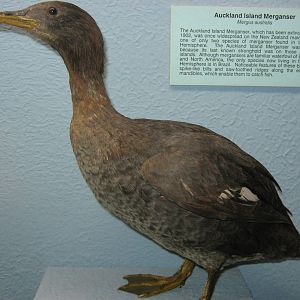
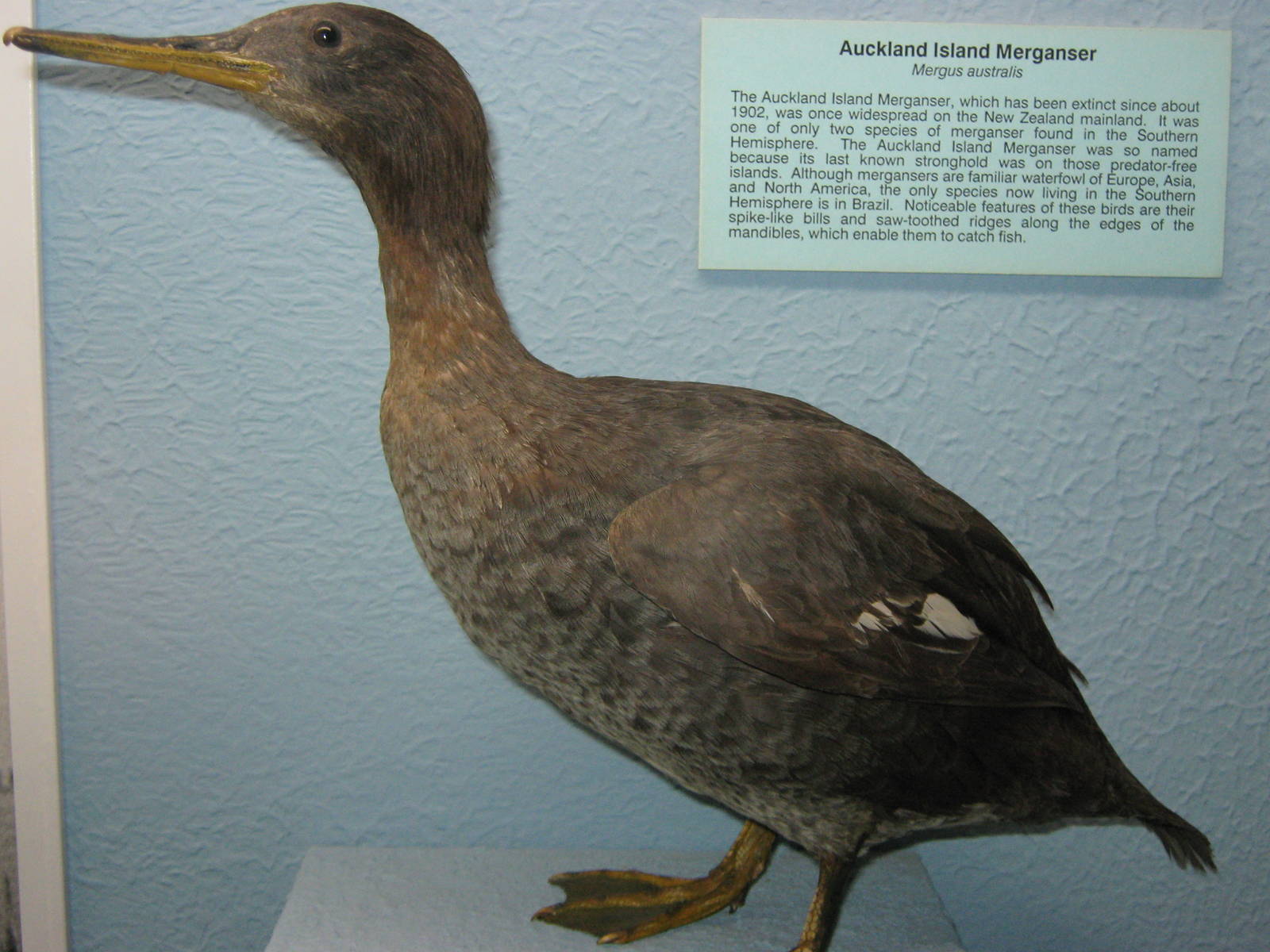
Auckland Islands merganser (Mergus australis)

this species was discovered on the Auckland Islands in the subantarctic around 1840, and the last known individuals were a pair shot there on 9 January 1902. Subfossil remains show the species was formerly widespread on the New Zealand mainland, from which it was probably eliminated by Maori hunting. Subfossil remains on the Chatham Islands show that this species or a closely-related one also occurred there. This merganser was one of only two species in the Southern Hemisphere (the other being the Brazilian merganser)

This specimen was photographed at the Canterbury Museum in Christchurch, New Zealand
  • Like
Reactions: UngulateNerd92
this species was discovered on the Auckland Islands in the subantarctic around 1840, and the last known individuals were a pair shot there on 9 January 1902. Subfossil remains show the species was formerly widespread on the New Zealand mainland, from which it was probably eliminated by Maori hunting. Subfossil remains on the Chatham Islands show that this species or a closely-related one also occurred there. This merganser was one of only two species in the Southern Hemisphere (the other being the Brazilian merganser)

This specimen was photographed at the Canterbury Museum in Christchurch, New Zealand
 
What drove the species to oblivion? Was it all hunting?:eek:

Are there any native species of NZ ducks still living?
 
mostly by hunting, yes. They were gone from the main islands of NZ by the time Europeans arrived, probably through a combination of direct hunting by Maori and by egg predation from the introduced Polynesian rats. The Auckland Islands population was on the edge of the species' survival capabilities and the numbers there were probably always small. They were wiped out very quickly by hunting (although mammals such as pigs and rats were also introduced there by the sealers).

Endemic waterfowl still surviving:
blue duck
brown teal (also Auckland and Campbell Islands brown teal on those islands)
NZ scaup
paradise duck

Native waterfowl still surviving:
grey duck
grey teal
Australasian shoveller

Introduced species:
mallard
Canada goose
black swan*
mute swan

Extinct species:
Auckland Islands merganser (and perhaps another on the Chathams)
NZ musk duck (closely related to the Australian musk duck)
NZ stiff-tailed duck (closely related, possibly conspecific with, the Australian blue-billed duck)
Scarlett's duck (closely related to the Australian pink-eared duck)
Finsch's duck (closely related to the Australian wood duck)
Chatham Islands duck
South Island goose (related to the Australian Cape Barren goose)
North Island goose (ditto)


*the black swan was found naturally in NZ in pre-human times but became extinct after the arrival of the Maori. The subfossil remains were described as a new species (Cygnus sumnerensis) but it was later determined to be identical to living Australian black swans. These were introduced to NZ in the 1860s but it is now accepted that the population grew so fast that the only possible explanantion was that the numbers were largely enhanced through natural (re)colonisation from Australia.


The blue duck and brown teal are both endangered, all other waterfowl in NZ are common (well, maybe not so much the mute swan)
 

Media information

Category
New Zealand - Other
Added by
Chlidonias
Date added
View count
3,558
Comment count
3
Rating
0.00 star(s) 0 ratings

Share this media

Back
Top