Chlidonias

Australian pelicans (Pelecanus conspicillatus)

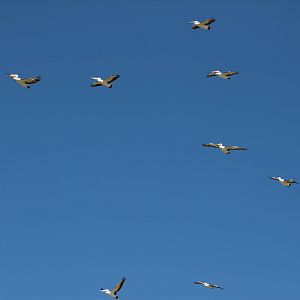
At the start of August an Australian pelican was spotted at Kerikeri, way up in the far north of New Zealand. This is a most unusual vagrant for New Zealand, and it caused a bit of a stir in the birding community because there haven’t been any seen here since the 1970s. Then a week later a flock of fourteen pelicans was filmed by a barge operator in the Kaipara Harbour a bit further south. This was even more unusual. One of the older records was of three birds but all other vagrant pelicans have been singletons. This was the first time an actual flock had been recorded in the country, possibly even one with the potential to establish as a breeding population. Another pelican was then photographed in early September at Whangamai to the east of the Kaipara, and then at Ruakaka, but no-one is sure if that was a sixteenth/seventeenth bird or one of the others (i.e. the Kerikeri one) on the move.

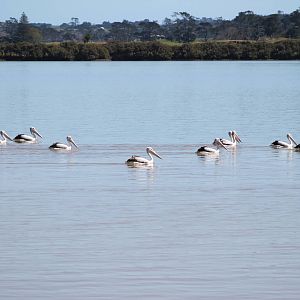
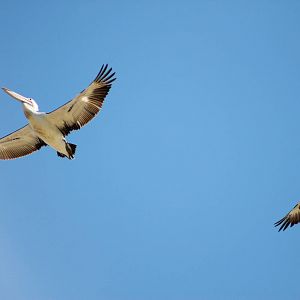
I fortuitously had an Auckland trip already planned (mainly for visiting Tiritiri Matangi), and I managed to build the pelicans into the time I had with the car-pooling assistance of a local Auckland birder. The birds in these photographs are part of the flock of fourteen on the river that flows into the north end of the Kaipara harbour near Ruawai.

Photo taken 13 September 2012
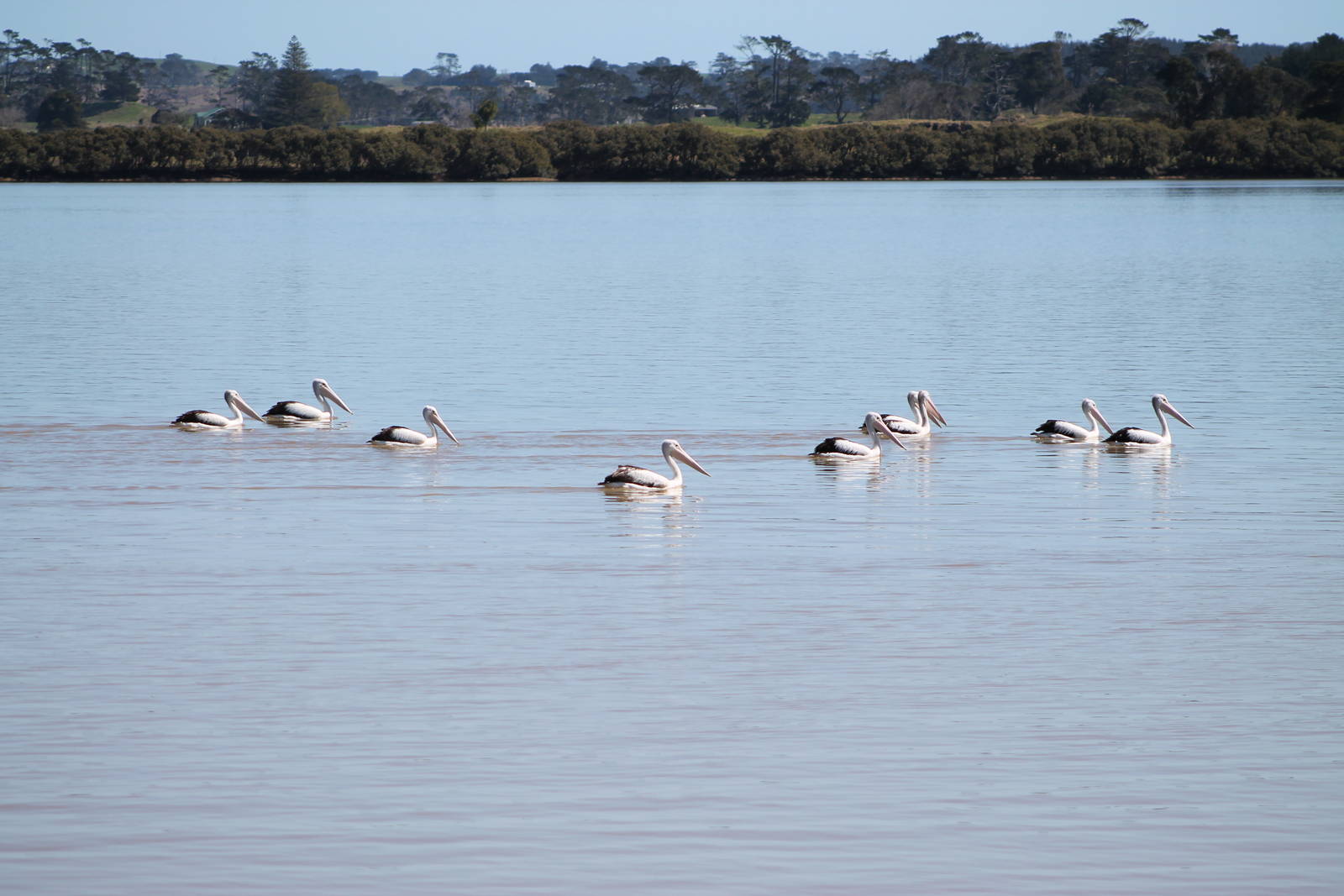
At the start of August an Australian pelican was spotted at Kerikeri, way up in the far north of New Zealand. This is a most unusual vagrant for New Zealand, and it caused a bit of a stir in the birding community because there haven’t been any seen here since the 1970s. Then a week later a flock of fourteen pelicans was filmed by a barge operator in the Kaipara Harbour a bit further south. This was even more unusual. One of the older records was of three birds but all other vagrant pelicans have been singletons. This was the first time an actual flock had been recorded in the country, possibly even one with the potential to establish as a breeding population. Another pelican was then photographed in early September at Whangamai to the east of the Kaipara, and then at Ruakaka, but no-one is sure if that was a sixteenth/seventeenth bird or one of the others (i.e. the Kerikeri one) on the move.

I fortuitously had an Auckland trip already planned (mainly for visiting Tiritiri Matangi), and I managed to build the pelicans into the time I had with the car-pooling assistance of a local Auckland birder. The birds in these photographs are part of the flock of fourteen on the river that flows into the north end of the Kaipara harbour near Ruawai.

Photo taken 13 September 2012
 
I dont think they will come back, I recon NZ will soon have a breeding population.
There has been a couple of big breeding years at Lake Eyre so we probably have a larger than usual population at the moment.
 
How was Tiritiri?
 
I dont think they will come back, I recon NZ will soon have a breeding population.
There has been a couple of big breeding years at Lake Eyre so we probably have a larger than usual population at the moment.
what usually causes influxes of Australian birds to NZ are widespread drought, large-scale bushfires, and flooding. In the case of these pelicans it is assumed that the floods over the last couple of years have meant that there have been some fabulous breeding seasons for them, but now the habitat is shrinking back again the water birds are having to spread out to try and find new living spaces. That's when you get the weird stuff turning up in NZ, New Guinea and the Pacific.

I had been of the opinion that it would be unlikely for these pelicans to establish here, but having seen how well they've settled in and how cohesive they are as a group, they may well prove me wrong and start breeding. However the problem they face is the lack of any substantial fish populations in freshwater habitats in NZ. Basically the birds are going to be limited to tidal rivers and estuaries (such as where they are right now, where there are loads of mullet), so they will be a bit restricted. I don't think they will actually establish as a permanent population, even if they do manage to breed.
 
How was Tiritiri?
AWESOME!!!

A pair of kokako were seen within ten minutes of landing, and I had three further sightings during the stay there but sadly no photos. Amazing birds. Little spotted kiwi took me three friggin' nights to track down (everybody else on the island found them no problem, damn them!). I saw almost all the bird species on the island quite easily, with the exception of rifleman and spotless crake which both remained unfound. Also found all but two of the reptile species. Someone else found a giant centipede too.

Photos will be uploaded in due course.
 
So did you stay for three nights, or more?
 
I was there for three nights. The ferry doesn't run on Monday or Tuesday, so if you go across on Sunday and back Wednesday you get two glorious public-free days. The bunk-house only sleeps fifteen people so you almost have the island to yourself.
 
Good to know. I'll keep that in mind when I plan my visit.

Thanks!
 

Media information

Category
New Zealand - Wildlife
Added by
Chlidonias
Date added
View count
1,446
Comment count
8
Rating
0.00 star(s) 0 ratings

Share this media

Back
Top