Chlidonias

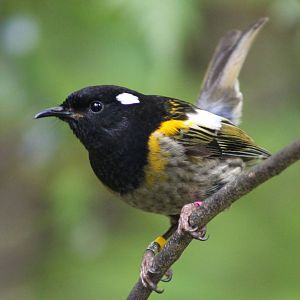
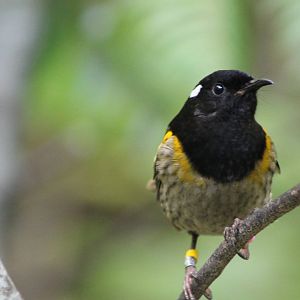
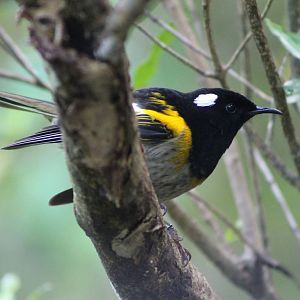
male stitchbird (Notiomystis cincta)

September 2012, Tiritiri Matangi island, Auckland.

A peculiar little bird endemic to the North Island. Formerly widespread, it disappeared from most of its range after the arrival of Europeans, surviving only on Little Barrier Island. Today there are populations on a number of other islands and even in some heavily-protected mainland areas.

Originally it was classed as a honeyeater (along with tui and bellbird), but more recently it has been moved to its own monotypic family Notiomystidae, which is thought to be most closely related to the wattlebirds (saddleback, kokako and huia).
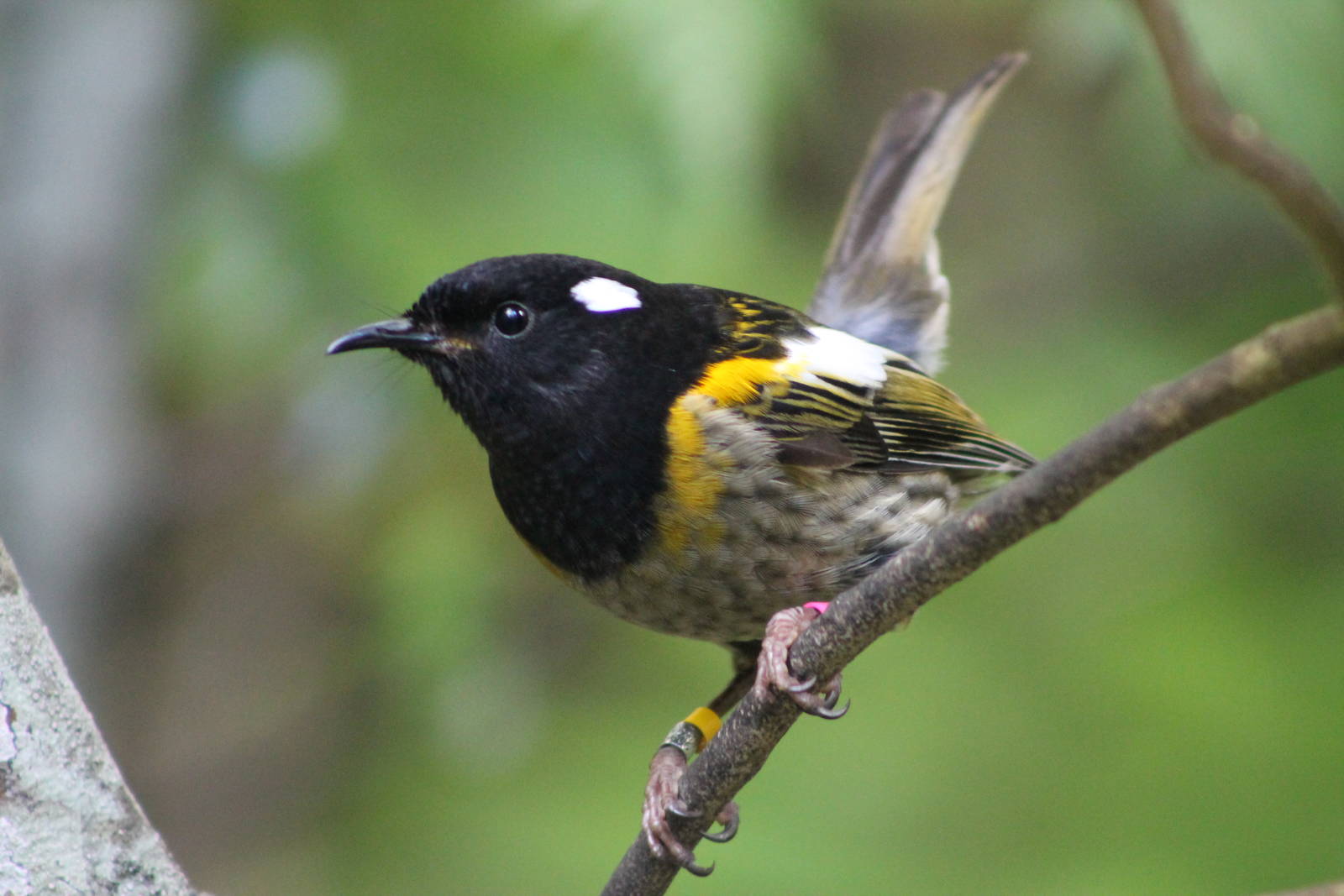
September 2012, Tiritiri Matangi island, Auckland.

A peculiar little bird endemic to the North Island. Formerly widespread, it disappeared from most of its range after the arrival of Europeans, surviving only on Little Barrier Island. Today there are populations on a number of other islands and even in some heavily-protected mainland areas.

Originally it was classed as a honeyeater (along with tui and bellbird), but more recently it has been moved to its own monotypic family Notiomystidae, which is thought to be most closely related to the wattlebirds (saddleback, kokako and huia).
 
Gorgeous photo. Is it a fairly 'steady' species or was it a challenge to get such a good photo? I'd be interested to know since i'm completely unfamiliar with it.
 
Formerly widespread, it disappeared from most of its range after the arrival of Europeans, surviving only on Little Barrier Island. Today there are populations on a number of other islands and even in some heavily-protected mainland areas.

Another 'tick' for me on Little Barrier.;) I think at that time LB represented the 'Stitchbird's Last Stand' and the reintroductions have happened since then?- circa 1990 that was.

Estimate of total population numbers now?
 
Nice photo!

I think their should be a Tiritiri Matangi folder in the New Zealand gallery.
 
Gorgeous photo. Is it a fairly 'steady' species or was it a challenge to get such a good photo? I'd be interested to know since i'm completely unfamiliar with it.
ha, they never stop still, and they are so fast that they will have left the frame between the button being pressed and the photo being taken: I got a lot of empty shots!! Even my best shots aren't quite sharp. All of them were taken by one of the nectar feeding stations. The forest on Tiritiri is still young (the island was formerly pasture) so most of the stitchbirds' food currently comes from the feeding stations.

I got what would have been a great photo of one with its white "ears" raised, but it was nowhere near in focus.
 
Another 'tick' for me on Little Barrier.;) I think at that time LB represented the 'Stitchbird's Last Stand' and the reintroductions have happened since then?- circa 1990 that was.

Estimate of total population numbers now?
the species was gone from the mainland by the 1880s, and so Little Barrier was its sole remaining home until the 1980s. It basically hung on there by the skin of its teeth (so to speak) in the face of rats and feral cats for a hundred years.

The first attempts at establishing new populations were translocations to Hen Island in 1980 and 1981; Cuvier Island in 1982 and 1985; and Kapiti Island in 1983 and 1985. None of these succeeded. Further attempts in the early 1990s to Kapiti, Mokoia and Tiritiri all resulted in established populations, although I think only the original Little Barrier one is still considered stable. More recently they have been introduced to Karori Sanctuary/Zealandia (in Wellington) and the Ark In The Park (in the Waitakere Ranges in Auckland), and these are currently the only wild mainland populations.

Total population is estimated to be somewhere between 3000 and 5000, mostly on Little Barrier. Tiritiri has about 150 birds.
 

Media information

Category
New Zealand - Wildlife
Added by
Chlidonias
Date added
View count
3,587
Comment count
6
Rating
0.00 star(s) 0 ratings

Share this media

Back
Top