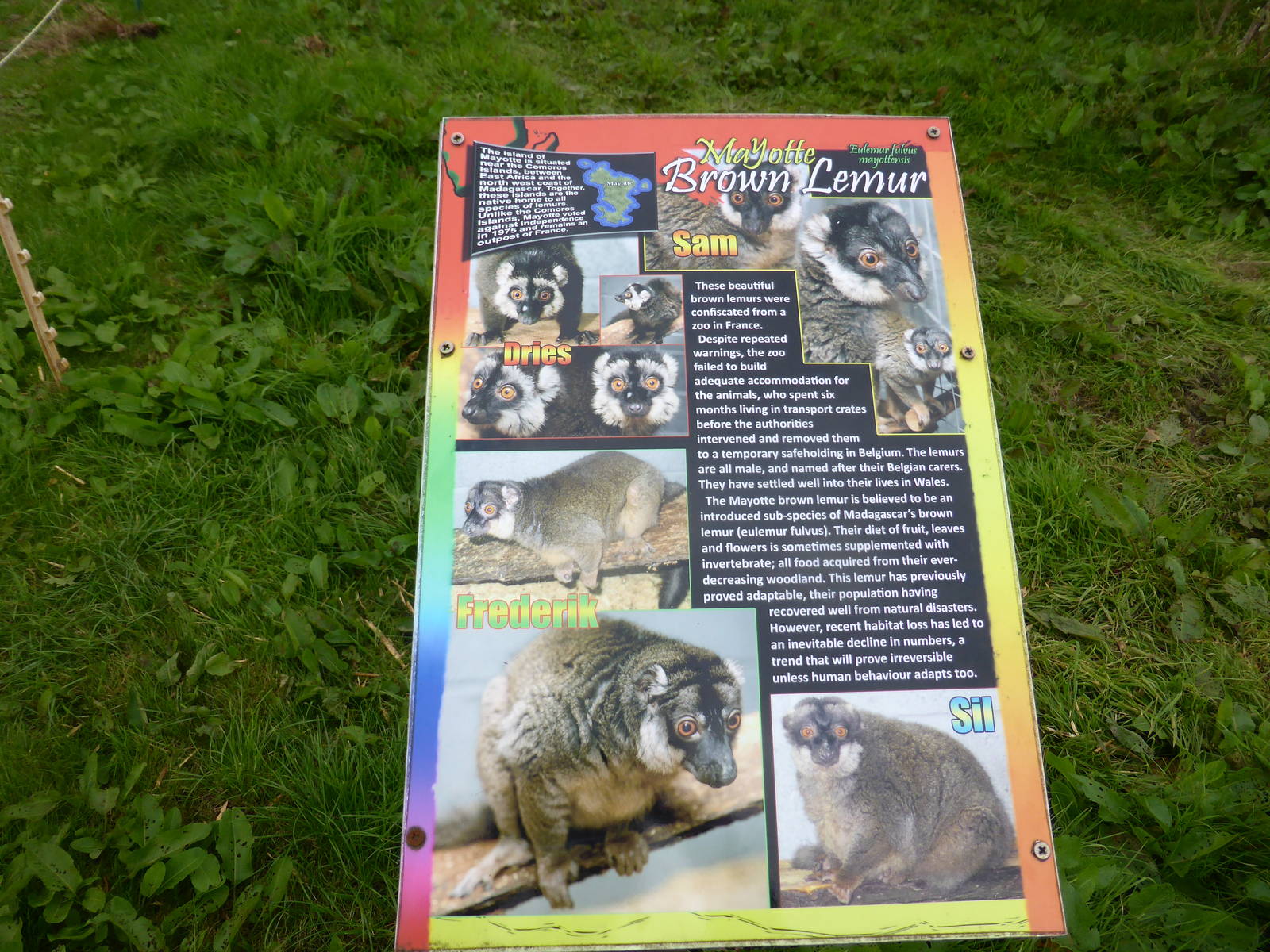
Sort of; they aren't a subspecies at all, and belong to E. fulvus only in the broadest sense.
To be precise, Mayotte Brown Lemurs represent a hybrid swarm of multiple Eulemur taxa which were introduced to the eponymous island and interbred profusely; I do not believe anyone has done detailed work into *which* precise taxa were involved beyond the true Brown Lemur, but I suspect Collared, Red-fronted and Mongoose are all involved.
Sort of; they aren't a subspecies at all, and belong to E. fulvus only in the broadest sense.
To be precise, Mayotte Brown Lemurs represent a hybrid swarm of multiple Eulemur taxa which were introduced to the eponymous island and interbred profusely; I do not believe anyone has done detailed work into *which* precise taxa were involved beyond the true Brown Lemur, but I suspect Collared, Red-fronted and Mongoose are all involved.
The first edition of Lemurs of Madagascar by Mittermeier et al - released in 1994 - stated that Eulemur fulvus mayottensis was nothing more than a synonym of E. fulvus fulvus; this book was released prior to several species being split from E. fulvus, after which point the taxon became monotypic.
However, these splits are taken into account by later editions of this book - the third of which, published in 2010, is substantially different from the original and contains work by about half a dozen authors absent from the first edition. In this edition - which I own - the Mayotte Brown Lemur is briefly discussed within the main account for E. fulvus, with Mittermeier noting that it comprises an introduced hybrid population, precise composition unknown, and as such is a curiosity worthy of further study but not a valid taxon for the purposes of the book.
My copy of the book is in Northumberland right now, with Helly; I will be visiting her tomorrow, so I will be able to transcribe the exact text for you then
that would be good. I didn't actually notice that the sign says mayottensis, all tucked away up the top there - I thought they were merely saying it was introduced to the island. Nobody has considered that a real subspecies for years, so you'd think even a general collecting of info from the internet wouldn't have resulted in that.
I was actually more interested in your "hybrid swarm" given that I haven't seen this anywhere else. Not saying that it isn't, given that all the original animals were introduced way back when, but the only reference I've ever seen which relates to this is that the small island of Bouzi (off Mayotte) has hybrid lemurs (specifically mentioned on the IUCN page, for example). Tourism websites usually say the island is for the "conservation of Mayotte's own endemic lemur" or words to that effect, suggesting it has been populated by animals from the main island - but I still find it curious that Bouzi would be singled out over Mayotte itself for remarks about hybrids, and indeed that I have never seen other comments on it.
I have just now (while typing) tried to find some info on Bouzi Island but it is all rather general. I think the lemurs have just been released there from the main island though.
I've got Lemurs of Madagascar (Third Edition) open in front of me right now so here goes.....
Within a general overview of Eulemur on pg. 377 of the book:
In this book we follow the taxonomy of Groves (2001) for the most part, recognizing 12 species of Eulemur overall. However, we also recognise Eulemur cinereiceps as the senior synonym for what has previously been called E. albocollaris; we elevate E. macaco macaco and E. m. flavifrons to full species; and we recognize the recent proposed split of Eulemur rufus and Eulemur rufifrons (Groves, 2006; Mittermeier et al., 2008c; Groves and Roos, in prep.). Finally, as indicated in the first and second editions, we continue to consider the brown lemurs inhabiting the island of Mayotte in the Comoros to be nothing more than introduced populations of E. fulvus (Mittermeier et al., 1994).
Then, within the specific account relating to Eulemur fulvus, the following two excerpts - both located on pg. 400 of the book - are relevant to the precise nature of the introduced population:
The population of this species on Mayotte shows many signs of being a hybrid swarm, composed mainly of E. fulvus founders but with features of a number of other brown lemur species (Mittermeier et al., 2008c). Further genetic investigation on this population would be interesting, but we do not consider it to be taxonomically distinct.
It is one of only two species to occur outside of Madagascar, being found on the island of Mayotte in the Comoros, where it was apparently introduced by our own species prior to European arrival. However, as noted above, the Mayotte population is not pure Eulemur fulvus.
Mittermeier et al.(1994) considered the introduced Mayotte populations to be Eulemur fulvus fulvus,and did not recognize them as a distinct taxon. Most other authors agree, backed up by genetic data (Pastorini et al. 2000). Recent field observations by Mittermeier indicate that the population is more than likely a hybrid swarm, with great variety in the phenotypes of the individuals at several field sites. Probably the origin of the population included representatives of Eulemur fulvus and other members of the group.
thanks for that. Nowhere else seems to have really picked up on the hybrid angle of the Mayotte lemurs. Even the IUCN page for fulvus somewhat contradicts itself, as I noted earlier, saying on the one hand that the Mayotte lemurs are introduced fulvus and then later singling out the offshore island of Bouzi as being home to hundreds of hybrid lemurs.
It doesn't seem that any genetic work has been done on this though, as the few references seem to relate only to the way the way the lemurs look - in fact it seems to stem solely from Mittermeier saying they are physically variable. So with the obvious lack of any evidence of where the original lemurs came from, and no genetic work, it is still only a theory based on their appearance. Not an unreasonable theory, but far from being an absolute.
Given that the paper quoted was released in 2008, and the book quoted was released in 2010, it is always possible that some genetic testing *has* taken place since then of course. I suppose time will tell.
In any case, the Mayotte Lemur is living on borrowed time as far as captive collections go; if one makes a distinction between the Brown Lemurs found in other captive collections - many of which are certainly hybrids to some degree themselves dating back to the days when most of the species found within Eulemur were classified within fulvus as subspecies - and the "true" Mayotte Lemur population imported from the Comoros back when they were believed to be a distinct subspecies, I know only of five surviving Mayotte individuals in Europe:
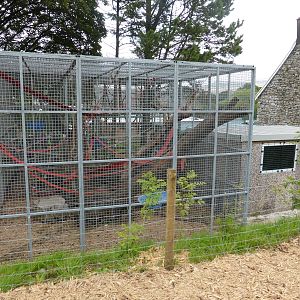
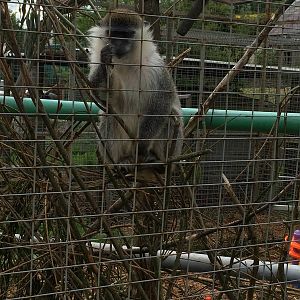
1) Two of the individuals within the exhibit signposted here - the other two being "generic" Brown Lemur to the best of my knowledge.
2) An elderly pair in a private collection somewhere in Cornwall.
3) A single geriatric at Tiergarten Nurnberg.