Chlidonias

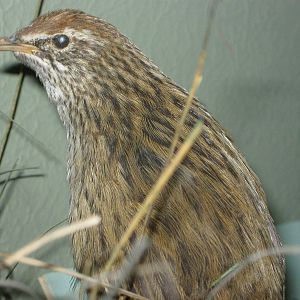
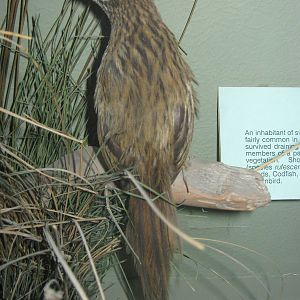
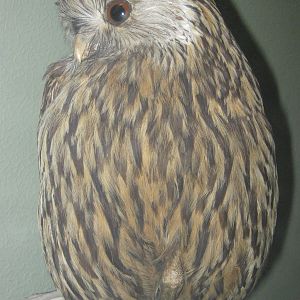
laughing owl (Sceloglaux albifacies)

There were two subspecies: the North Island [i]S.a. rufifacies[/i] which, apart from subfossil remains, is known only from two specimens and a few sightings from the mid to late 1800s; and the South and Stewart Island [i]S.a. albifacies[/i] which was common at the time of European settlement but of which the last known individual was found dead in 1914

Old nests found in various parts of the country have provided invaluable data on diet, via the pellets of indigestible material (bones etc) that owls habitually cough up. Prey remains include those from weevils and other beetles (including ones no longer found on the mainland), snails, and many species of vertebrates, particularly kiore (Polynesian rat) and large geckoes, but also skinks, tuatara, bats, frogs, fish, and birds ranging from canopy species such as yellowhead, rifleman, kakariki, pigeon and kokako, to terrestrial species such as ducks, snipe, kakapo, moa chicks, petrels, owlet-nightjars and kiwi. One nest-site even yielded bones from a seal pup. The bones of mice, rats, rabbits, goldfinches, starlings etc, show that some nest-sites were still in use long after European colonisation (and some may, in fact, have been in use by successive generations of owls for over 1000 years).

This specimen was photographed at the Canterbury Museum in Christchurch, New Zealand
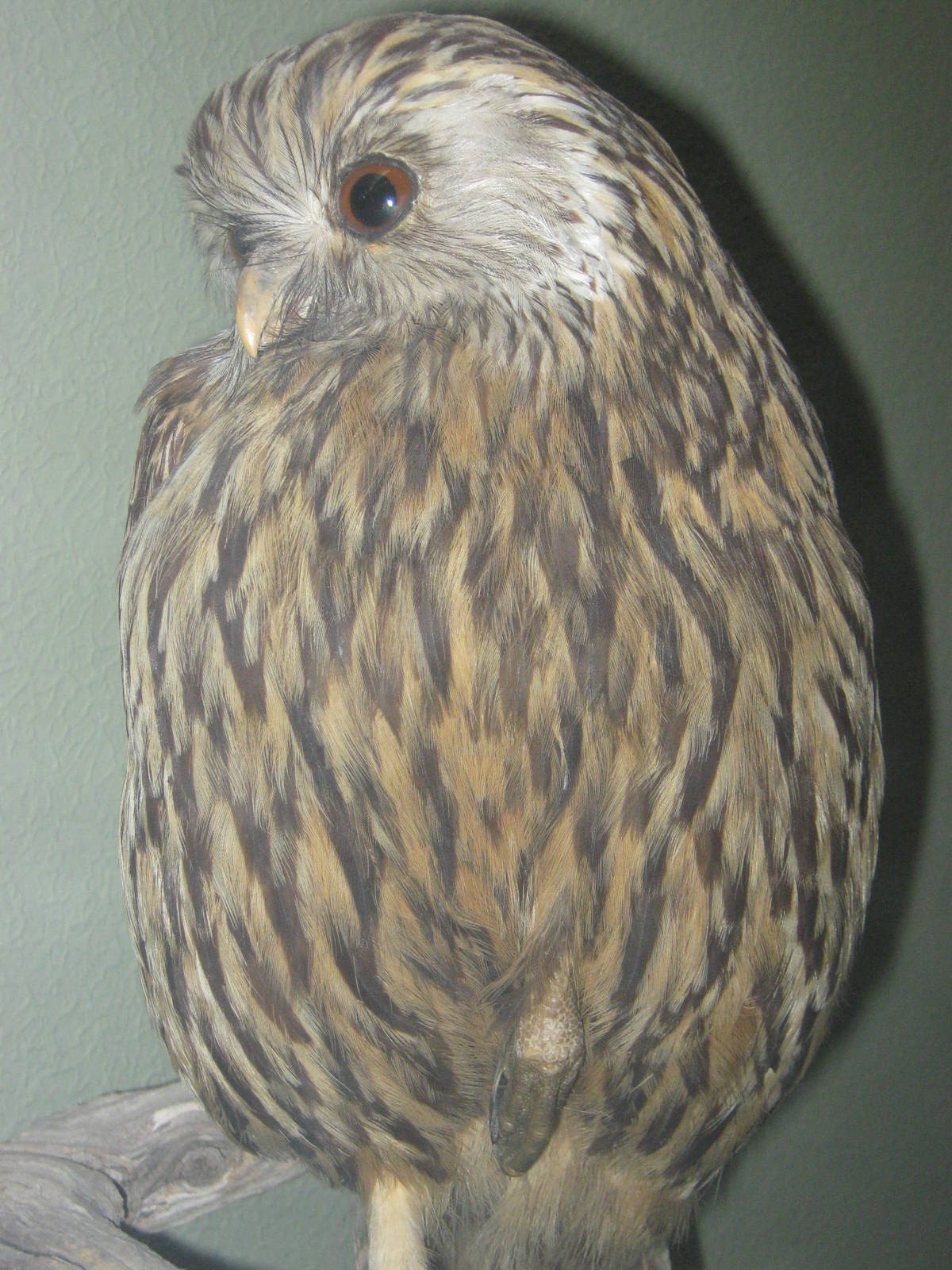
There were two subspecies: the North Island S.a. rufifacies which, apart from subfossil remains, is known only from two specimens and a few sightings from the mid to late 1800s; and the South and Stewart Island S.a. albifacies which was common at the time of European settlement but of which the last known individual was found dead in 1914

Old nests found in various parts of the country have provided invaluable data on diet, via the pellets of indigestible material (bones etc) that owls habitually cough up. Prey remains include those from weevils and other beetles (including ones no longer found on the mainland), snails, and many species of vertebrates, particularly kiore (Polynesian rat) and large geckoes, but also skinks, tuatara, bats, frogs, fish, and birds ranging from canopy species such as yellowhead, rifleman, kakariki, pigeon and kokako, to terrestrial species such as ducks, snipe, kakapo, moa chicks, petrels, owlet-nightjars and kiwi. One nest-site even yielded bones from a seal pup. The bones of mice, rats, rabbits, goldfinches, starlings etc, show that some nest-sites were still in use long after European colonisation (and some may, in fact, have been in use by successive generations of owls for over 1000 years).

This specimen was photographed at the Canterbury Museum in Christchurch, New Zealand
 
Of all the New Zealand extinctions, this is one of the saddest ones to me. It was actually bred in captivity by a private individual in 1882, suggesting that with a bit more awareness, this bird might well be with us today.
 
from historical reports laughing owls did seem very docile and adaptable to captivity, but of course one cannot attach 19th century attitudes to those of today (unfortunately).

Equally as sad I suppose is the Stephens Island wren. If the lighthouse keepers hadn't introduced cats to the island (and if the museum collectors had been held in check!) then that species would still be with us today amongst the tuatara and other inhabitants of that little island.
 
Hi Chlidonias (seems odd hailing a marsh tern!)

Do you think that, possibly, the Stephens Island lighthouse keeper's cat MIGHT be unfairly maligned? Had rats got to the island first, which would explain why the cat was a necessity?

19th century museum curators are people that have a lot to answer for. I can understand settlers in the back country of Tasmania being worried about the depredations of a wolf-like animal amongst their sheep and hens, but the collectors who did for the last remaining Great Auks were commissioned by men who must have known that they were pushing a very rare bird to the brink of extinction.
 
rats have never reached Stephens Island, which may seem surprising but there was nowhere to actually land a boat there. This is the reason the island still teems with tuatara and lizards, as well as a species of native frog and several insect species that are extinct on the mainland.

The story of the lighthouse keeper's cat is not an entirely accurate one because in fact there wasn't one cat, the island was infested with them. They wiped out several species of birds there, although all were at that point still found on the mainland as well (the wren was the only one restricted to the island, but that was only due to having been wiped out over the rest of NZ by Polynesian rats introduced with the Maori). The lighthouse was built in 1894 and by 1899 the cats were so numerous that it was decided to eradicate them -- by 1910 a total of 700 feral cats had already been destroyed, and the final ones were despatched by 1925.

All the wrens that were obtained and sent to museums were done so in the years 1894 and 1895. Many or most of these were probably actually collected by shooting. However it was certainly the cats that caused the extinction. If the cats hadn't been there the birds may still have been wiped out by the museum collectors (in fact, given the values of the time and the probable low population of the bird that is almost a certainty!), but it was the cats that were the problem. They were probably also the leading cause of the other (local) extinctions on the island.
 
I've read in several articles and books that only 3 specimens of the wren were ever collected but if I read your story, there must have been more collected. Do you have numbers of specimens in musea and names of musea in which the wren can be seen ?
 
I've read in several articles and books that only 3 specimens of the wren were ever collected but if I read your story, there must have been more collected. Do you have numbers of specimens in musea and names of musea in which the wren can be seen ?
specimen list from Wikipedia which seems to be accurate:
15 specimens (excluding prehistoric bones) are now known. Additionally, there are some uncertainties suggesting that some additional ones might have existed.
Rothschild's specimens, all of which were collected between July and October 1894: Natural History Museum, London: three (NHM 1895.10.17.13; 1939.12.9.76; 1939.12.9.77).
American Museum of Natural History, New York City: four (AMNH AM 554502; AM 554503; AM 554504; AM 554505).
Academy of Natural Sciences, Philadelphia: one (ANSP 108,631).
Harvard Museum of Comparative Zoology, Cambridge, Massachusetts: one (MCZ 249,400).

Buller's specimens, collected at unknown dates between 1894 and 1899: Carnegie Museum, Pittsburgh: one (CMNH 24639), labelled as female and dated 1894 in Buller's handwriting. Apart from the date discrepancy, it could be the bird Buller spoke of in August 1895; possibly the specimen was collected months before Buller had examined it. Alternatively, it could be the Bethune bird in case Buller kept it (he initially seems to believe it to be a female), as Rothschild (1907) believed. DNA analysis could at least clarify the bird's sex.
Canterbury Museum, Christchurch: AV917 and AV918, a pair from the collection of Buller's son, dated 1899. They were acquired between late 1896 and 1899, but may have been collected before that date.

World Museum Liverpool: one (B 18.10.98.10). Purchased by Buller from Travers for Tristram, probably after late 1896 (but may have been collected earlier). Sold to the museum in October 1898.
Museum of New Zealand Te Papa Tongarewa, Wellington: one (OR.005098)[2] mounted specimen without data; may be Travers' specimen sold in 1901 or another one. This photograph by Dr Paddy Ryan shows the Te Papa specimen and another one - possibly the Otago Museum bird, but the matter is not clear.
Otago Museum, Dunedin: one, but two catalog numbers (AV739 and AV7577) exist. It is not clear whether they represent re-cataloguing of the one specimen sold by Travers in 1905, or whether a specimen was lost.
Unaccounted for (all collected in 1894 or very early in 1895): Bethune's specimen: lent to Buller for the description, apparently later given back. If so, it was probably deposited at the Colonial Museum (now part of Te Papa) for safekeeping between 1895 and 1897, or
Buller's female mentioned in August 1895, or even both (if neither is CMNH 24639).
two of Lyall's first three specimens (one was given to Bethune) remain unaccounted for. They may be part of Rothschild's nine, or Buller's three. They were not in Buller's possession as of early February 1895.
Travers' "lost" specimen referred to in January 1895. It is not certain that this specimen was indeed lost; it may have been one of the alcohol specimens mentioned in November 1895, and Travers may simply have withheld it so he could fetch a higher price as the bird became extinct.


Stephens Island Wren - Wikipedia, the free encyclopedia
 
P
Recording of unidentified owl

If you use the following link

https://www.dropbox.com/sh/xdymse2zbdnnu3u/SX94ygZnzB#/

we have recorded a family of owls in our area. We are in New Zealand, and they are not ruru (morepork) but have often wondered if they were whekau (laughing owls). we hear them every year. Unfortunately have no photos, though we have seen them. We do have little owls in our area but these are a larger bird.

We would appreciate if anyone would could id the owls by their sounds.

Thank you
 
If you use the following link

https://www.dropbox.com/sh/xdymse2zbdnnu3u/SX94ygZnzB#/

we have recorded a family of owls in our area. We are in New Zealand, and they are not ruru (morepork) but have often wondered if they were whekau (laughing owls). we hear them every year. Unfortunately have no photos, though we have seen them. We do have little owls in our area but these are a larger bird.

We would appreciate if anyone would could id the owls by their sounds.

Thank you
hi,

sorry I missed this post earlier. I suggest you post your link onto the NZ birding forum because there will be someone there who will recognise it. I am pretty useless at bird calls myself, but it doesn't sound like an owl. However if you have seen the birds and they are definitely large owls then that is very interesting.
BirdingNZ.net • Index page
 

Media information

Category
New Zealand - Other
Added by
Chlidonias
Date added
View count
5,303
Comment count
16
Rating
0.00 star(s) 0 ratings

Share this media

Back
Top